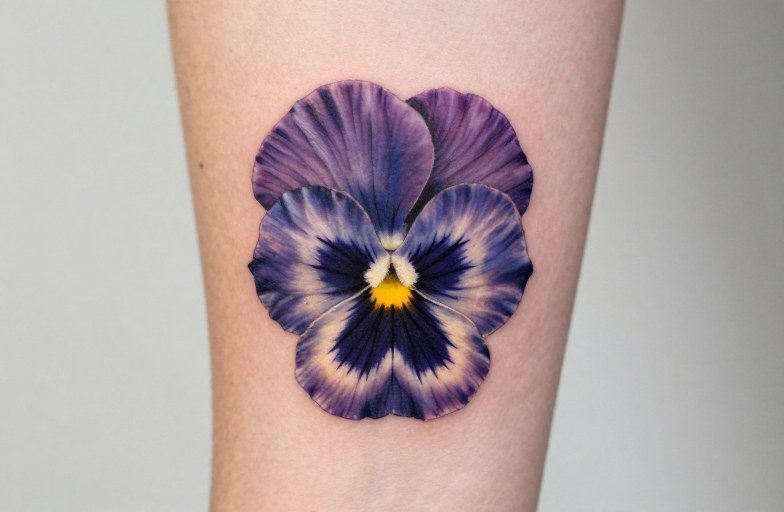
A pansy tattoo most commonly signals remembrance and thoughtful love, rooted in the flower’s old nickname “heart’s ease.” Beyond sentiment, it carries threads of free thinking and nonconformity, “pansy” derives from the French pensée (thought), and the bloom became a quiet symbol for those who questioned norms. On skin, it reads as intimate rather than flashy, chosen by people who want meaning without shouting.
Similar & Related Symbols
Blooms That Overlap in Meaning
The pansy sits in a family of flowers with comparable emotional weight. Violets share its purple palette and connection to modesty, though they lean more toward shyness than the pansy’s active, thinking quality. Forget-me-nots overlap heavily on remembrance, both flowers appear in Victorian mourning jewelry and early memorial tattoos. Lavender carries a similar soft purple tone but shifts the meaning toward calm and cleansing rather than memory.
Where the pansy distinguishes itself is in duality: it’s a flower of both tender feeling and sharp intellect. That combination is harder to find. Roses cover love but lack the cerebral edge. Lilies handle grief with more grandeur, less intimacy. The pansy occupies a middle space, emotional without being dramatic, thoughtful without being cold.
Non-Floral Counterparts
Some people pair pansies with objects that reinforce the same themes. Antique lockets or handwritten letters echo the remembrance aspect. Open books or spectacles push the “free thinker” angle. These combinations work because they don’t compete visually, the pansy’s soft, rounded petals provide organic contrast to harder edges.
Common Variations & Styles
Linework vs. Color Approaches
Single-needle black linework captures the pansy’s delicate veining and scalloped petal edges with precision. This style ages cleanly because the flower’s structure is simple, five petals, distinct center markings. Fine lines hold up better on pansies than on complex roses or peonies because there’s less competing detail to blur together.
Color realism brings out the characteristic purple-to-yellow gradients. The “face” of a pansy, that dark central blotch, gives tattooers a natural focal point that draws the eye. Watercolor washes, where pigment bleeds outside the lines, suit the flower’s soft garden quality but require more frequent touch-ups. The blurred edges that look intentional at month three can read as faded by year five.
Scale and Composition
- Small and solitary: A single pansy at 2-3 inches works as a discreet piece, often placed on the wrist, ankle, or behind the ear. The flower’s natural compact shape doesn’t require enlargement to read clearly.
- Clustered or trailing: Multiple pansies connected by vine or stem suit larger areas like the forearm or ribcage. Victorian illustration styles, with crosshatched shading, reference the flower’s historical popularity.
- Integrated with text: Short phrases in script, names, dates, or single words like “pensée”, fit naturally in the negative space around the bloom. The flower’s rounded form creates pockets that letter well.
Personal & Modern Meanings
Contemporary Reclamation
The word “pansy” was weaponized as a slur for decades, particularly in British and American English. Some tattoo wearers reclaim it deliberately, inverting the insult into a mark of queer resilience. This usage isn’t universal, context matters, and not everyone with a pansy tattoo intends this layer, but the reclamation is documented and growing. The flower’s historical association with unconventional thought adds weight to this reading.
Private Significance
Many choose the pansy for reasons invisible to outsiders. A grandmother’s garden, a specific shade of purple tied to a person, a preference for underdog flowers over showy roses. The pansy’s unassuming size makes it suited to personal commemoration rather than public declaration. Its meaning doesn’t require explanation, which appeals to people who dislike the “what does it mean?” conversations that larger, more obvious tattoos invite.
How It Ages on Skin
Structural Advantages
The pansy’s simple, broad petals age better than flowers with fine, numerous elements like cherry blossoms or daisies. Bold central markings, the dark “face”, maintain contrast longer than subtle gradient shading. A well-executed pansy still reads as itself at ten years because the silhouette is unmistakable: rounded, slightly overlapping petals with a distinct center.
Color Fading Realities
Purple inks, particularly violet and magenta, are prone to faster fading than black or blue. Yellow centers shift toward skin tone or take on a greenish cast as the warmer pigments break down. Sun exposure accelerates both processes. On areas like hands or forearms that see regular daylight, expect noticeable softening within five to seven years. Deeper purples with black mixed in hold longer than pure bright violet.
Black and grey versions bypass most color concerns entirely. The trade-off is losing the pansy’s characteristic color-coded meaning, purple for royalty and thought, yellow for warmth and memory, but gaining longevity and lower maintenance.
Who Chooses This Tattoo
Demographics and Motivation
Pansy tattoos skew toward people who prioritize symbolism over trend. The flower never dominated Instagram the way snakes or butterflies did, so it carries less algorithmic baggage. Wearers often have specific personal connections rather than aesthetic-only motivation, gardeners, people with European family ties, those drawn to Victorian or Arts and Crafts visual culture.
The choice also attracts people who want floral imagery without feminine-coded cliché. The pansy’s brief association with men’s fashion in the Elizabethan era (worn in buttonholes by dandies and thinkers) gives it enough gender ambiguity that it doesn’t read as exclusively one thing. That flexibility matters to people who reject the “delicate flower” stereotype while still wanting botanical work.
Best Placements
Size-Appropriate Locations
The pansy’s compact form suits small spaces without losing integrity. Wrists and inner forearms allow the wearer to see it regularly, which matters for a meaning-forward piece. Behind the ear, the flower’s rounded shape echoes the body’s natural curve. Ankles and feet work but heal harder, more friction, more sun if sandals are worn.
Larger Canvas Options
On the upper arm or thigh, a pansy can anchor a larger composition or repeat as a pattern. The ribcage and sternum provide flat planes where the flower’s symmetry shows well. These areas hurt more and heal slower, but the pansy doesn’t require the extended sessions that dense blackwork or large color fields demand.
One practical note: the pansy’s purple tones can look muddy on melanin-rich skin if the artist uses too-light violet straight from the bottle. Experienced tattooers adjust with deeper magentas or blue-purple bases to maintain visibility. This isn’t a limitation of the design, it’s a color-theory consideration that skilled artists handle routinely.
Final Thoughts
The pansy tattoo endures because it offers density without noise. Its meanings, memory, thought, love, resistance, layer together without contradiction, and its physical structure translates cleanly to skin. It doesn’t demand attention, which paradoxically makes it more interesting to people who’ve thought past the first idea. For a flower tied to the word for “thought,” that seems appropriate.
What separates a lasting pansy tattoo from a dated one is usually restraint: letting the simple form carry weight rather than overdecorating. The flower itself has been cultivated for centuries; it doesn’t need embellishment to prove its significance. In tattooing, as in gardening, the best results often come from knowing when to stop.
Frequently Asked Questions
Does a pansy tattoo always mean something about being LGBTQ+?
Not necessarily. While some people reclaim the pansy as queer symbolism, many choose it for remembrance, family connections, or its “free thinker” history. The meaning depends on the wearer’s intent, not the image alone.
How small can a pansy tattoo be before it blurs?
A skilled artist can execute a readable pansy at 1.5-2 inches because the shape is simple and distinctive. Below that, the central “face” detail may merge into a dark blob over time. Single-needle work helps preserve detail at smaller scales.
Why do purple pansy tattoos fade faster than other colors?
Purple pigments, particularly violet and lighter magentas, have larger molecular structures that break down quicker under UV exposure. Deeper purples with black added, or placement on less sun-exposed areas, extends color life significantly.
Is a black and grey pansy less meaningful than a colored one?
Color carries historical weight, purple and yellow are the classic pansy palette, but black and grey versions emphasize form and texture over botanical accuracy. The personal meaning comes from the choice and context, not the pigment used.
Related Tattoo Meanings
- Pistol Tattoo Meaning: Power, Protection, and Rebellion
- Puppy Paw Tattoo Meaning: Loyalty, Love Remembrance
- Purple Lotus Flower Tattoo Meaning: Spirituality Ink
- Explore more