
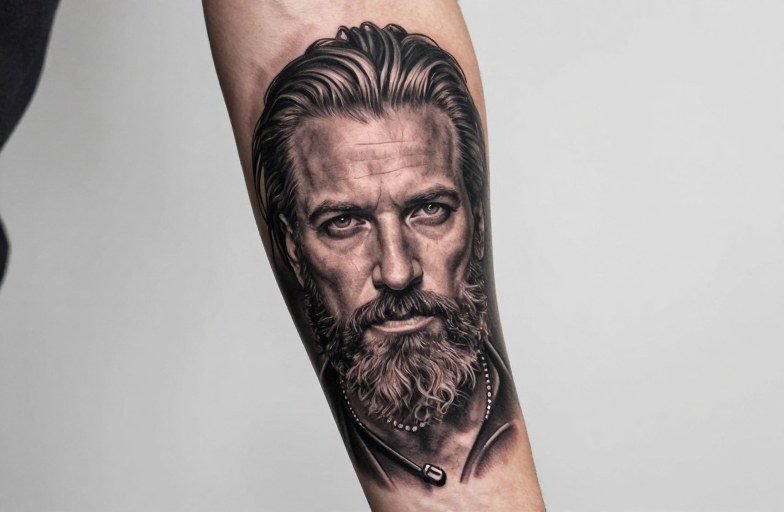
The Michael Fanone tattoo refers to ink honoring Michael Fanone, the Washington D.C. Metropolitan Police officer who suffered a traumatic brain injury and heart attack during the January 6, 2021 Capitol attack. For many, this tattoo represents loyalty to law enforcement, personal survival, or political statement about that specific day. Others choose it to symbolize broader themes of duty, sacrifice, and standing by your post when everything goes wrong.
Common Variations & Styles
Most Michael Fanone tattoos fall into recognizable visual categories, each carrying slightly different weight depending on placement and surrounding imagery.
Portrait Work
Realistic portraits of Fanone himself, often based on his testimony footage or the widely circulated photo of his injuries, require a specialist in black-and-grey realism. These typically run 4-6 inches minimum to capture facial detail. Line weight matters enormously here: single-needle work around the eyes and mouth separates amateur from expert. Without proper contrast, these portraits muddy within five years as the greywash settles.
Symbolic and Text-Based Designs
- Date stamps: “01/06/21” or “J6” in bold lettering, sometimes paired with Fanone’s badge number
- Thin blue line adaptations: The flag stripe motif, occasionally with Fanone’s name worked into the negative space
- Broken badge or cracked shield: Represents institutional damage and personal sacrifice simultaneously
- Heart rhythm line: References his cardiac arrest, sometimes integrated with the Capitol dome silhouette
Script-heavy designs age more predictably than portraits. Bold, black letterforms with adequate spacing between characters hold crisp edges longer than cursive or tightly kerned text.
History & Cultural Roots
Memorial and tribute tattoos within police culture trace back decades, often linked to the post-9/11 surge in first-responder ink. The specific Fanone phenomenon emerged from the unusual public visibility of his injuries and his subsequent advocacy. Unlike traditional police memorial tattoos honoring fallen colleagues, this subject is complicated by living status and political entanglement.
Political Iconography in American Tattooing
Political figure tattoos spike after galvanizing events, think Che Guevara in the 1960s, or more recently, various presidential portraits. The Fanone tattoo sits uncomfortably in this tradition because it honors a non-politician who became politically significant against his apparent wishes. Some trace this tension to earlier “reluctant hero” ink, like specific military personnel who resisted celebrity status after famous battles.
The January 6 date itself carries independent symbolic weight now, similar to how “9/11” functioned as visual shorthand in the 2000s. Tattoo collectors sometimes separate the date from the person, using Fanone as one reference point among several.
Symbolism & Core Meaning
What this tattoo communicates depends heavily on context, who wears it, where it sits on the body, and what accompanies it.
For Law Enforcement Collectors
Among active or retired officers, Fanone ink often signals solidarity with someone who took physical damage while the institution hesitated to defend him. The badge number element matters here: it transforms general tribute into specific kinship. Some collectors pair it with their own department identifiers, creating lineage.
For Civilians and Political Statement
Outside police circles, the tattoo frequently operates as anti-insurrectionist marker. The Capitol dome silhouette, the specific date, and Fanone’s injured face become shorthand for a particular narrative about democratic fragility. This usage risks reducing a living person to symbol, which carries ethical weight some collectors acknowledge by consulting Fanone’s own statements about his experience.
- Duty vs. politics: Some designs emphasize the former (uniform details, service weapons rendered respectfully) while others lean the latter (Capitol architecture, congressional chamber references)
- Survival narrative: Medical imagery, ECG lines, brain scan aesthetics, focuses on bodily recovery rather than political message
- Institutional betrayal: Cracked foundations, broken chains, or torn fabric elements suggest the system failing its own
Design Tips & Pairings
Practical decisions shape how this tattoo functions long-term and reads to others.
Placement Logic
Upper arm and calf offer the flat real estate portraits demand. Chest placement over the heart makes literal sense for cardiac-related imagery but distorts across pectoral movement. Forearms force constant visibility, appropriate for political statement, potentially limiting for professional contexts.
Small designs (under 3 inches) struggle with facial recognition in portraits. Text-based alternatives work better at reduced scale. The “J6” abbreviation fits fingers, knuckles, or behind-ear placement where larger imagery won’t.
Complementary Elements
- American traditional eagles: Classic police tattoo vocabulary, but can read as generic patriotism rather than specific tribute
- St. Michael imagery: The archangel patron of police; the shared name with Fanone creates intentional or accidental resonance
- Damaged column architecture: References both the Capitol building and classical notions of republican vulnerability
- Contradictory elements: Some collectors deliberately pair with imagery from opposing viewpoints, creating personal tension pieces
Color vs. black-and-grey decisions matter. Red accents in thin blue line variations age to muddy burgundy; pure black-and-grey maintains tonal consistency longer but sacrifices immediate visual punch.
How It Ages on Skin
Portrait tattoos of specific individuals face particular aging challenges. The uncanny valley effect, where slight distortion makes familiar faces look wrong, intensifies as ink spreads. Fanone’s distinctive facial features (specific scar patterns, hairline, jaw structure) provide anchor points that help maintain recognizability even with softening.
Technical Longevity Factors
Black-and-grey realism relies on contrast between dark blacks and light greys. Over time, the lightest greys fade toward skin tone, flattening dimension. A skilled artist builds in slightly exaggerated contrast knowing this shift happens. Without that foresight, portraits become uniformly grey and lose structure.
Text elements face different problems: letterform bleeding where ink migrates along skin’s natural lines. Bold, simple fonts resist this better than ornate scripts. Spacing between letters should look slightly too wide when fresh; it tightens visually as edges soften.
Sun exposure disproportionately damages political tattoos, which tend to be displayed rather than hidden. UV-protective moisturizers and consistent coverage matter for longevity. Hand and finger placements, popular for date stamps, require touch-ups every 2-3 years regardless of initial quality.
Who Chooses This Tattoo
The collector profile splits roughly into three categories, with significant overlap possible.
First Responder Community
Active police, fire, and EMS personnel who identify with the physical danger Fanone experienced. These collectors often have existing traditional police tattoos and integrate Fanone imagery into established collections. The tattoo functions as internal communication, recognizable to insiders, potentially opaque to outsiders.
Political Activists and January 6 Observers
Individuals who followed the hearings, read Fanone’s testimony, or participated in related advocacy. This group tends toward text and symbolic designs rather than portraits, and often places ink for visibility. The tattoo operates as conversation starter and ideological marker simultaneously.
Survivors of Violence
People who experienced traumatic injury, cardiac events, or assault who connect to Fanone’s medical narrative rather than his professional identity. These designs lean heavily on ECG lines, anatomical hearts, recovery imagery. The political context becomes secondary to personal bodily experience.
Crossover exists: a retired officer with cardiac history might combine professional and medical symbolism. The tattoo’s meaning isn’t fixed by category but by individual composition choices.
Final Thoughts
The Michael Fanone tattoo occupies uncomfortable territory, honoring a living person who didn’t choose symbolic status, embedded in unresolved political conflict, carrying different weight depending on the wearer’s relationship to law enforcement and trauma. That complexity isn’t a flaw. It’s what distinguishes this ink from simpler tribute work.
Technical execution demands the same standards as any portrait or political tattoo: adequate scale for detail, contrast built for aging, placement appropriate to the collector’s visibility comfort. The difference lies in the conversation this piece starts, whether welcomed or not. Anyone considering it should understand that conversation before the needle touches skin.
Frequently Asked Questions
Is Michael Fanone aware people are getting tattoos of him?
Fanone has publicly acknowledged the tattoos in interviews, expressing mixed feelings about being turned into a symbol. He hasn’t endorsed or condemned the practice specifically, focusing instead on his own recovery and advocacy work.
Do tattoo shops require proof of law enforcement status for this design?
Most reputable shops treat this like any other portrait or political tattoo, no special verification required. Some artists may discuss the living-subject ethics during consultation, particularly for realistic portraits.
How much should a quality Michael Fanone portrait tattoo cost?
Expect $400-800 for a skilled black-and-grey portrait in the 4-6 inch range, with specialists in photorealism charging toward the higher end. Text and symbolic designs run significantly less, often $150-300.
Can this tattoo be misinterpreted as supporting the January 6 attackers?
Context and design choices determine reading. Portraits emphasizing Fanone’s injuries or text referencing his testimony clearly oppose the attack. Ambiguous placement or pairing with generic patriotic imagery risks confusion, which is why specific design consultation matters.
Related Tattoo Meanings
- Chucky Tattoo Meaning: Horror, Rebellion Dark Playfulness
- Greek Mythology Tattoo Meanings: Symbols That Last
- Nmm Tattoo Meaning: Symbolism, History What Artists See
- Explore more









