
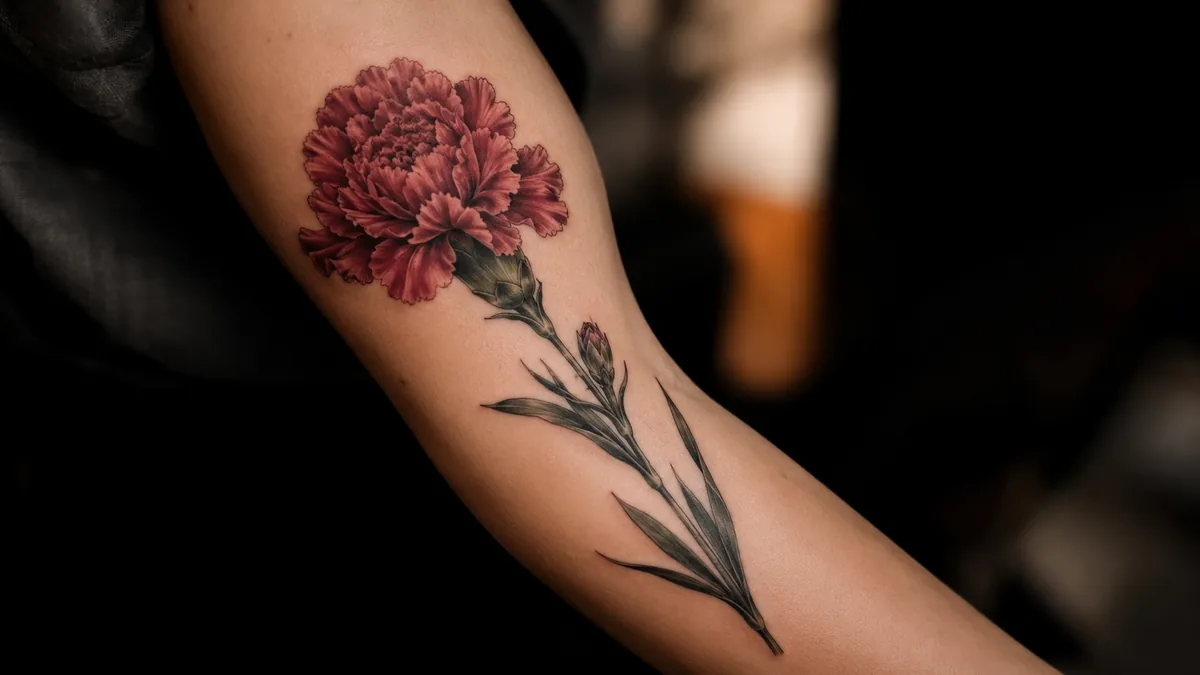
The carnation doesn’t get the same spotlight as the rose, but that’s exactly why people who know flowers choose it. It carries deep, specific meaning that dates back centuries, and it reads beautifully on skin in almost every style. If you’ve been thinking about getting one, you’re not just picking a pretty flower.
Carnations mean different things depending on color, context, and culture, but the core thread is always emotion: love, grief, devotion, admiration. There’s no single locked-in reading. That flexibility is part of the appeal. Here’s what you need to know before you sit in the chair.
The Core Meaning of a Carnation Tattoo
Carnations are fundamentally about love and deep emotion, but they’re more layered than that. They represent admiration, distinction, and fascination. In the language of flowers, called floriography, carnations were one of the most-used blooms for sending coded emotional messages. People got specific with them. They didn’t just say love. They said devotion, remembrance, or mourning.
That specificity still holds in tattoo culture. Someone getting a carnation usually has a precise feeling or person in mind. It’s not a default filler flower. It’s a choice. The ruffled, layered petals give it a complex look that mirrors its complex symbolism, and that’s not an accident for the people who pick it.
Cultural and Historical Background
The carnation tells your story in color, choose wrong and it tells the wrong story.
In Christian iconography, carnations appear in paintings of the Virgin Mary, associated with maternal love and the tears she shed for Christ. Some scholars link the word carnation to the Latin ‘incarnation,’ connecting it to the flesh and the sacred. This religious tie made carnations a common funeral and mourning flower in parts of Europe, especially Spain and Italy.
In Korea, carnations hold a specific living tradition: red and pink carnations are gifted on Parents’ Day to express love and gratitude to mothers and fathers. In the US labor movement of the early 20th century, a red carnation became a symbol of workers’ solidarity. These aren’t invented connections. They’re documented, real, and they give the flower genuine cultural weight.
What Each Color Actually Means
Color is where carnation tattoos get really specific. Red carnations mean deep love and admiration, close to what a red rose means but with more of an old-world feeling. Pink carnations, especially light pink, are tied to motherly love and gratitude. They’re one of the most popular choices for memorial tattoos honoring a mother or grandmother. White carnations represent pure love and good luck. Yellow carnations historically carried a harsher reading: rejection and disappointment.
Purple carnations are associated with capriciousness, changing moods, and whimsy. Striped carnations traditionally meant refusal in floriography, as in ‘sorry, I can’t be with you.’ Most people don’t know that one. If you want to be historically accurate with your ink, the color you choose is not decorative. It’s part of the message. A good artist will ask what you’re going for before locking in the palette.
Popular Design Styles for Carnation Tattoos
Carnations work across a wide range of styles. In traditional American tattooing, they show up with bold outlines, solid color fills, and that classic saturated look that holds up for decades. The shape of the petals is forgiving in this style because the ruffled edges read as texture even when slightly softened by time. Bold will hold applies hard here. Traditional carnations read from across the room.
Fine line botanical carnations are huge right now, especially for women who want something delicate and detailed. These are best done by artists with steady hands who understand how fine line heals, because those thin strokes can blur over a few years in high-movement areas. Blackwork and black-and-grey carnations hit different, especially in memorial pieces. The whip shade technique on the petals creates a soft, almost watercolor depth without using color ink.
Carnation Tattoos as Memorial and Tribute Pieces
This is where the carnation really earns its place. Pink carnations in particular are a go-to for honoring a mother who has passed. It’s not a trend. It’s a tradition that feels genuinely personal because of the specific meaning behind that color. People pair them with birth dates, names, or a small portrait element. Done right, these pieces are some of the most meaningful work you’ll see in a studio.
Red carnations show up in labor and political tribute tattoos, especially for people connected to union history or leftist traditions. There’s a whole lineage of red carnation imagery in socialist and workers’ rights movements that some people want to carry on their skin. That’s a legitimate, historically grounded choice. If that context resonates with you, the carnation is one of the most honest ways to represent it.
Best Placements and How It Ages
Carnations have a vertical silhouette with the bloom on top and a stem below, which makes them naturally suited for forearms, shins, calves, and upper arms. These placements give the design room to breathe and keep the proportions correct. The layered petals have enough detail to fill a larger piece, so scaling up to a full forearm or thigh placement is a real option and it looks great.
Avoid placing highly detailed fine line carnations on the hands, fingers, or feet. These are high-wear zones with thin skin, and fine line work blows out faster there. The ink breaks down, the lines spread, and within a couple years it can look muddy. Inner arm and ribcage placements are spicy but the ink tends to stay crisp because those areas don’t see as much sun and friction. Thighs and upper arms are the sweet spot for longevity.
Who Gets Carnation Tattoos and How to Make It Yours
People who get carnation tattoos tend to be more intentional than average about their ink. They’ve usually done the research, they know the color meanings, and they have a specific person or feeling in mind. It’s a popular choice for first tattoos and for people building a sleeve or patchwork collection who want flowers that aren’t roses. The carnation signals that you know your floriography.
To make it personal, start with the color and nail down why. Then bring reference images that show the style you want, whether that’s traditional, fine line, neo-traditional, or blackwork. Tell your artist the meaning behind it. The best pieces come out of that conversation. A carnation with a name, a date, or a specific cultural symbol tucked into the design becomes something nobody else has. That’s the whole point.
Pairing Carnations With Other Design Elements
Carnations pair naturally with other flowers in botanical arrangements, but they also hold their own as a standalone piece. In traditional flash, you’ll see them with banners, daggers, and other classic elements. In fine line botanical work, pairing a carnation with baby’s breath, eucalyptus, or small buds creates a full composition that wraps nicely around a limb. The ruffled texture of carnation petals contrasts well with smoother elements.
For memorial pieces, some artists frame the carnation with a simple geometric border or let it stand alone on a clean background. Adding a bee, a butterfly, or a hummingbird gives the design movement and symbolism without overloading it. If you’re going color, keep the palette tight. A pink carnation with light green stems and maybe one warm accent color is cleaner and more timeless than trying to use five shades. Restraint in color is what keeps a tattoo looking intentional twenty years out.









