
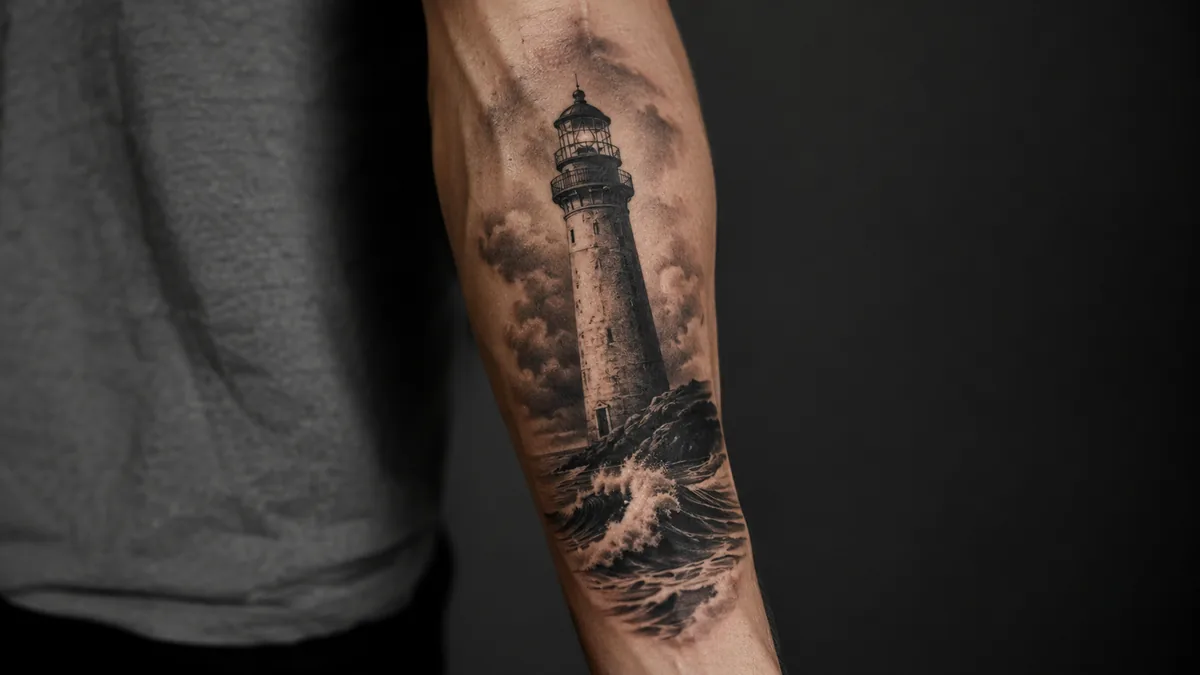
A lighthouse tattoo is one of those pieces that carries real weight. It’s not just a pretty coastal image. It’s a symbol of guidance, of finding your way through the dark, of something solid standing firm while everything around it moves. People get this tattoo because it means something concrete to them, not because it looks cool on a mood board.
The meanings stack on top of each other naturally. Hope. Resilience. Safe return. Protection from unseen danger. That’s a lot of emotional punch packed into one image, and it’s why lighthouse tattoos stay popular across every style, from old school bold to delicate fine line. This one ages well in the flash box and ages well on skin.
Core Symbolism: What a Lighthouse Tattoo Actually Means
The main reading is guidance through darkness. A lighthouse exists to warn ships away from rocks, to mark safe passage, to say here is the way. As a tattoo, that translates directly to a person, a belief, or an experience that kept you from crashing. It’s a tribute to whatever or whoever is your guiding light. That’s the universal read, and it holds across cultures without any stretch.
Second layer is resilience. A lighthouse stands on exposed rock, gets hit by everything the sea throws, and keeps the light on. That stubbornness, that refusal to go dark, resonates with people who’ve been through serious storms in their own lives. It signals survival without having to say survivor anywhere on the piece. The image does the talking.
Hope, Safe Harbor, and Homecoming
Every sailor feared the dark water. The light didn't remove the storm, it just showed the way through.
Beyond guidance, the lighthouse tattoo carries a strong sense of hope. When you’re lost at sea, literal or metaphorical, spotting that light means you’re going to make it. A lot of people get this piece after a rough patch, a recovery, a loss they came out the other side of. It marks the moment the light came back on. That’s not a cliche reading. That’s exactly what the symbol has meant to sailors for centuries.
Safe harbor and homecoming fold into this too. For people with military family, fishing family, or anyone who deals with long stretches away from home, the lighthouse is the promise of return. It shows up in memorial tattoos for people lost at sea or in service, and in matching sets between parents and kids, partners, siblings. It’s a solid symbol for that bond without being sentimental to the point of being soft.
Historical and Maritime Background
Lighthouses have been functional structures since antiquity. The Pharos of Alexandria, one of the Seven Wonders of the Ancient World, was a lighthouse. They’ve been part of human navigation for over two thousand years. That’s real history behind the image, not invented symbolism. Sailors depended on them entirely before GPS existed, and the keeper who maintained the light held lives in their hands every night.
In American coastal communities, lighthouses carry genuine cultural weight. The US Lighthouse Society tracks over 700 lighthouses still standing. Families who lived near specific lights, especially on the Great Lakes, the Atlantic coast, and the Pacific Northwest, have generational connections to these structures. Getting a tattoo of a particular lighthouse, like Portland Head in Maine or Point Reyes in California, roots the piece in real personal or regional history.
Popular Design Variations and Styles
Traditional American style is the most durable take on this image. Bold black outlines, flat saturated color, waves crashing at the base, maybe a banner, maybe some rays of light coming off the top. Reads clean from across the room and holds for decades. Neo-traditional builds on that with more refined linework, richer color blending, and added detail in the water and sky. Both styles were built for longevity and they deliver.
Black and grey realism is huge right now for lighthouse pieces. A stormy sea, dramatic clouds, fine whip shading on the tower itself. Done right it looks like a photograph on skin. Fine line is popular for smaller placements, wrists, inner arms, behind the ear, but it’s a high-maintenance choice. Those thin lines can fade and blur over time, especially in high-wear zones. Your artist needs clean, confident linework for fine line to heal nice and stay crisp long term.
Color vs. Black and Grey
Color lighthouses pop hard. A red and white striped tower against a stormy dark sky, saturated waves, a warm yellow light beam cutting through, that contrast is striking. Color works especially well in traditional and neo-traditional formats. The trade-off is upkeep. Color tattoos need touch-ups more often, and certain hues, yellows and light blues especially, can fade faster depending on your skin tone and sun exposure.
Black and grey gives you more versatility in placement and a longer-lasting result in most cases. The full tonal range you get with black and grey, deep darks in the water, soft greys in the clouds, bright white highlights on the light itself, creates real depth without the fade risk of color. For a sleeve or a chest piece where the lighthouse is part of a larger composition, black and grey tends to integrate more cleanly with surrounding elements.
Best Placements and How It Ages
The forearm is the classic spot for a lighthouse. Vertical format, good real estate, easy to show off or cover depending on the situation. The outer calf works similarly, low-wear zone, holds detail well, heals nice. The upper arm and shoulder give you room for a bigger composition with waves, sky, and surrounding elements without crowding the image. Chest placements work for people who want it close to the heart, literally.
Avoid fine line lighthouses on the hands, fingers, and feet. Those are high-wear zones and fine line blows out fast there. Inner bicep and ribs are spicy spots, pain-wise, but the skin quality is good. Ribs in particular can shift as your body changes over time, so go bold there rather than intricate. A solid, well-outlined lighthouse with bold will hold better through the years than a delicate fine line piece, especially in areas that see friction or sun.
Who Gets This Tattoo and How to Make It Personal
This piece attracts a wide range of people. People in recovery from addiction or illness, who see the lighthouse as their turning point. Military and Coast Guard veterans, and their families. People who’ve lost someone and want a symbol of guidance or safe passage. Coastal natives with real ties to the sea. And people who just connect with the idea of something steady in the chaos, which is pretty much everyone at some point.
To make it personal, anchor the design to something specific. Use the actual lighthouse near where you grew up or where something important happened. Add a date in a banner, a name worked into the rocks, stars that match a specific night sky. Incorporate the water conditions that matter to you, calm seas read differently than a full storm. Talk to your artist about what the piece needs to say, not just what it needs to look like. That conversation is where the real tattoo gets built.









