
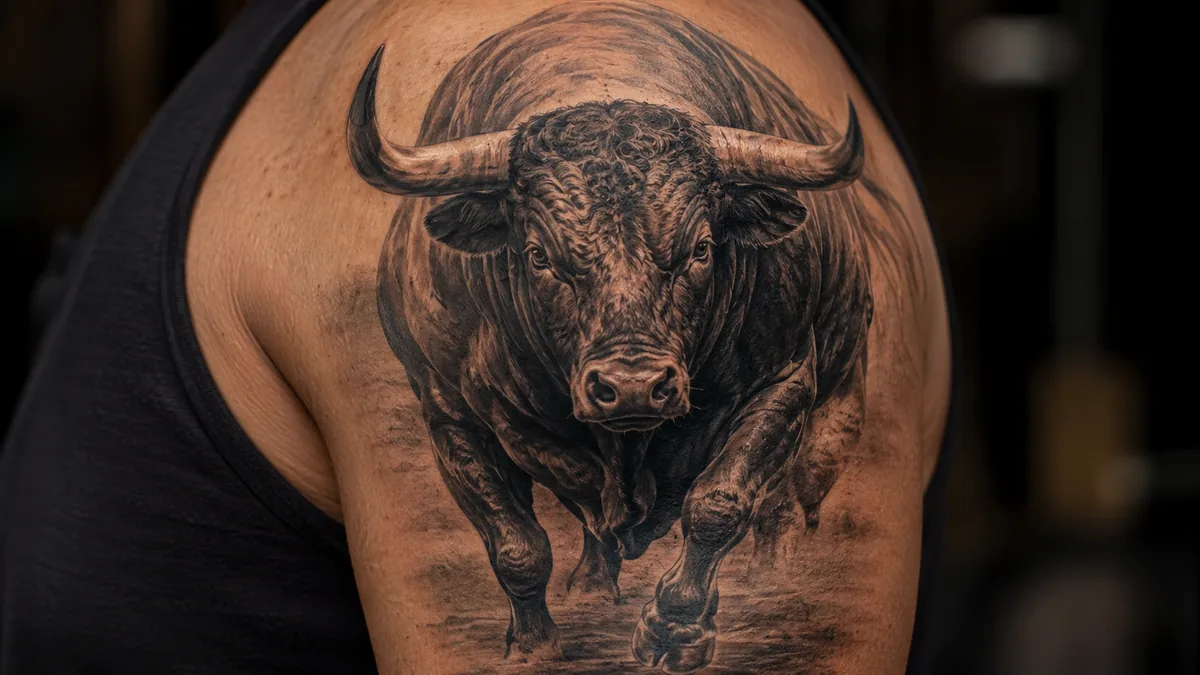
The bull is one of the oldest symbols humans ever put on a wall, and it translates just as hard onto skin. Power, stubbornness, raw strength, fertility, and unstoppable will, those are the core reads. A bull tattoo says something about who you are without you having to open your mouth.
It works across a ton of styles too. Whether you want a massive black and grey chest piece or a clean fine-line Taurus symbol on your wrist, the design fits. Here’s what people actually mean by it, and how to make yours hit right.
Core Symbolism: What a Bull Tattoo Actually Means
The bull represents raw, unrestrained power. That’s the baseline. It also carries strength, endurance, determination, and an almost irrational stubbornness that a lot of people wear proudly. A bull doesn’t back down. It charges. People who’ve pushed through hard seasons in life, addiction, loss, grinding for years to build something, gravitate toward this image for exactly that reason.
Fertility and abundance are older meanings that trace back thousands of years. Bulls were wealth in agrarian cultures. They literally fed and farmed whole communities. That layer still shows up, especially in more classical or traditional designs. The image holds both the violent charge and the patient, productive grind at the same time.
Cultural and Historical Background
The bull does not ask permission, and neither does the person who wears it.
The bull shows up across ancient Mediterranean civilizations as a major sacred symbol. In Mesopotamia, the Bull of Heaven was a divine force. In ancient Greece, the Minotaur and the Cretan bull tied the animal to power, danger, and myth. In ancient Egypt, the Apis bull was worshipped as an incarnation of Ptah. These weren’t decorative choices. The bull meant something serious in every one of those cultures.
Spanish bullfighting culture added a different layer: bravery, confrontation, and the drama of life and death in the ring. In Hindu tradition, Nandi the sacred white bull is the devoted companion of Shiva, representing loyalty and righteousness. These readings don’t cancel each other out. They stack. Your bull tattoo can pull from one tradition or sit on top of all of them.
Taurus Zodiac Bull Tattoos
Taurus is the second sign of the zodiac, covering late April through late May, and the bull is its symbol. Taurus is an earth sign ruled by Venus. The personality traits tied to it: grounded, loyal, patient, sensual, and yes, stubborn as hell. People born under this sign get bull tattoos as a direct identity marker. It’s not abstract symbolism for them. It’s literally who they are on paper.
Common Taurus-specific designs include the Taurus glyph, which looks like a circle with two horns on top, paired with the bull itself, constellation dot maps, or birth date script underneath a bull portrait. Fine line works great for the minimal glyph version. For the full bull portrait, you’ve got room to go bold, especially in black and grey or neo-traditional color.
Popular Design Styles and Variations
Traditional American style bulls are thick-outlined, saturated, and built to last. They read from across the room and hold up for decades because bold will hold. Neo-traditional adds dimension and richer color palettes while keeping that structured outline. Geometric bulls, built from triangles and clean angles, have been popular for the last several years and age well when the lines are crispy to start.
Realistic black and grey bulls, especially full portraits with dramatic shading and heavy contrast, are a staple for sleeve and chest work. The rage bull, nostrils flared, head lowered, ready to charge, is probably the most requested variation. You also see skeletal or sugar-skull hybrid bulls, bull skulls as a standalone piece, and Mandala-style bulls with geometric fills inside the body. Each variation shifts the tone. Rage reads aggression. Skull reads mortality. Mandala reads spiritual.
Color vs. Black and Grey
Black and grey bulls are the workhorse of the style. They’re versatile, time-tested, and give an artist serious room to whip shade, build depth, and make the piece feel three-dimensional. A well-executed black and grey bull with heavy contrast and solid highlights heals nice even on textured or tanned skin. It photographs well and stays readable as the years pile on.
Color opens up a different energy. Traditional red, gold, and black combinations hit hard for Spanish bullfighting references or classic Americana vibes. Full-color neo-traditional bulls let you push teal, burnt orange, and deep purple in ways that make the piece pop. Just know that saturated color on high-sun skin zones, like outer arms and hands, will need touch-ups sooner. Plan for that upfront.
Best Placements and How the Tattoo Ages
The upper arm, chest, back, and thigh are the best real estate for a bull. These are lower-wear zones with good muscle padding. A large realistic bull on the chest or upper back has room to breathe, and the natural contours of the body actually help the composition. An angry bull head fits the deltoid or pec perfectly because the muscle shape mirrors the animal’s mass.
Fine-line Taurus glyphs on the inner wrist, collarbone, or ribcage are popular for minimal placements. Know that fine line in high-friction spots, like the inner wrist or ribcage sides, can soften and spread faster than a bold traditional piece would. The ribcage is also spicy for pain. Thick outline and saturated fills will age more predictably than hairline work, especially if the placement gets regular sun or clothing friction.
Who Gets a Bull Tattoo and How to Make It Personal
Taurus folks are the obvious crowd, but the bull pulls in way more people than just one zodiac sign. Athletes, weightlifters, military veterans, entrepreneurs, and anyone who’s had to outwork the room by sheer force of will all connect with the image. It’s also popular among people who grew up on farms or ranches and want something rooted in that identity.
To make it personal, think about which layer speaks to you. Is it the zodiac angle, the ancestral cultural symbol, or just the straight-up attitude of an animal that does not quit? Adding elements like a specific breed, a home state flower, a banner with a name or date, or a specific cultural reference like a Spanish torero’s cape in the background all anchor the piece to your story. Talk that through with your artist before you commit to a layout.









