
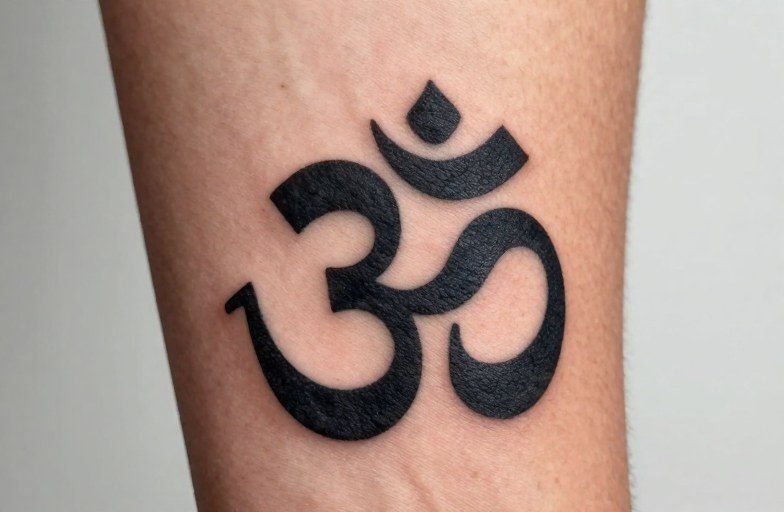
The Om symbol (ॐ), written in Devanagari script, carries the weight of Hindu cosmology in a single character. It represents the primordial sound that preceded the universe, the vibration from which all existence emerged. For the millions of people who have chosen to ink it permanently onto their skin, understanding what it means, how it ages, and what respect it requires is not optional reading.
What Om Actually Means
Om is not a word in the conventional sense. In Hindu tradition it is a sacred syllable, the root sound of the cosmos. The written symbol encodes far more than phonetic value: its three curves map the three states of human consciousness. The lower curve represents the waking state. The middle curve holds the dreaming state. The upper curve carries deep, dreamless sleep. Above those three, separated by a crescent arc, sits a dot. That dot marks turiya, the fourth state: pure awareness, the ground beneath all experience.
The Mandukya Upanishad, a short but dense text in the Hindu philosophical tradition, lays out this mapping in detail. The oral tradition the symbol represents is older than any written version, likely predating the Gupta-era script that gave it its familiar visual form by millennia.
Practically, Om opens mantras, prayers, and meditation sessions. It is chanted at births, deaths, and daily rituals. This is not historical decoration; practitioners use it this way right now, across the world. That living context matters when you consider wearing it permanently.
Cultural Appropriation: A Direct Look
If you are not Hindu or raised in a tradition where Om has personal religious meaning, the question of appropriation deserves a genuine answer, not a dismissal.
Some Hindu practitioners welcome sincere engagement with the symbol, viewing it as a bridge rather than a boundary. Others experience the tattoo trend as a stripping of sacred meaning from a living religious tradition, reduced to aesthetic choice by outsiders. Both positions exist, and neither is irrational.
What tends to read as disrespectful: Om inked as a filler piece, paired with unrelated symbols for visual balance, or worn with no knowledge of what the three curves mean. What tends to read as sincere: knowing the symbol’s structure, having some actual relationship with the tradition through practice or community, and being able to speak honestly about why you chose it if asked.
The tattoo world uses the phrase “do your research” loosely. Here it means something specific: read the Mandukya Upanishad, understand what turiya refers to, talk to Hindu practitioners rather than just scrolling Pinterest. That preparation will not resolve every question, but it will show whether the symbol fits your life or only your aesthetic.
Design Variations
Traditional Form
The classical Devanagari Om is the most culturally coherent version. Its precise curves, crescent, and dot are visually balanced and structurally meaningful. Any deviation from the proportions, especially the gap between the crescent and dot, weakens both the aesthetics and the symbolic accuracy.
Pairings That Work
- Lotus: The lotus rising through water mirrors consciousness moving through the three states. The pairing has narrative logic, not just visual appeal.
- Mandala geometry: Radiating patterns frame Om like an altar composition. Keep the Om itself as the unambiguous focal point.
- Sanskrit text: Short mantras or a single word beside Om can add depth. Get any Sanskrit verified by a native reader or religious scholar, not an online generator. Errors in sacred text read as carelessness.
- Trishula (Shiva’s trident): Intensifies the Shaivite dimension; works best at larger scales where neither symbol crowds the other.
What to Avoid
Mixing Om with Buddhist iconography without understanding the distinctions creates confusion rather than harmony. Pairing it with generic spiritual symbols from unrelated traditions reads as spiritual decoration rather than practice. Tribal adaptations that distort the symbol’s proportions can strip out the meaning entirely.
Placement and What It Costs You
Where Om Ages Well
Placement is a long-term decision. The symbol’s aging depends heavily on skin movement, sun exposure, and how much natural moisture the area holds.
- Inner forearm: Flat, stable canvas. Moderate sun exposure. Good visibility for a symbol meant as personal reminder. Holds detail well with proper aftercare.
- Upper back (center): Minimal distortion, easy to conceal, one of the most stable placements on the body. Aging is slow here.
- Sternum: Follows the body’s natural vertical line. More painful, but the skin stays relatively stable over time. Works for mid-size pieces.
- Chest over heart: Traditional devotional placement, used across many spiritual tattoo traditions. Skin here is stable.
- Spine: Strong compositional placement for a vertically oriented symbol. Aging is generally reliable if you keep it moisturized.
Placements With Higher Risk
- Wrist: High visibility, but tendon movement and sun exposure accelerate fading. Fine lines blur here faster than most people anticipate.
- Back of neck: Works for a minimal, simplified version. Hairline proximity and lymph node texture create challenges for detailed work.
- Ankle and foot: High friction, sun exposure, and movement. Not recommended for a symbol where precise geometry matters.
- Ribcage: The curves of Om can distort with breathing and weight changes. Experienced artists account for this; less experienced ones often do not.
How Om Ages on Skin
Om’s visual power depends on the precise relationship between its curves, crescent, and dot. Aging does not respect that precision.
Over five to seven years, the lower curve tends to thicken where it once tapered. The crescent softens. The dot, if placed too small, can disappear into surrounding skin tone entirely. These are normal, predictable changes, not failures, but they alter what the symbol communicates. A smudged dot no longer marks turiya. It just marks smudged ink.
Line Weight Is a Long-Term Decision
Single-needle and fine-line work achieves beautiful precision in the first year or two. The crescent and dot look crisp and delicate. By year five, that delicacy becomes blur. Bold outlines at 7-9RL hold definition for decades. The choice is yours, but make it with a ten-year horizon in mind, not a first-week photo shoot.
On darker skin tones, the negative space between curves carries as much meaning as the lines. An artist experienced with Om on varied skin tones will adjust line weight upward to maintain legibility rather than assuming default parameters.
Size Minimums
Below one inch in height, the dot and crescent details blur into surrounding ink within a few years. For long-term legibility, two inches in the primary dimension is the practical minimum. Go smaller only with the understanding that touch-ups will be needed sooner and the symbol may lose its distinctive geometry.
Touch-Up Timeline
Expect the dot and crescent to need attention before the main curves, typically at the five to seven year mark. Sun protection on the tattoo from the start, not as an afterthought, delays this significantly. Artists who build slightly heavier lines into the crescent and dot area anticipate this wear pattern. Ask your artist whether they do this and why.
Finding the Right Artist
Devanagari script requires specific skill. The curves of Om are not generic calligraphy. Straight lines in what should be a flowing arc, uneven spacing between the crescent and dot, or a compressed bottom curve are all signs of an artist guessing rather than knowing.
Ask to see healed examples of Om or Devanagari work specifically. Not fresh, not photo-edited. Healed, on real skin, with visible aging. An artist who has done this twenty times knows where the curves hold and where they drift. One who has done it twice does not.
I’d add one more thing: ask the artist about the symbol’s meaning. Not to test them, but to understand their relationship to it. Some artists with personal connection to Hindu tradition bring a different level of care to the work. That matters for a mark you will carry for decades.
What to Carry Into the Chair
The best Om tattoos are questions pressed into skin, not answers. They ask you to return to the sound, the silence, the four states, the single vibration behind the many. Whether that return happens daily or rarely is the real commitment, the one that outlasts any ink.
Verify any accompanying Sanskrit text before it becomes permanent. Research the tradition past aesthetics. Choose an artist with proven Devanagari experience. Plan the placement with aging in mind from the first consultation. And decide honestly whether the symbol belongs in your life or only on it.
Frequently Asked Questions
Does the direction the Om symbol faces matter for a tattoo?
The traditional written form has a specific orientation, and significant rotation can distort the symbol’s recognizable structure. Some practitioners prefer the symbol oriented toward the wearer as a personal reminder. The critical factor is maintaining the correct relationship between the three curves, the crescent, and the dot rather than a specific cardinal direction.
Is it disrespectful to get an Om tattoo if I am not Hindu?
The answer is genuinely contested. Some practitioners welcome sincere engagement with the symbol’s meaning. Others view non-Hindu adoption as appropriation of a living sacred tradition. Understanding what the symbol actually encodes, engaging with the tradition beyond the visual, and being prepared to speak honestly about your relationship to it is the minimum due diligence.
How small can an Om tattoo be before it becomes unreadable?
Below one inch in height, the dot and crescent details tend to blur within a few years. Two inches in the primary dimension is the practical minimum for long-term legibility. Adjust line weight based on your skin tone and the specific placement’s aging patterns.
Can Om be combined with English words or other languages in the same tattoo?
English text beside Om often creates a visual and cultural mismatch that works against the symbol’s traditional weight. Sanskrit maintains coherence. If you combine languages, consider spacing them so neither dominates. Any Sanskrit used must be verified by a native reader or religious scholar before being inked.
Related Tattoo Meanings
- Symbolic Religious Tattoo Meaning: Faith, Protection & Personal Belief
- Trident Tattoo Meaning
- Triangle Tattoo Meaning
- Explore more









