
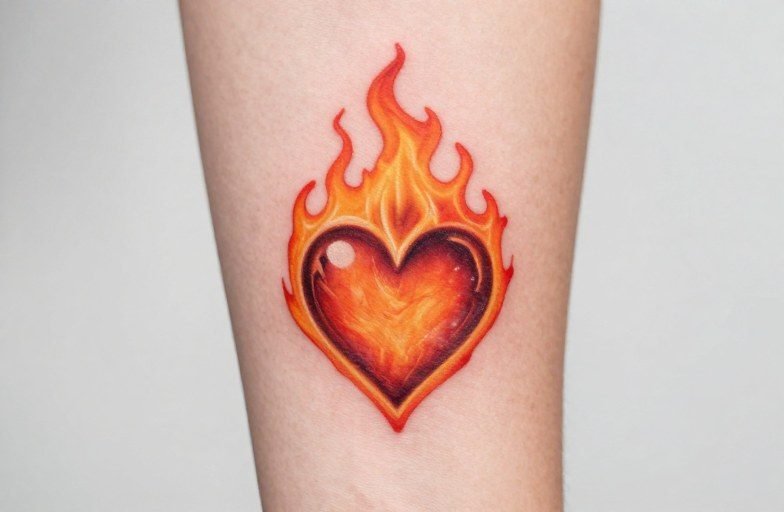
The flaming heart tattoo means passion that burns, love tested by fire, or spiritual devotion intense enough to consume. It pairs the heart, already loaded with meaning, with flames that suggest transformation, danger, and unshakable commitment. Someone wearing this usually wants to mark something they won’t walk away from: a person, a faith, a cause, or a version of themselves they fought to become.
Symbolism & Core Meaning
Fire doesn’t decorate the heart here; it changes what the heart signifies. A plain heart tattoo reads as affection, loss, or loyalty. Add flames and the meaning tilts toward sacrifice, purification, or desire hot enough to hurt. The fire can represent something the wearer has survived, grief, addiction, a broken period that forged something harder, or something they’re still burning for.
Secular vs. Sacred Readings
Outside religious context, the flaming heart often signals romantic obsession, creative drive, or memorial grief. Inside sacred traditions, the same image becomes the Sacred Heart of Jesus or the Immaculate Heart of Mary, both representing divine love made visible and suffering made meaningful. The symbol travels between these worlds easily, which is why you’ll see it on both churchgoers and people who haven’t set foot in a pew in years.
Transformation and Trial
Fire destroys and refines. In alchemical imagery, it’s the agent of change. A flaming heart can mark a personal breaking point: the month everything burned, the relationship that remade you, the identity you had to fight to claim. The heart stays recognizable through the flames, suggesting survival rather than annihilation.
Religious & Spiritual Angles
The flaming heart is most densely coded in Catholic visual culture. The Sacred Heart, Jesus’s heart exposed, crowned with thorns, wrapped in flames and topped with a cross, dates to medieval mysticism and became widespread after Margaret Mary Alacoque’s visions in the 17th century. The flames represent Christ’s love for humanity, the thorns his Passion, the cross his sacrifice. Some trace the image to earlier devotional practices where the heart alone stood for Christ’s emotional life.
The Immaculate Heart of Mary
Mary’s version drops the cross and thorns, sometimes adding roses or a sword. The flames here suggest her love and her sorrows, particularly the prophecy that a sword would pierce her soul. People who choose this variant usually know exactly which tradition they’re drawing from and often pair it with specific prayers or scapular imagery.
Beyond Christianity
Fire and heart imagery appear in Hindu and Buddhist iconography too, Kali’s heart-devouring ferocity, the agni of sacrifice, the heart as seat of consciousness in some yogic traditions. These aren’t direct ancestors of the Western tattoo, but some wearers blend them deliberately, especially in fusion or neo-traditional pieces.
History & Cultural Roots
The heart shape we recognize, two rounded lobes tapering to a point, solidified in European art by the 14th century, though its origin is debated. Some link it to ivy or silphium leaves; others to anatomical misunderstanding. The flaming heart as devotional image grew through Counter-Reformation Catholicism, when the Church pushed emotional, sensory religious experience against Protestant austerity. By the 19th century, mass-produced holy cards made the Sacred Heart a working-class staple across Catholic Europe and Latin America.
The tattoo specifically descends from this devotional print culture, through sailor and military tattooing, into biker and Chicano traditions. Mexican-American fine-line black and grey often features the flaming heart as an ex-voto or milagro image, promises made and kept, or favors asked. The biker adaptation tends to drop the thorns and cross, keeping the flames and sometimes adding banners with names or club lettering.
Common Variations & Styles
The basic formula, heart plus flame, supports endless modification. What changes is the flame’s behavior, the heart’s condition, and what else shares the frame.
Traditional and Neo-Traditional
- Bold black outlines, limited color palette, flames as symmetrical licks or stylized wings
- Often paired with banners, daggers, or scrollwork
- Flames typically red, orange, yellow; heart red or pink
- Works best at palm-size or larger; small trad pieces lose the flame detail
Black and Grey Realism
- Flames rendered with smooth grey wash, no color needed
- Heart can be anatomical or stylized; anatomical versions read more visceral, less romantic
- Popular in Chicano and West Coast styles
- Requires skilled shading; bad grey wash flames look like smudged charcoal
Contemporary and Experimental
- Flames as negative space, geometric breakdown, or watercolor bleed
- Heart sometimes fragmented, mirrored, or replaced with other organs
- Color choices depart from tradition: all blue flames, monochrome red, neon accents
Best Placements
Where you put this changes how it reads. The flaming heart is a frontal, declarative image, it faces outward, demands attention.
High-Visibility Spots
Chest, over the actual heart, is the literal choice and still effective. The chest’s flat planes suit the bilateral symmetry of most flaming heart designs. Outer forearm or upper arm (bicep/front) keeps it visible without the full commitment of torso placement. Thigh fronts work well for larger pieces, especially with surrounding scrollwork or companion images.
Smaller and Hidden Placements
Behind the ear, inner bicep, or ribs can work for smaller, simpler versions, but the flame detail suffers below two inches. If you’re set on something discreet, consider a single flame emerging from a minimal heart outline rather than full traditional rendering. Ankle and wrist placements are possible but often look cramped; the flames need room to read as fire, not abstract spikes.
Color vs. Black and Grey
This choice shapes meaning as much as aesthetics. Color flames read as active, energetic, almost celebratory. Black and grey flames suggest something more solemn: memory, endurance, the weight of what’s been burned through.
How Color Ages
Red and orange are workhorse pigments, generally stable. Yellow fades fastest and can shift peachy or pale. Bright flame tips in pure yellow often need touch-ups within five years. White highlights on flames (common in traditional work) disappear into lighter skin tones and yellow on darker skin; plan for replacement rather than permanence. Black and grey ages more predictably but can muddy if the artist packs grey too dense, flames need air, gradation, the suggestion of movement.
Skin Tone Considerations
On darker skin, saturated reds and deep oranges hold better than yellow. Some artists build flame depth with magenta under red rather than orange under yellow. Black and grey relies on contrast between packed black and open skin; on very dark skin, this means bolder blacks and more negative space, subtler greys. Not every design that works on pale skin translates directly.
Final Thoughts
The flaming heart endures because it handles contradiction without resolving it. Love and pain, destruction and persistence, the sacred and the profane, all coexist in the same image. That flexibility is its strength and its risk: without personal context, it can read as generic flash. The best versions carry specific weight, a name, a date, a particular fire the wearer walked through.
If you’re considering one, know which tradition you’re speaking to, if any. Know whether you want the flames to consume or illuminate. And find an artist who understands fire as structure, not just decoration; bad flame work looks like leaf shapes or tribal spikes, and that undermines everything the symbol tries to carry.
Frequently Asked Questions
Does a flaming heart tattoo always mean something religious?
No. While the image has deep Catholic roots, many people wear it for secular reasons: passionate love, creative drive, survival through hardship, or memorial grief. The meaning depends on context and what the wearer adds.
How well do the flame details hold up over time?
Fine flame tips and white highlights fade or blur first, especially on high-movement areas. Bold traditional flames with solid color packing age better than delicate realism. Expect touch-ups for yellow and white within five to seven years.
What’s the difference between a Sacred Heart and a flaming heart tattoo?
The Sacred Heart specifically includes thorns, a cross, and usually a crown or wound, referencing Christ’s love and suffering. A generic flaming heart drops these elements and opens the meaning to personal or romantic interpretation.
Can a flaming heart work as a small tattoo?
It can, but below two inches the flame detail becomes hard to read and may blur into unrecognizable shapes. For small placements, simplify to a minimal heart with a single flame lick rather than full traditional rendering.
Related Tattoo Meanings
- Aces Tattoo Meaning: Luck, Rebellion, and Going Solo
- Upside Down Pineapple Tattoo Meaning: Symbolism Significance
- Blue Jay Tattoo Meaning
- Explore more









