
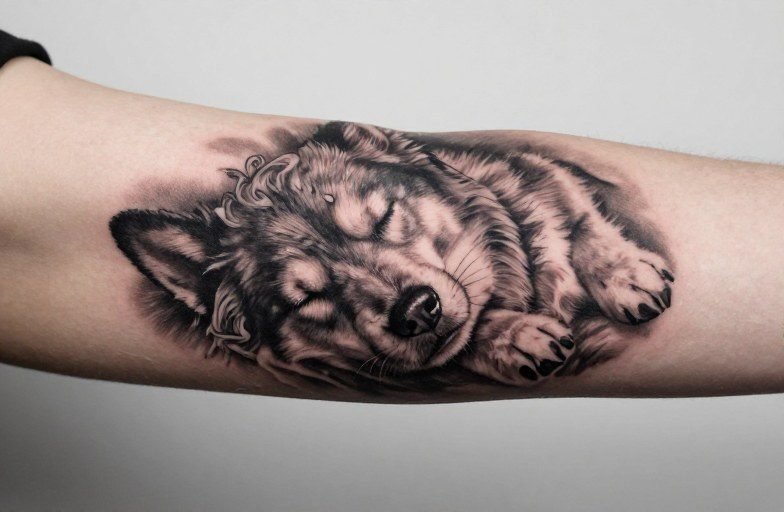
A dreaming tattoo typically represents the space between consciousness and the unconscious: the liminal zone where desire, fear, and imagination blur together. For most people who choose this imagery, it signals an active relationship with their own inner life, not passive sleep, but engaged exploration of what lies beneath the surface. The symbol can mark a period of change, a creative breakthrough, or a commitment to paying attention to what the mind produces when the ego loosens its grip.
What Dreaming Imagery Actually Represents
The dreaming tattoo carries distinct symbolic weight depending on which visual elements appear. A solitary sleeping figure suggests introspection and the need for rest as a form of resistance. Eyes with dream imagery spilling from them, clouds, animals, or abstract shapes speak to perception itself being reshaped by the unconscious. The most common motif, a human profile dissolving into a landscape or sky, captures the porous boundary between self and the imagined world.
Not all dreaming imagery reads the same way. A figure receiving dreams, with stars or symbols floating toward a sleeping face, implies openness, receptivity, perhaps vulnerability. A figure generating dreams, reaching into clouds or pulling threads from the moon, suggests creative agency. The dreamer becomes architect rather than passenger. This distinction matters for placement and composition: receptive imagery tends to work better on the back or ribs, areas you cannot see directly; generative imagery suits the forearm or chest, where you can literally watch the symbol at work.
Many designs incorporate darkness deliberately: a figure half-submerged in black water, a dreamscape that turns ominous at the edges. This is not pessimism. Collectors drawn to Jungian psychology often use such imagery to acknowledge that dreams carry what consciousness rejects. The shadow keeps the symbol from feeling like a motivational poster.
Cultural Roots and Visual History
The visual vocabulary for dreaming tattoos draws from several sources, and responsible artists acknowledge these lineages rather than treating the imagery as culturally neutral.
In European art, the dream vision has medieval roots: Dante’s Divine Comedy structured as dream narrative, Bosch’s populated dreamscapes, the Romantic era’s fascination with the sublime. The reclining figure in Western visual culture carries these accumulated associations into modern tattooing.
Modern dreaming tattoos owe significant debt to 1920s and 1930s surrealism, particularly the automatic drawing techniques and biomorphic forms developed by artists like Miro and Tanguy. The melting, flowing, impossible architectures common in contemporary dreaming tattoos descend from this visual lineage. Collectors interested in this connection might research specific surrealist works to inform their custom designs rather than defaulting to generic imagery.
Indigenous dream traditions deserve careful handling. The Ojibwe dreamcatcher was originally a protective object made for children. Its specific cultural function is largely absent from most tattoo adaptations. The Aboriginal conception of Dreamtime is not individual psychology but something closer to cosmic law, a framework for understanding creation and relationship to land. Direct copying of these symbols into unrelated tattoo compositions is increasingly understood as extraction rather than homage. If you are drawn to these images, research their origin before committing.
Japanese Tradition
Japanese imagery offers the baku, a chimera creature that devours nightmares. The baku appears occasionally in tattooing, though it is more commonly associated with netsuke and woodblock print traditions. It represents active intervention in dreams rather than passive experience, a useful distinction for collectors drawn to protective or aggressive dream symbolism.
Design Options and Style Choices
Line weight matters enormously for dreaming tattoos. Fine single-needle work captures the ethereal quality of dream imagery but ages poorly on high-movement areas like wrists and ankles. The delicate lines blur within five to seven years, turning detailed cloudscapes into grey smudges. For longevity, slightly bolder linework with strategic black saturation preserves readability without sacrificing atmosphere.
- Watercolor: Bleeding edges and unpredictable saturation can reinforce the dream-state feeling if executed by someone who understands how watercolor ages. Darker values hold; light washes often disappear within a decade.
- Black and grey: Dominates this genre because it reads as nocturnal and subconscious, removed from waking life’s color saturation. When color appears, it typically functions as accent, mimicking how specific images stand out in remembered dreams.
- Dotwork: Creates a dissolving, particulate quality that suits dreamscapes well. Dots hold better than lines over time and can suggest the grainy texture of dream memory.
- Fine-line realism: Works well for portrait-style elements, a sleeping face, a hands-over-eyes pose, but requires an artist with strong illustrative skills, particularly if the design blends realistic and surreal elements.
Placement Considerations
Upper arms and shoulder blades carry larger narrative pieces comfortably. Ribs suit vertical compositions with a solitary figure or a cascading dreamscape. Wrist and ankle placements work for minimalist versions, a single sleeping eye or a crescent with a face, but only with bolder linework given the movement on those joints.
Common Visual Motifs
A few recurring elements appear across dreaming tattoos, each bringing its own layer of meaning:
- Moon and stars: The moon is cyclical and external; dreaming is personal and interior. A crescent with a sleeping face bridges both and remains one of the most recognizable combinations in this category.
- Closed eyes with imagery inside or escaping them: Suggests that perception continues even without waking sight. The eyes become windows into an inner landscape rather than tools for observing the outer world.
- Clouds and impossible architecture: Atmospheric elements in dreaming tattoos tend to be specific and populated, containing faces, objects, or structures that could not exist in waking life. Generic cloud tattoos lack this psychological layer.
- Melting or distorted clocks: Borrowed from surrealist painting, these signal that time works differently in the dream state, non-linear and subject to emotional weight.
Practical Advice Before You Commit
A few things worth thinking through before the appointment:
If you want to incorporate a dreamcatcher, research its Ojibwe origin first and discuss with your artist how to handle it responsibly. Some artists decline to reproduce it directly; others will help you develop an interpretation that acknowledges the source.
For surrealist compositions, ask to see your artist’s illustrative work specifically, not just their tattoo portfolio. Melting architecture and biomorphic forms require drawing skill that not every tattooist has developed. A technically proficient tattoer can still struggle with these designs if their foundation is flash-based work.
Think about what actual dream material you want to encode. The generic sleeping-face design available from any flash sheet communicates little beyond vague introspection. The effective version emerges from your own recurring imagery: specific locations, colors that stay vivid upon waking, the physical sensation of flight or falling. Work with an artist who asks about your dreams rather than showing you pre-made imagery.
Final Thoughts
The dreaming tattoo rewards specificity and patience. It is not a symbol that works well as an impulse choice. Its meaning comes from the material you bring to it, and that material takes time to identify clearly. The best versions function like a dream journal you cannot misplace: permanent, visible, and eventually readable only to the person who lived the experience that generated it. That is not a limitation. That is the point.









