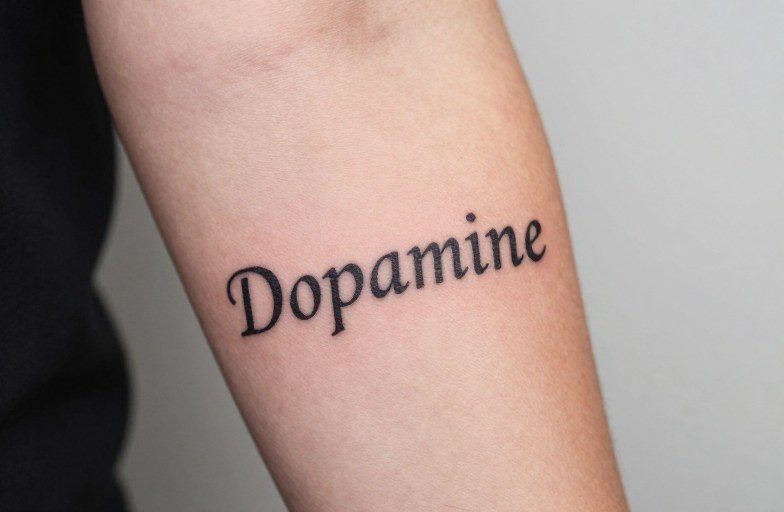
A dopamine tattoo depicts the molecular structure of the neurotransmitter dopamine, the brain chemical tied to reward, motivation, and pleasure. For most people who get it, the design signals a personal relationship with mental health, addiction recovery, or the pursuit of what drives them. The hexagonal rings and hydroxyl groups of the structure carry weight because they’re scientifically precise, this isn’t abstract symbolism, but a literal map of a molecule that shapes human behavior.
Symbolism & Core Meaning
The Molecule Itself
Dopamine’s structure consists of a catechol backbone, two hydroxyl groups attached to a benzene ring, connected to an ethylamine side chain. Tattoo artists render this with varying degrees of realism: some clients want skeletal formula (lines and angles), others prefer the ball-and-stick model with implied three-dimensionality. The skeletal version reads cleaner at smaller sizes, while ball-and-stick needs more space to avoid muddling the oxygen and nitrogen points.
Beyond the literal chemistry, the tattoo functions as shorthand for complex internal states. Depression, ADHD, addiction, and Parkinson’s all involve dopamine dysregulation, so the symbol attracts people who’ve fought those battles or watched loved ones fight them. It also appeals to scientists, therapists, and anyone who finds meaning in the biological mechanics of human drive.
Reward vs. Motivation
Popular culture conflates dopamine with pleasure, but neuroscientists distinguish between the “wanting” and “liking” systems. The tattoo can represent either or both. Some people emphasize the anticipation, the molecule of pursuit, of getting up and doing the hard thing. Others focus on the payoff, the earned satisfaction. The way an artist weights the design can tilt this meaning.
History & Cultural Roots
Scientific Illustration Traditions
Chemical structure tattoos descend from the broader tradition of scientific and medical illustration ink. Anatomical drawings, Darwin’s finches, and the DNA double helix all preceded molecular structures in tattoo culture. The dopamine molecule specifically gained traction as mental health destigmatization accelerated in the 2010s, often linked to online communities where people shared recovery stories and science literacy.
Pop Culture Amplification
Social media platforms, particularly those built on intermittent reward mechanisms, ironically popularized dopamine imagery. The term “dopamine hit” entered casual vocabulary, and the molecular structure became recognizable enough to work as body art. Some trace it to specific musician or influencer visibility, though no single origin point dominates. The symbol spread organically through mental health advocacy spaces and STEM communities simultaneously.
Best Placements
Visibility and Scale
The molecular structure demands clean lines and enough space to preserve the ring geometry. Wrist and forearm placements suit the horizontal spread of the carbon backbone. Ribs and shoulder blades offer more canvas for adding orbitals, electron dots, or companion elements like serotonin or oxytocin structures. Behind the ear works only for highly simplified versions, anything detailed will blur together within a few years.
- Inner forearm: Ideal for medium-sized skeletal formulas; easy to show or cover; moderate sun exposure affects aging.
- Upper arm/shoulder: Accommodates larger designs with color-coded atoms (red oxygen, blue nitrogen); less distortion from movement.
- Chest/sternum: Symmetrical placement suits the molecule’s bilateral structure; higher pain threshold required.
- Ankle/foot: Generally discouraged, the small bones and thin skin cause blowout, and the area fades fastest from friction and sun.
Pairing and Composition
Some clients frame the molecule within a larger piece: a brain silhouette, a pill capsule dissolving into the structure, or a synapse with dopamine as the neurotransmitter crossing the gap. Others keep it isolated, letting the scientific precision speak. Script additions, coordinates, dates, single words like “forward” or “survive”, need careful integration so they don’t clutter the already busy geometry.
How It Ages on Skin
Line Integrity
Dopamine tattoos rely heavily on straight lines and consistent angles. Over time, all tattoos spread slightly, ink particles migrate through the dermis, and collagen changes blur edges. For molecular structures, this means the benzene ring can soften from a crisp hexagon to something more organic and less recognizable. Single-needle work looks stunning fresh but degrades faster; 3-5 needle groupings hold definition longer without sacrificing the delicate appearance.
Color vs. Black and Gray
Traditional scientific diagrams use color coding: carbon (black), oxygen (red), nitrogen (blue), hydrogen (white or omitted). On skin, red and blue pigments fade at different rates, blues generally hold better than organic reds, which can shift toward orange or brown. Black-only versions age more predictably, though they sacrifice the immediate “chemistry textbook” recognition. Some artists solve this by doing the structure in black with subtle gray-wash shading to suggest depth without committing to color maintenance.
Sun exposure accelerates fading everywhere, but molecular tattoos suffer disproportionately because the meaning depends on legibility. A blurred animal or flower still reads as itself; a blurred hexagon with sticks becomes abstract geometry, losing the specific reference. SPF on forearm and wrist placements isn’t optional, it’s preservation.
Similar & Related Symbols
Other Neurotransmitters
Serotonin (5-HT) shares the catechol backbone structure with dopamine, making them visually similar, clients sometimes get both, or choose based on which molecule aligns with their specific experience. Serotonin tattoos more commonly signal anxiety or depression management; dopamine leans toward motivation, addiction, and movement disorders. Norepinephrine and acetylcholine structures appear less frequently but follow the same visual logic.
Adjacent Imagery
- Brain anatomical drawings: More literal, less chemically specific; often larger and more illustrative.
- Semicolon: The suicide prevention and mental health continuation symbol; sometimes paired with dopamine as complementary messaging.
- Pills and pharmaceuticals: Direct reference to medication management; can read as pro-psychiatry or critique depending on context.
- Receptor binding sites: Advanced scientific imagery showing where dopamine attaches to neural receptors; appeals to researchers and biochemists.
Personal & Modern Meanings
Recovery Narratives
For people in addiction recovery, the dopamine tattoo acknowledges the hijacked reward system, how substances or behaviors artificially flood receptors, and how the slow work of normalization requires patience. The tattoo doesn’t celebrate the molecule so much as name the battlefield. Placement choices here often favor visibility as accountability: the forearm you see when reaching for a drink, the wrist that enters a handshake.
Neurodivergence and Diagnosis
ADHD communities particularly gravitate toward dopamine imagery, reframing the “dopamine chase” from pathology to understanding. The tattoo becomes a self-identifier, a way to signal to others that your motivation operates differently, not an excuse, but an explanation. Some pair it with diagnostic dates or medication names; others keep it purely structural, letting fellow initiates recognize the symbol.
There’s also a strain of darker humor: people who’ve burned out in capitalist grind cultures, who recognize their own exploited dopamine systems in productivity apps and side hustles. The tattoo here carries irony, a self-aware acknowledgment of being played by the chemistry that was supposed to drive authentic pursuit.
Key Takeaways
A dopamine tattoo works because it bridges precise science and messy human experience. The molecular structure grounds it in verifiable reality, no ambiguity about what the image depicts. The meaning layers on top: mental health, recovery, scientific identity, neurodivergence, or the simple fact that motivation itself is biological and therefore neither moral failure nor superhuman virtue.
If you’re considering this design, prioritize line precision and placement that protects the geometry. Size it large enough to age, small enough to suit your life. Decide whether you want the scientific color coding or the longevity of blackwork. And know that the molecule will mean something slightly different to everyone who recognizes it, which is exactly how a good symbol functions.
Frequently Asked Questions
Do dopamine tattoos have to include the full molecular structure?
No. Simplified versions with just the hexagonal ring and key bonds work, especially at small sizes. Full structures with every hydrogen and carbon labeled need more space and age less gracefully.
What’s the difference between dopamine and serotonin tattoo meanings?
Dopamine tattoos typically emphasize motivation, reward, addiction, and drive. Serotonin tattoos more commonly represent mood stability, anxiety management, and depression recovery. The structures look similar but signal different experiences.
How much does a dopamine tattoo typically cost?
Small simple line work might start around $100-150; detailed pieces with color coding or companion elements run $300-600 depending on artist rates and location. Complex scientific illustrations with shading or background elements cost more.
Can a dopamine tattoo be covered up or modified later?
The linear structure limits coverup options, geometric designs don’t lend themselves to easy transformation. Plan for the long term, or choose placement where a larger piece could eventually incorporate or surround the molecule.
Related Tattoo Meanings
- Asce Tattoo Meaning: Symbolism, Styles Placement Guide
- Serotonin Tattoo Meaning: Chemistry, Hope, and Honest Skin
- Dreaming Tattoo Meaning: Symbolism, Design Cultural Roots
- Explore more