A born to die tattoo declares mortality as the one universal truth. It can signal punk defiance, existential acceptance, or a personal reckoning with impermanence. The phrase itself is stark, unromantic, and refuses to soften death into metaphor, making it a raw choice for people who want their skin to acknowledge what most language dances around.
Mythology & Folklore
Death-and-rebirth cycles thread through nearly every cultural tradition, though the exact phrasing “born to die” rarely appears in ancient texts. Instead, the sentiment lives in the symbolism.
The Thanatos Archetype
Greek personifications of death, Thanatos as gentle release, Keres as violent spirits, remind us that dying has many faces. A born to die tattoo sometimes borrows from this visual language: skulls with closed eyes (peaceful), or grinning, fleshless jaws (mocking). The wearer isn’t choosing a specific myth so much as tapping into a long human habit of making death speakable through image.
Rebirth Motifs Across Cultures
Phoenix imagery, often linked to Egyptian and Greek sources, pairs surprisingly well with born to die text. The contradiction, death as prerequisite for renewal, gives the tattoo narrative tension. Some trace the phoenix’s Western popularity to medieval bestiaries, but its use in tattooing is thoroughly modern, filtered through rock album art and biker culture. Other pairings include the ouroboros (snake consuming itself), which frames mortality as circular rather than terminal.
History & Cultural Roots
The phrase gained recognizable cultural weight through multiple channels, none exclusively dominant.
Punk and Post-Punk Lineage
The Damned released “Born to Die” in 1982. Lana Del Rey titled her 2012 album and its title track Born to Die, pushing the phrase into mainstream consciousness with deliberate melancholy glamour. Before either, military and biker subcultures used death-affirming slogans as camaraderie badges. The tattoo exists at this intersection: working-class fatalism, punk nihilism, and pop-culture romanticism. Someone wearing it might reference any, none, or all of these, context matters more than pedigree.
War and Memorial Traditions
Soldiers have long inscribed death-acknowledging phrases on equipment and bodies. “Born to Die” fits a lineage that includes “Death Before Dishonor” and “Remember Death” (memento mori in Latin). The difference is tonal: older military inscriptions often frame sacrifice as noble, while born to die strips away justification. It says simply that existence ends, not that the ending proves anything.
Religious & Spiritual Angles
Christian theology contains the phrase’s most direct parallel, though practitioners vary widely in how they interpret it.
Christian Dual Readings
Romans 6:23 states “the wages of sin is death,” while the broader narrative promises resurrection. Some believers get born to die tattoos as acknowledgment of original sin and Christ’s sacrificial death. Others read it more broadly: all flesh is temporary, and spiritual preparation matters more than bodily preservation. The tattoo’s bluntness can disturb more sanitized religious expression, which partly explains its appeal to people who find conventional piety too comfortable.
Secular Existentialism
Outside religious frameworks, the phrase aligns with existentialist acceptance of absurdity. Camus’s Sisyphus, condemned to eternal pointless labor, finds meaning in the struggle itself. A born to die tattoo can function similarly, not as despair but as liberation from the pressure to justify existence. If death is certain, the reasoning goes, choices matter more, not less. The tattoo becomes a private anchor against distraction, not a public sermon.
How It Ages on Skin
Text tattoos age differently than imagery, and this phrase presents specific challenges.
Lettering Choices That Last
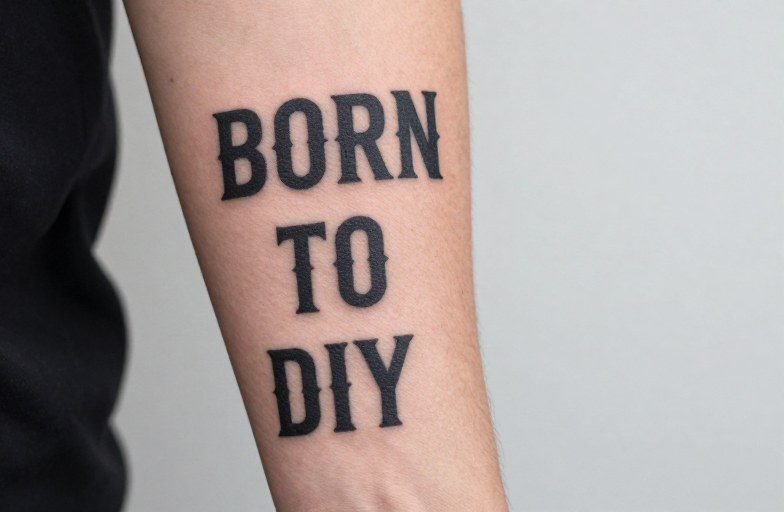
Script and fine-line lettering blur fastest on high-movement areas: wrists, fingers, throats. Born to die works well in bold serif or block letters, where ink density provides buffer against spread. All-caps treatments hold crisper edges over decades. The phrase’s brevity is practical, fewer letters mean fewer opportunities for merging. On the outer forearm or upper arm, where skin sees less flexion and sun exposure, readability extends ten to fifteen years before significant touch-up needs.
Pairing with Imagery for Longevity
Skulls, hourglasses, or wilting roses give the eye something to read even as text softens. Shaded imagery ages more gracefully than pure linework because slight blur becomes intentional atmosphere. A solid black skull behind born to die text creates contrast that preserves legibility. Red ink, sometimes used for roses or accent lines, fades fastest to pink or salmon, plan accordingly if color matters to the design’s impact.
Who Chooses This Tattoo
Demographics here are genuinely broad, defying easy profiling.
- Recovering trauma survivors sometimes use the phrase to mark survival without sentimentality, acknowledging that near-death experience changed perspective permanently.
- Musicians and fans of Lana Del Rey, punk, or metal subcultures wear it as subcultural identification, sometimes ironically, sometimes devotionally.
- Veterans and first responders may choose it as unsentimental occupational acknowledgment, less heroic than “thin blue line” or unit insignia.
- Young adults in existential crisis, the phrase’s bluntness resonates during periods of instability, though impulsive placement (hands, neck) can limit employment options later.
- People marking specific losses sometimes pair born to die with dates or names, though the phrase’s generality can feel insufficient for concrete grief.
The unifying thread isn’t biography but temperament: preference for direct statement over decorative consolation.
Symbolism & Core Meaning
Strip away subcultural associations and the tattoo reduces to a stance toward mortality.
Rebellion vs. Resignation
The same phrase reads differently depending on presentation. Aggressive lettering, dagger imagery, or placement on visible skin suggests defiance, death as enemy, acknowledged but not submitted to. Softer script, paired with flowers or natural decay imagery, leans toward acceptance. Most actual tattoos occupy middle ground, and the wearer’s own explanation shifts over time. The symbol’s flexibility is feature, not bug.
Temporal Awareness
Unlike memento mori in Latin, born to die uses contemporary English without classical distancing. It sounds like something said aloud, not read on a monument. This immediacy suits people who want mortality present in daily consciousness, not reserved for philosophical occasions. The tattoo functions as temporal anchor: when noticed, it recalls that time is finite, and that recollection shapes how the next hours get spent.
Final Word
The born to die tattoo works because it refuses to resolve its own tension. It isn’t hopeful or despairing, religious or secular, rebellious or resigned, it’s available to all these readings without committing to any. On skin, its power comes from repetition: the wearer sees it, remembers, and continues anyway. That continuation, not the phrase itself, is the actual meaning. The tattoo just marks where someone decided to stop looking away.
Frequently Asked Questions
Does a born to die tattoo always mean someone is depressed or suicidal?
Not at all. Many wearers use it to mark survival, acceptance, or existential clarity rather than active despair. Context and accompanying imagery usually reveal intent more clearly than the phrase alone.
What’s the best placement for a born to die tattoo?
Outer forearm and upper arm offer the best balance of visibility and aging stability. Avoid fingers, palms, and throat unless you’re prepared for frequent touch-ups and potential employment friction.
Should I get the words alone or add imagery?
Pure text ages faster and offers less visual interest over decades. Adding a skull, hourglass, or botanical element gives the design structural backup as lines inevitably soften.
How do I explain this tattoo to family who find it morbid?
Focus on the philosophical tradition it draws from, memento mori as life-affirming reminder rather than fixation on death. Most resistance softens when the stance is explained as temporal awareness, not gloom.
Related Tattoo Meanings
- Delphinium Tattoo Meaning: Openness, Joy Protection
- FTW Tattoo Meaning: Origins, Symbolism and Design Choices
- Grenade Tattoo Meaning: Power, Risk Controlled Chaos
- Explore more