
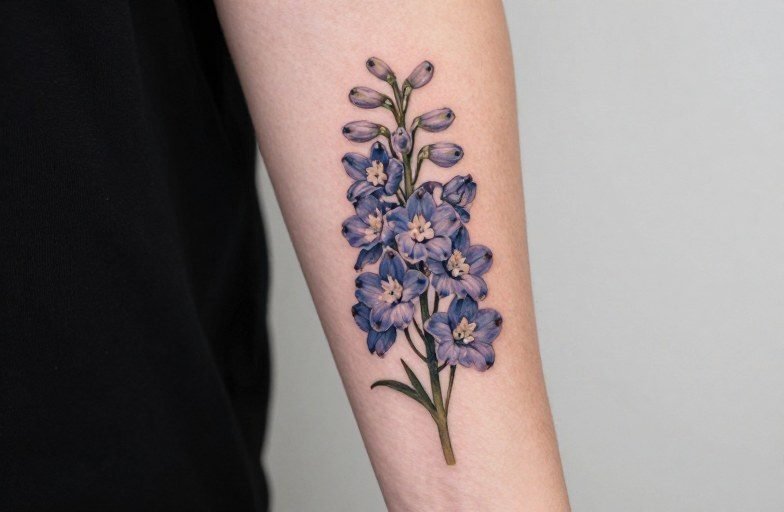
A delphinium tattoo most commonly signals an open heart, protective spirit, and capacity for joy. The tall, clustered blooms carry quieter secondary meanings too, dignity, grace, and the ability to stand apart without arrogance. Depending on color and placement, the same flower can read as playful memorial or quiet personal armor.
History & Cultural Roots
The delphinium’s name comes from the Greek delphinion, meaning dolphin, early botanists thought the unopened bud resembled the sea creature’s nose. That etymology stuck, and the flower accumulated symbolic weight across centuries rather than overnight.
European Folk Traditions
In medieval England, delphiniums were planted near homes to repel scorpions and evil spirits, an early association with protection that persists in tattoo symbolism. Some trace the flower’s link to mourning and remembrance to Victorian floriography, where deep blue blooms were sent to express attachment to someone who had passed. The language of flowers made delphiniums a coded way to say “I miss you” without speaking it aloud.
Native American and Pacific Northwest Use
Certain Plateau tribes used larkspur species (close botanical relatives) in dye work and as protective talismans. The blue pigment was often linked to the sky and to spiritual boundaries. This connection to protection and transcendence sometimes surfaces in modern tattoo choices, though artists should be careful not to appropriate specific tribal designs without understanding their context.
Symbolism & Core Meaning
The delphinium’s layered meaning comes from its physical form as much as its history. The flower spikes upward, blooms cluster tightly, and individual blossoms are small but numerous, each trait translates into symbolic reading.
Color-Specific Meanings
- Blue (most common): Dignity, grace, and an open heart. The classic “true blue” delphinium carries the strongest traditional associations.
- Purple: Often linked to royalty and first love; slightly more romantic and less formal than blue.
- White: Purity and new beginnings, but in memorial contexts, a quieter form of remembrance.
- Pink: Fickleness or capriciousness in Victorian floriography, rarely chosen for tattoos unless someone deliberately owns that trait with humor.
The Protective Reading
The flower’s historical use as a warding plant gives it a less-obvious meaning: self-protection that doesn’t harden into isolation. Someone who has survived something and still chooses to bloom upward. This interpretation appeals to people who want floral imagery without the vulnerability that roses or cherry blossoms can imply.
Best Placements
Delphiniums suit vertical placements because the natural flower grows on a spike. Fighting that form usually wastes the design’s structural logic.
Where the Form Works
- Forearm (inner or outer): The natural length fits here; outer forearm shows the bloom cluster well, inner allows for finer detail that ages more gracefully on that skin quality.
- Ribcage: Vertical space, can scale to full flower spike with leaves. Pain is significant, but the canvas rewards the commitment.
- Thigh (front or side): Enough room for multiple stems or a small bouquet; skin here holds color well over time.
- Spine: Literal vertical alignment, though this placement limits viewing and requires a client who can sit still through long sessions.
Placement Pitfalls
Delphiniums compressed into horizontal bands, wrist wraps, ankle bands, lose the essential upward movement. The flower becomes unrecognizable or generic. Small single-bud designs behind the ear or on the finger are possible but risky; the fine petal structure blurs quickly on high-movement, high-wear skin. If you want something tiny, consider a simplified silhouette rather than detailed linework.
Personal & Modern Meanings
Contemporary wearers rarely choose delphiniums for strict Victorian floriography. The meanings have loosened and merged with personal narrative.
Birth Month and Memorial Connections
Delphinium is the July birth flower alongside larkspur, making it a natural choice for people born that month who want botanical identification without the obviousness of a zodiac symbol. In memorial work, the flower often represents someone who was joyful but not simple, someone with depth and a protective streak. The blue specifically reads as calm persistence rather than dramatic grief.
Queer and Trans Symbolism
The delphinium’s combination of softness and structural height has found traction in queer tattoo communities as a symbol of flourishing against expectation. The flower is tall, noticeable, unapologetically ornamental, qualities that resonate with people claiming space. This meaning is emergent rather than traditional, but it’s increasingly recognized in shop conversation.
Who Chooses This Tattoo
There’s no single demographic, but patterns emerge. Delphinium clients often arrive with specific color intentions and a reason for choosing this flower over more common options.
Common Client Profiles
- People avoiding rose/poppy saturation: They want floral, they want meaning, but they don’t want the tenth identical design in their friend group.
- Those with gardening or botanical backgrounds: Actual plant knowledge often drives the choice; they know delphiniums are harder to grow than they look, and respect that resilience.
- Memorial clients seeking something less overtly mournful: The flower acknowledges loss without centering it.
- July birthdays with taste: Self-explanatory, but the good ones know why they’re choosing it and don’t just default to “it’s my birth flower.”
Common Variations & Styles
Style choice dramatically changes how the delphinium reads. The same flower in fine line versus bold traditional communicates different temperaments.
Linework and Black-and-Grey
Single-needle or fine-line delphiniums emphasize the flower’s delicacy and can incorporate botanical accuracy, visible stamens, individual petal curves, proper leaf serration. This style ages faster; the thin lines that define petal edges will spread and soften within 5-10 years depending on placement and sun exposure. Black-and-grey versions rely on contrast between the dense bloom cluster and negative space; they hold up better but lose the color-specific meaning entirely.
Color Realism and Neo-Traditional
Color realism captures the blue’s particular depth, delphinium blue is slightly violet-shifted, not pure sky or navy. Achieving this requires an artist comfortable with floral saturation and willing to pack color carefully into small petal areas. Neo-traditional approaches simplify the form into bolder shapes, often adding decorative elements like geometric frames or ornamental dots. This style sacrifices botanical accuracy for visual punch and longevity.
Watercolor and Abstracted Forms
Watercolor delphiniums are popular but technically demanding. The flower’s natural structure provides an anchor; without it, the color wash can read as generic floral mush. Successful versions keep the stem and central bloom cluster defined, letting the color bleed at the edges. Abstracted or geometric delphiniums, triangulated petals, linear stem interpretations, work best when the viewer can still identify the source flower; otherwise the meaning connection breaks.
The Bottom Line
A delphinium tattoo works best when you choose it for the specific combination of joy and protection it offers, not as a generic pretty flower. The vertical form demands vertical placement. The color matters for meaning; blue and purple carry the weight, pink and white read lighter or more ambiguous. Pick an artist who understands botanical structure, because the difference between a delphinium and a generic spike flower is in the petal count, the leaf shape, and the way the blooms cluster. Get those wrong and you’ve got a tall blue plant with no particular reason to be on your skin. Get them right, and the flower does what it has always done: stands tall, protects its ground, and opens upward.
Frequently Asked Questions
Does delphinium tattoo color change the meaning significantly?
Yes. Blue carries the strongest traditional associations with dignity and open-heartedness. Purple leans toward first love and royalty. White works for memorials or new beginnings, while pink historically signified fickleness, rarely chosen unless intentionally ironic.
How well does fine-line delphinium detail hold up over time?
Poorly on high-wear areas like fingers or wrists. The thin petal lines blur within years, not decades. Inner forearm or thigh hold better. For longevity, choose slightly bolder linework or accept that touch-ups will be necessary.
What’s the difference between delphinium and larkspur tattoos?
Botanically they’re close relatives and often confused. Delphiniums are more garden-cultivated, with denser bloom clusters. Larkspurs are wilder, more scattered. Tattoo-wise, the distinction matters less than getting the petal structure right for whichever you claim.
Is a delphinium tattoo too feminine for masculine presentation?
The flower’s vertical structure and protective symbolism translate across gender presentation easily. Bold linework, black-and-grey execution, or pairing with non-floral elements (daggers, architectural frames) shift the reading without distorting the core meaning.
Related Tattoo Meanings
- Larkspur Tattoo Meaning: July Birth Flower Symbolism
- Depression Tattoo Meaning: Symbols of Survival and Struggle
- Dopamine Tattoo Meaning: Chemistry, Motivation Mental Health
- Explore more









