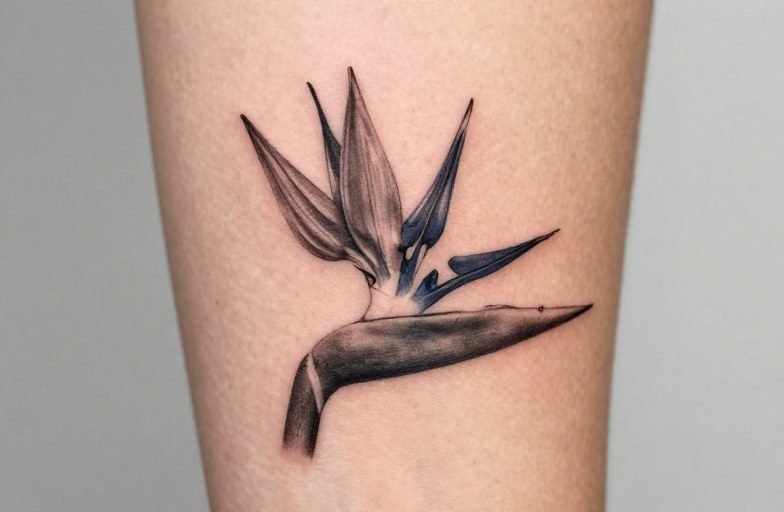
The bird of paradise tattoo carries layered symbolism rooted in its striking, almost architectural form. Most commonly, it signals freedom, exotic beauty, and resilience through hardship, references both to the actual bird and the flower that borrowed its name. The flower’s crane-like structure evokes flight and aspiration even when grounded, making it a favorite for people marking personal transformation.
Personal & Modern Meanings
Rebirth After Hardship
People gravitate toward this image after surviving something that reshaped them. The flower pushes through tough growing conditions and still produces those impossible orange and blue bracts. That visual logic translates cleanly to skin: a permanent marker that something difficult forged something vivid. Unlike roses or lilies with their softer associations, bird of paradise reads as earned beauty, almost defiant.
Freedom Without Rootlessness
There’s a specific tension in this symbol that resonates now. The bird of paradise flower looks like it’s about to take off, yet it’s firmly planted. That duality, grounded but reaching, attracts people who’ve built stability without sacrificing ambition. Parents returning to careers, recovering addicts rebuilding, immigrants straddling two cultures: the image holds that complexity without needing explanation.
- Orange and blue colorways dominate, though black-and-grey versions strip the symbol to its structural drama
- Single bloom versus clustered spray changes the energy: solitary reads contemplative, grouped reads celebratory
- Stem inclusion adds verticality and a sense of growth trajectory
How It Ages on Skin
Color Fading Reality
Those saturated oranges and electric blues? They’re high-maintenance. Red and yellow pigments fade fastest under sun exposure, and the bird of paradise relies heavily on both. Within five to seven years, unprotected color softens to a muted peach and slate unless you commit to sunscreen or touch-ups. Black-and-grey versions age more gracefully, though they sacrifice the immediate species recognition that makes this flower distinctive.
Line Work vs. Shading Tradeoffs
Bold outlines preserve the flower’s crane-like silhouette as color bleeds or fades. Watercolor-style pieces without strong linework risk becoming unidentifiable blurs within a decade. The spiky, angular bracts that define this flower demand crisp edges. Soft shading alone can’t carry the form. If you’re committed to color, negotiate with your artist: heavier black line weights around the outer bracts, color packed inside rather than diffused across.
Placement affects longevity too. Upper arms and thighs see less sun degradation than hands, feet, or collarbones. The flower’s vertical orientation suits forearms, ribs, and calf sides naturally. Small versions under three inches lose the structural detail that makes this flower readable; it becomes generic tropical flora.
Mythology & Folklore
The flower’s name originates from its resemblance to the birds of paradise native to New Guinea and surrounding islands, often linked to Victorian-era natural history enthusiasm. Some trace the bird’s name to European explorers who believed these creatures hailed from paradise itself, they arrived dried and footless, fueling myths of celestial origin. The flower, named later, inherited that aura of the remote and unattainable.
In South African folklore, where Strelitzia reginae grows natively, the flower carries associations with faithfulness and love between separated partners. The bird-like form supposedly represents a crane couple, one flying, one waiting. That reading surfaces occasionally in tattoo choices for long-distance relationships or military deployments, though it’s not the dominant interpretation.
There’s no ancient tradition of this as a tattoo motif specifically. Its popularity surged with 1990s tropical aesthetic trends and resurged recently alongside maximalist botanical illustration styles. That relative novelty means fewer accumulated clichés, you’re not fighting decades of overexposure like with roses or lotuses.
Who Chooses This Tattoo
Demographics & Placement Patterns
Women in their late twenties to forties disproportionately select this design, though that’s shifting as botanical tattoos broadly gain male collectors. The vertical growth pattern appeals to people wanting rib pieces that follow the body’s natural lines, or forearm extensions that draw the eye upward. It’s less common as a first tattoo than as a third or fourth, people tend to arrive at it after simpler imagery feels insufficient.
Professional Considerations
The flower’s exoticism reads differently across industries. In creative fields, it’s distinctive without edge-lord aggression. In conservative environments, it’s colorful and visible enough to require strategic placement. People who need coverage flexibility often choose upper arms or thighs over hands or necks. The image doesn’t code obviously to any subculture, it’s not punk, not New Age, not military, so it travels between contexts without heavy baggage.
- Common pairings: hummingbirds (extending the flight theme), geometric frames (contrasting organic with structural), script banners (risky, often dated within years)
- Less successful pairings: skulls (thematic clash, not productive tension), tribal elements (aesthetic mismatch from different eras)
Religious & Spiritual Angles
Christian interpretations occasionally connect the bird of paradise to the Holy Spirit, borrowing from general dove imagery, though this is more interpretive stretch than established tradition. The flower’s upward reach and crane-like posture support that reading for individuals already working within that framework.
Hindu and Buddhist practitioners sometimes associate it with Garuda, the divine eagle mount, though this is less common than with actual eagle or phoenix imagery. The flower’s name creates loose associative possibilities rather than doctrinal significance.
More broadly, the bird of paradise functions as spiritual shorthand for paradise itself, enlightenment, the afterlife, peak experience. That works ecumenically without requiring specific religious commitment. People who’ve had near-death experiences or profound psychedelic journeys occasionally choose it as non-literal representation of something ineffable.
Common Variations & Styles
Botanical Illustration Approach
Scientific accuracy with fine linework, often including cross-section details, Latin nomenclature, or measurement notations. This style ages well if line weight is consistent, but requires an artist comfortable with technical drawing. The flower’s actual anatomy is complex, multiple bract types, the spathe and spadix structure, so accuracy demands reference material, not memory.
Neo-Traditional & Bold Color
Heavy black outlines, limited but saturated palette, stylized simplification of the form. This approach sacrifices some botanical accuracy for graphic impact and longevity. The orange reads as orange, not subtle sunset gradation. Artists often add decorative background elements, sunbursts, geometric halos, that weren’t part of the original request but fit the style’s conventions.
Abstract and geometric interpretations are emerging: the flower’s angular structure translates naturally to polygonal rendering, negative space exploitation, or single-line continuous drawing. These read as contemporary art references rather than botanical tattoos, appealing to design-industry professionals.
- White ink highlights: effective short-term, nearly invisible within three years on most skin tones
- Stipple shading: beautiful but slow to execute, expensive, prone to uneven healing
- Mixed media effects: watercolor splashes behind defined linework, currently popular, longevity uncertain
What to Remember
The bird of paradise tattoo succeeds when its structural drama is respected. This isn’t a soft, forgiving image, it demands precision. Choose an artist whose portfolio shows strong botanical or neo-traditional work, not someone who dabbles. Budget for the time it takes to get those edges right; rushing shows in the bracts.
Consider your color commitment honestly. The full visual impact requires orange, blue, and green maintenance. If that’s not sustainable, black-and-grey with heavy linework preserves the form but changes the symbol’s energy entirely. Neither is wrong, but they’re different tattoos with different resonances.
Finally, the meaning crystallizes through placement and context, not the image alone. On a rib cage hidden from most view, it’s private affirmation. On a forearm, it’s public declaration. The flower itself holds multiple possibilities; your body completes the statement.
Frequently Asked Questions
Does a bird of paradise tattoo always represent a specific bird species?
No. Most people choose the flower Strelitzia reginae, which was named for its resemblance to birds of paradise. The actual birds are rarely tattooed except by serious birders or people with Papua New Guinea connections. The flower has largely eclipsed the bird in tattoo popularity.
How much does a detailed bird of paradise tattoo typically cost?
Quality botanical work with this complexity usually runs $400-$800 for palm-sized pieces, more for larger color work or full sleeves. The spiky bracts take time to render precisely. Pricing varies enormously by city and artist reputation, so consultations are essential.
Can this flower work in a small tattoo, or does it need to be large?
It struggles below three inches. The defining structure, pointed bracts, crane-like profile, compresses into unrecognizable abstraction when miniaturized. If you want small, consider just the most distinctive upper bract rather than the whole flower.
Is there a difference between the bird of paradise flower and the bird of paradise plant as tattoo symbols?
In practice, no. Tattoo references almost always mean Strelitzia reginae, the orange and blue flower. The banana-relative giant bird of paradise (Strelitzia nicolai) has white flowers and different proportions, but most people and artists conflate them unless specifically requesting botanical accuracy.
Related Tattoo Meanings
- Bkc Tattoo Meaning: Symbolism, History Design Guide
- Blackberry Tattoo Meaning: Growth, Resilience Hidden Depth
- Blackbird Tattoo Meaning: Symbolism, Styles What to Know
- Explore more