
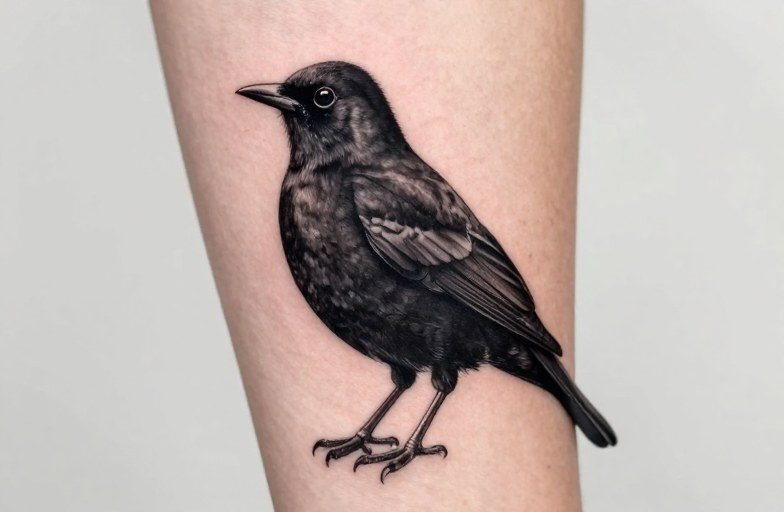
A blackbird tattoo most commonly signals the unseen, movement between states, life and death, freedom and confinement, the known and the hidden. The specific meaning shifts with species (raven, crow, grackle, true blackbird) and cultural context, but the through-line is liminality: these birds occupy edges, thresholds, and in-between spaces. Your design choices, including species accuracy, placement, and color versus black and grey, shape how that symbolism lands.
Symbolism and Core Meaning
Blackbirds carry dense symbolic weight across cultures, but several threads recur. Understanding them helps you choose imagery that genuinely resonates rather than defaulting to generic “mystery.”
Death, Transition, and the Unseen
Carrion-feeding species like crows and ravens naturally link to mortality. This is not necessarily morbid; many people choose blackbirds to mark survived trauma, lost relationships, or major life transitions. The bird becomes a psychopomp figure, guiding between states rather than dwelling in darkness. A raven with spread wings reads differently than a perched crow; the former suggests active passage, the latter watchfulness or waiting.
Intelligence and Adaptation
Corvids demonstrate tool use, facial recognition, and complex social behavior. Tattoos emphasizing the eye, sharp and sometimes reflective, tap this association. A design showing the bird in problem-solving posture (head tilted, object manipulated) carries different energy than a silhouette in flight. Consider what aspect of intelligence matters to you: cunning, memory, social bonds, or survival instinct.
Communication and Voice
True blackbirds (Turdus merula, the European species) are celebrated songsters. Their tattoos often emphasize the open beak, musical notation integration, or placement near the throat and collarbone. This diverges sharply from raven symbolism, so know which species you are referencing. A singing blackbird signals expression, dawn, renewal; a silent raven suggests secrets or foreboding.
Styles and Visual Approaches
The blackbird’s visual flexibility makes it adaptable across tattoo traditions, but certain approaches carry specific connotations.
Silhouette and Negative Space
Single-needle or fine-line silhouettes against moon, branch, or geometric background remain consistently popular. The stark contrast ages well, black ink holds, and minimal skin trauma preserves detail. Negative-space variants (bird shape left in skin tone, surrounded by black) require larger scale to read clearly; finger-sized versions blur within years. Best placements: forearm outer edge, upper arm flat, calf side panel.
Realism and Neo-Traditional
Realistic corvid portraits demand technical precision in feather texture and eye reflection. These work best at palm-size minimum, ideally with background atmospheric elements such as mist, bare branches, or weathered stone. Neo-traditional approaches, with bold outlines and a limited but saturated color palette, stylize the form while maintaining readable symbolism. The exaggerated eye size in neo-traditional designs amplifies the watchful, intelligent quality.
- Single blackbird: solitude, personal change, individual voice
- Multiple birds in flight: flock behavior, community, collective movement
- Bird with key or clock: time, access, secrets revealed
- Bird and skull: memento mori, accepted mortality
- Bird emerging from geometric break: emergence, breaking old patterns
Cultural and Mythological Roots
The blackbird’s symbolic prominence spans continents with significant variation.
European Traditions
Medieval European folklore often linked blackbirds to otherworldly messengers. Welsh and Scottish border traditions feature blackbirds in liminal roles, appearing in ballads and folk tales as creatures crossing between the ordinary world and something beyond it. Sources vary on specific origin stories, but the Celtic thread connecting blackbirds to thresholds and hidden knowledge appears consistently. The nursery rhyme “Sing a Song of Sixpence,” with its four and twenty blackbirds baked in a pie, likely references medieval entertainment practices where live birds were released as surprise spectacle.
Norse and Celtic Spiritual Contexts
Odin’s ravens, Huginn and Muninn (thought and memory), represent mind functions rather than moral poles. Twin raven tattoos referencing this tradition call for paired, distinguishable birds, often one looking forward and one back, or with subtle differences in posture. The Valknut or runic integration can clarify the reference for those familiar with the tradition. Celtic Christianity tended to view blackbirds more neutrally than later medieval interpretations, sometimes as souls under divine care.
Indigenous North American Perspectives
Various nations hold distinct relationships with corvid species. Raven appears as creator-trickster in Pacific Northwest traditions, fundamentally different from the European death-omen association. The specific tribal context matters enormously; generic “Native American raven symbolism” collapses important distinctions. If this lineage informs your tattoo, specificity matters: particular nation, particular story, particular artist with cultural permission.
Mythology and Folklore Threads
The Grimm tale “The Twelve Brothers” features a princess who communicates through song as a bird, with the blackbird (or raven, in variants) enabling voice when human form is denied. This resonates with tattoos marking survival of silencing experiences: abuse, suppression, closeted identity. The bird form becomes not disguise but essential expression.
Edgar Allan Poe’s raven cemented the gothic association for English-speaking audiences, though the poem’s bird speaks only one word, emphasizing obsessive memory rather than prophetic wisdom. Tattoos referencing this specifically, with “nevermore” script, bust of Pallas, or chamber door framing, signal literary engagement rather than generic darkness.
Japanese folklore offers the karasu-tengu, crow-like mountain spirits distinct from the more humanoid tengu forms. These beings bridge wilderness and human settlement, skilled in martial arts and mischief. The association is protective and disruptive simultaneously, useful complexity for tattoos marking contradictory qualities.
Color Choices and Longevity
The blackbird’s natural coloration makes black and grey the intuitive choice, but strategic color integration carries specific effects. Monochrome emphasizes form and shadow. It ages predictably, black ink holds better than most colors, and grey wash provides depth without the fading that plagues light blues and yellows. For small pieces, black and grey preserves readability longer.
A single red eye, yellow beak interior, or subtle blue sheen on wing feathers (accurate to actual raven coloration in direct light) creates focal points without undermining the blackbird identity. Red specifically intensifies danger, blood, or passion associations; use it deliberately. The iridescent quality of actual raven feathers (purple, green, blue in sunlight) is extremely difficult to render in tattoo ink. Artists attempting this often end with muddy dark tones, so discuss realistic expectations with your artist before committing.
Placement and Practical Decisions
Placement affects meaning and practicality both. Throat and hand placements signal commitment to visibility and also age faster due to movement and sun exposure. The upper back and shoulder blade offer flat, stable skin for detailed work, though you will rarely see it yourself. Inner forearm provides personal visibility and reasonable aging, though frequent flexing can blur fine detail over years.
Species accuracy matters more than many clients expect. A raven tattoo with crow proportions reads as an error to knowledgeable viewers. Ravens are significantly larger, with heavier beaks, shaggier throat feathers, and wedge-shaped tails in flight. Crows are smaller and more compact, with fan-shaped tails. European blackbirds are thrush-sized, with slender bills and a distinctive yellow eye-ring in males. Your artist should reference actual anatomy, not stylized conventions.
Line weight matters for longevity. Single-needle fine lines in feathers blur within five to ten years; slightly heavier outlining or strategic black-fill areas provide structure as detail softens. Ask your artist to show healed work from several years prior, not just fresh tattoos.
Choosing Your Blackbird Tattoo
The blackbird’s cultural density means your tattoo enters existing symbolic conversations. You do not control all readings, but informed choices, including accurate species, specific reference points, and thoughtful placement, shift random association toward intentional communication. Decide which symbolic thread matters most to you: mortality and passage, intelligence, voice, or a specific cultural tradition. Build the design outward from that core meaning, and you will end up with something that holds up across decades, not just aesthetically but personally.
Frequently Asked Questions
What’s the difference between a raven and crow tattoo meaning?
Ravens typically signal larger-scale passage, prophecy, and Norse or Celtic spiritual associations due to their size and mythology. Crows lean toward intelligence, adaptability, and everyday survival. Ravens also require more space for accurate anatomical representation.
Do blackbird tattoos have negative meanings?
Some European traditions associate them with death or ill omen, but this is culturally specific and frequently reclaimed. Many wearers choose them for precisely their ability to hold contradictory meanings, darkness and intelligence, mortality and change.
How well do detailed blackbird feather tattoos age?
Fine feather detail blurs over time, especially on mobile skin areas. Strategic black-fill sections and slightly heavier line work maintain structure as detail softens. Expect to need touch-up or reinterpretation after 8 to 12 years for highly detailed pieces.
Can a blackbird tattoo work with other birds in a piece?
Yes, but consider scale and ecological accuracy. A raven alongside songbirds creates predator-prey tension unless deliberately composed. Multiple corvids read as family or community; mixing corvid species (raven, crow, magpie) suggests multiplicity of thought or memory.
Related Tattoo Meanings
- Blessing Thai Tattoo Meaning: Sacred Ink and Its Significance
- Blueberry Tattoo Meaning: Symbolism, Folklore Style
- Born to Die Tattoo Meaning: Mortality, Rebellion Acceptance
- Explore more









