
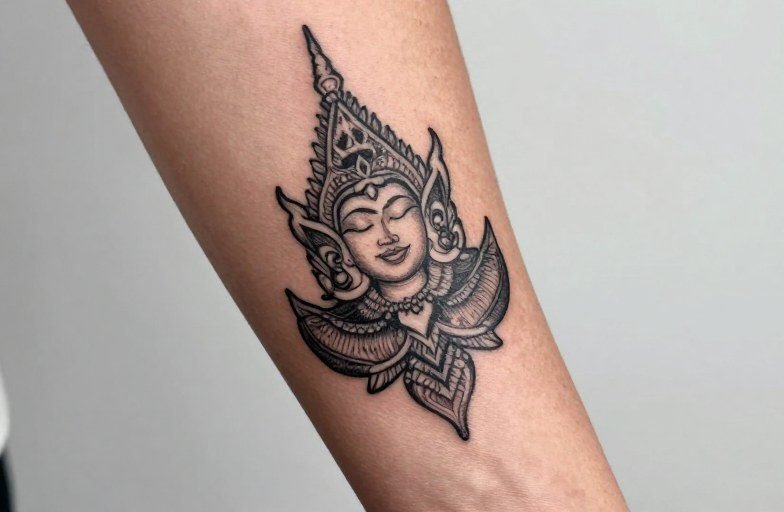
A blessing Thai tattoo, most commonly recognized through the sak yant tradition, functions as a spiritual emblem believed to confer protection, good fortune, and guidance. These designs combine sacred geometry, depictions of deities or animals, and Pali script incantations into a single composition. Rather than purely decorative ink, the tattoo operates within a ritual framework where the act of receiving it and the accompanying blessing are considered equally important to the image itself.
History & Cultural Roots
The tradition of sacred tattooing in Thailand stretches back centuries, often linked to Buddhist and animist practices that predate modern nationhood. Monks and ajarns (master practitioners) have historically administered these markings, with the process incorporating prayer, chanting, and specific ritual protocols.
From Temples to Tattoo Shops
Traditional sak yant were applied using long metal needles tapped by hand, with recipients sometimes required to observe precepts or abstain from certain behaviors. Contemporary blessing Thai tattoos now appear in conventional tattoo studios using machine work, though some practitioners still maintain ceremonial elements. The migration from temple to shop has sparked ongoing debate about authenticity and spiritual efficacy within Thai communities.
Regional Variations
Cambodia, Laos, and parts of Myanmar share cognate traditions with distinct local characteristics. Thai sak yant often emphasize Hanuman, the five lines (ha taew), or the nine peaks (gao yord), while Khmer designs may prioritize different protective figures. Understanding this regional texture matters when selecting a design, as motifs carry culturally specific resonances that don’t transfer cleanly across borders.
How It Ages on Skin
Blessing Thai tattoos present particular aging challenges due to their structural complexity. Dense Pali script packed into small areas tends to blur faster than open geometric work. The five-line ha taew design, with its stacked horizontal bands, often holds up better than circular paed tidt (eight directions) pieces where fine spokes radiate from a center point.
Placement and Longevity
- Upper back and shoulder blades provide stable surfaces where the skin experiences less stretching and sun exposure
- Forearms and calves see more movement and friction, accelerating fade in detailed script
- Hands, feet, and neck age notoriously fast for any tattoo, and blessing Thai designs rarely suit these placements culturally or practically
- Line weight matters: traditional hand-tapped work often uses heavier lines that outlast fine machine work by decades
Shading in deity figures or animal representations will soften and require touchup within 5-10 years depending on sun exposure and skin type. Black ink generally ages more gracefully than color in this specific tradition.
Common Variations & Styles
The visual vocabulary of blessing Thai tattoos remains relatively codified, though individual practitioners bring distinctive interpretations to classic forms.
Core Motifs
The ha taew (five lines) ranks among the most requested, with each line traditionally associated with different benefits: protection, wealth, love, health, and success. The gao yord (nine peaks) represents the Buddha with nine stacked elements, often topped with a spire. Paed tidt (eight directions) creates a circular mandala-like form with protective function across all compass points.
Animal yants include the tiger for power and fearlessness, Hanuman for strength and loyalty, and the gecko for adaptability and luck. These aren’t chosen arbitrarily; each carries specific behavioral associations and corresponding kata (chants).
Contemporary Adaptations
Some collectors blend traditional motifs with illustrative or neo-traditional Western styling, though this hybrid approach generates criticism from purists. Others scale designs down for discretion or incorporate them into larger compositions. The script itself sometimes gets isolated as a text-only piece, divorced from its geometric framework, a choice that alters both aesthetic impact and traditional function.
Color vs Black and Grey
Authentic sak yant was historically black ink only, with color introduction being a relatively recent development, often linked to Western tattooing influence. Traditional practitioners still predominantly work in black, with any color appearing as accents in robes or flames rather than as dominant fields.
Practical Considerations
Black ink on medium to dark skin tones maintains contrast and readability longer than color alternatives. Red, when used in traditional work for specific ritual purposes, tends to fade to a muddy brown. Modern collectors sometimes request full color in deity figures, but this pushes the work toward illustrative territory and away from the stark graphic quality that defines classical sak yant.
Skin undertone significantly affects how any ink reads. Cool undertones can make black appear slightly blue; warm undertones may read it as softer brown-black. This isn’t a flaw but a biological reality that affects how script-heavy designs will look in ten years.
Who Chooses This Tattoo
The demographic has broadened considerably. Thai nationals, diaspora communities, Muay Thai practitioners, spiritual seekers, and travelers all approach this tattoo with different expectations and relationships to its cultural context.
Motivations and Missteps
Some collectors have genuine Buddhist practice or Thai heritage grounding their choice. Others are drawn through combat sports exposure, where sak yant visibility in MMA and boxing has normalized the imagery. The latter group sometimes selects designs without understanding associated precepts or behavioral commitments traditionally expected.
There’s a meaningful distinction between appreciation and appropriation here. Wearing sacred script without understanding its content, or receiving a yant from someone without legitimate training in the tradition, raises questions that thoughtful collectors should confront directly.
Symbolism & Core Meaning
At its foundation, the blessing Thai tattoo operates as a yantra, a geometric instrument designed to focus and direct spiritual energy. The combination of image, text, and sacred geometry isn’t decorative redundancy but functional layering, with each element reinforcing the others.
The Script as Active Component
Pali incantations aren’t merely labels or captions. In traditional understanding, the written kata carries potency through its sound and form, even when the wearer cannot read the language. This creates a complex dynamic for non-Thai speakers: the tattoo functions as a relationship with a tradition and language that the wearer may not fully access intellectually.
Behavioral Dimensions
Traditional sak yant often comes with associated precepts, abstaining from certain foods, avoiding particular behaviors, maintaining ethical standards. The tattoo’s protective function is understood as conditional, requiring the wearer’s conduct to align with the blessing’s intent. This active dimension distinguishes blessing Thai tattoos from passive amulet-wearing or purely symbolic imagery.
Before You Decide
Research your practitioner thoroughly. Traditional ajarns and monks operate within specific lineages with verifiable training; studio tattooists offering “sak yant style” work may replicate visuals without transmitting associated practice. Ask directly about their training background and relationship to the tradition.
Consider the script content. If you’re wearing sacred text, understanding what it says, or at minimum, confirming its accuracy with a literate speaker, seems like basic respect. Numerous instances exist of misspelled, nonsensical, or accidentally humorous Pali in Western-applied “Thai” tattoos.
Think about placement in terms of your actual life, not just aesthetics. These designs carry weight in Thai culture that may affect how you’re perceived in certain contexts, including immigration situations, professional environments, or religious spaces. The back, upper arms, and chest remain standard placements; face, neck, and lower leg positioning can carry different social implications.
Finally, budget for quality. Rushed work, poor line quality, or incorrect geometry doesn’t just look bad, it arguably defeats the purpose of a tattoo whose function depends on precise execution. This isn’t a design category where bargain hunting serves you well.
Frequently Asked Questions
Do I need to be Buddhist to get a blessing Thai tattoo?
No, but you should understand and respect the tradition you’re engaging with. Some practitioners will only administer certain designs to practicing Buddhists, while others are more inclusive. The key is honest communication about your intentions and willingness to learn.
Can a regular tattoo artist give me a real sak yant?
Technically they can replicate the visual elements, but traditional sak yant involves specific ritual components, lineage training, and often hand-tapped application that machine work doesn’t replicate. Whether “real” requires all these elements depends on your personal framework.
How painful is the traditional hand-tapped method compared to machine tattooing?
Pain varies by placement and individual tolerance, but hand-tapping typically feels more percussive and less like continuous abrasion. Some find it more tolerable; others prefer the faster completion of machine work. The experience itself is traditionally considered part of the process.
What happens if I break the precepts associated with my yant?
Traditional belief holds that the tattoo’s protective power diminishes or inverts. Some practitioners offer renewal ceremonies. From a non-religious perspective, the precepts function as ethical commitments that structure your relationship to the tattoo’s meaning, breaking them doesn’t physically harm you, but may alter your psychological connection to the piece.
Related Tattoo Meanings
- Blueberry Tattoo Meaning: Symbolism, Folklore Style
- Hexagon Tattoo Meaning: Structure, Nature, and Sacred Geometry
- Horse Shoe Tattoo Meaning: Luck, Protection Folk Symbolism
- Explore more









