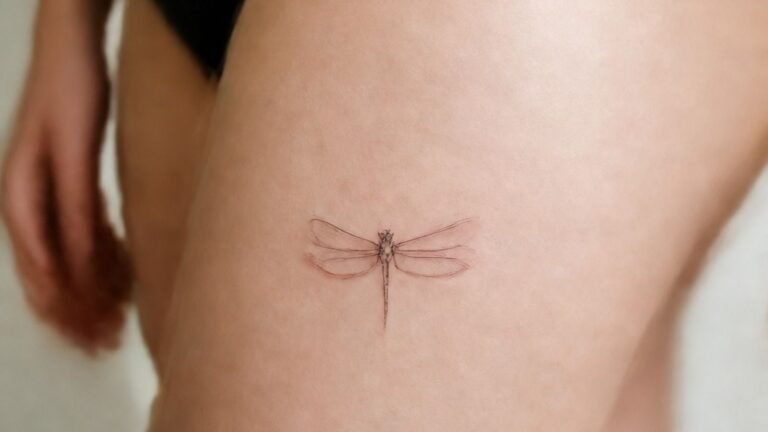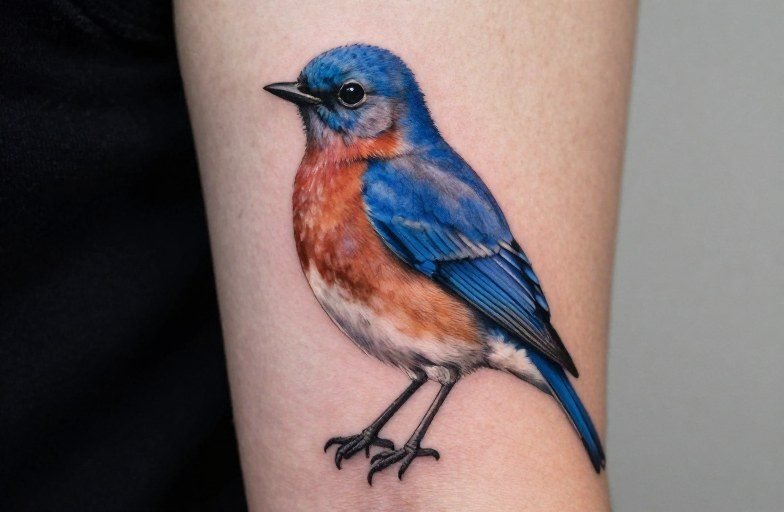
A traditional bluebird tattoo is a specific, codified design within American traditional tattooing: a small to medium-sized bird rendered in bright cobalt or navy, with a red or orange chest, black outlines, and minimal background. The style demands bold, readable shapes that hold up for decades, not delicate feather detail. These pieces function as standalone flash, filler between larger work, or matched pairs on the chest, hands, or sides of the neck.
Key Characteristics & Motifs
Color Palette & Symbolic Colors
The blue isn’t optional. True traditional bluebirds use a saturated, almost electric blue for the back and wings, Sailor Jerry-era flash often pushed toward cobalt, while later Midwest and East Coast trad leans navy. The chest is typically red or warm orange, creating immediate contrast against the cool body tone. Beaks and feet are yellow or pale orange. Black outlines frame every color field; without them, the piece blurs inside five years. White highlights go on last, usually as small dots or thin lines on the head and wing edges, never as large unoutlined areas.
Body Structure & Pose
Traditional bluebirds appear in three main poses: profile facing left or right (most common), three-quarter view with one wing lifted, and straight-on with spread wings (rarer, harder to execute cleanly). The body is a rounded, almost football-shaped mass, not anatomically accurate. Wings are simplified into layered curves or scalloped shapes. The tail feathers fan in three to five distinct points. Eyes are simple black dots or small circles with a white highlight, never realistic, never shaded gradients.
Linework & Technique
Line Weight & Application
Traditional bluebird tattoos rely on bold, consistent linework, typically 7- to 14-round liner needles for outlines, with some artists switching to a 5-round for finer internal details like beak separation or feather division. The outline must be fully saturated black, no graywash, no sketchy single-pass lines. A proper trad bluebird has lines you can read from across a room. Inside the outline, color gets packed with magnum shaders or curved mags, laying in solid fields with minimal overlap streaks. The goal is flat, even saturation; subtle shading happens at the edges of color blocks, not as soft gradients.
Skin Behavior & Technical Reality
Blue pigment behaves specifically in skin. Cobalt-based blues can spread slightly more than black or red over decades, making tight outline control essential. On oily skin or areas with frequent movement (hands, ribs), blue can fade to a greenish cast as yellow undertones in skin mix with the cool pigment. Experienced trad artists compensate by packing blue slightly heavier at the edges and keeping the design compact, loose, airy bluebird designs blur faster than dense ones.
Origins & History
Naval & Maritime Connections
The traditional bluebird is often linked to sailor tattooing, though the connection is looser than swallows or anchors. Some trace it to early 20th-century British and American naval flash, where any small, bright bird stood for distance traveled or safe return. The specific bluebird (as opposed to the more common swallow) may have gained traction through Midwestern American flash sheets in the 1930s-40s, where artists simplified complex designs for speed and readability. Unlike swallows, which carried specific nautical mileage claims, bluebirds functioned more as general good-luck emblems.
Evolution Through Flash Culture
By the 1950s and 60s, the bluebird appeared in standard flash sets from artists like Bert Grimm, Sailor Jerry, and regional Midwestern painters whose names are lost. The design compressed well to small sizes, making it profitable shop filler. Its persistence into modern traditional tattooing owes partly to this practicality: it teaches color packing, line consistency, and small-scale composition without the complexity of a full ship or pin-up. Contemporary artists like Valerie Vargas, Stewart Robson, and numerous Japanese trad-influenced painters have kept the motif current, sometimes adding subtle ornamental elements while maintaining the core structure.
Modern Variations
Neo-Traditional & Decorative Shifts
Neo-traditional bluebirds stretch the color range, teal bodies, magenta chests, gold beaks, while keeping the simplified silhouette. Artists may add decorative elements: banners with lettering, small flowers or leaves, or ornamental frames. These work best when the added elements don’t compete with the bird’s readability. A common mistake is over-detailing the wings with realistic feather texture; this breaks the graphic punch that makes traditional tattooing durable. Good neo-trad variation keeps the body simple and puts complexity in the surrounding ornament.
Placement & Scale Adjustments
Modern collectors request bluebirds in sizes and placements traditional flash rarely served: behind the ear, on fingers, as throat patches, or clustered in multi-bird compositions. At under two inches, the design loses its color impact and becomes a blue smear within years. The practical minimum for a readable traditional bluebird is roughly 2.5 inches in the longest dimension. On hands and fingers, where ink drops out faster, some artists offer a “bold traditional” version with thicker lines, heavier black, and reduced color fields, essentially a bluebird reduced to its most structurally essential elements.
Cost & Sessions
Time & Pricing Factors
A straightforward traditional bluebird takes 45 minutes to 1.5 hours of tattooing time, depending on size, artist speed, and whether it’s part of a larger session. Single-piece pricing in established shops typically runs $150-$400, with coastal cities and well-known trad specialists at the higher end. The small scale doesn’t mean cheap work; a clean, properly saturated bluebird requires precise technical control that newer artists often underestimate. Paying for an experienced hand matters more at this scale than on a large back piece where small flaws disappear in the composition.
Matching Pairs & Custom Flash
Matched bluebird pairs, chest pieces, hand tattoos, or symmetrical placements, demand additional design time to ensure mirror-image balance. Some artists charge a design fee for custom-painted flash even on small pieces; others roll it into the session rate. If you’re requesting a specific vintage flash reference, bring a clear image. Reputable artists won’t copy another tattooer’s custom piece, but most will interpret classic flash sheets or create original work in the same lineage.
Aftercare Notes
Healing Specifics for Color-Heavy Small Pieces
Traditional bluebirds pack dense color into small areas, which creates more plasma and ink weeping during the first 24-48 hours than sparse blackwork. Keep the initial bandage on for the time your artist specifies, usually 2-6 hours, sometimes overnight with specific medical-grade bandages. Wash gently with unscented soap, pat dry, and apply a thin layer of recommended aftercare product. The blue and red areas will scab more noticeably than black linework; resist picking, as blue pigment lifts easily from healing skin and leaves patchy spots that require touch-ups.
Long-Term Color Behavior
After healing, bluebird tattoos need sun protection. Blue pigment is particularly vulnerable to UV breakdown; unprotected bluebirds fade to gray-green or wash out entirely within a few years of regular sun exposure. A healed piece with solid saturation should read clearly from ten feet away. If the blue starts looking “dusty” or the red chest muddies into the surrounding skin, that’s typically sun damage or initial under-packing, not normal aging. Touch-ups on small trad pieces are common at 5-10 years, especially on high-movement areas.
The Bottom Line
A traditional bluebird tattoo succeeds or fails on technical fundamentals: clean black outlines, saturated flat color, readable silhouette, and appropriate scale for its placement. It’s not a design that rewards subtlety or personal embellishment at the expense of structure. The best examples look like they could have come off a 1950s flash sheet even if they were tattooed last week. Choose an artist whose portfolio shows solid, healed traditional work in similar size ranges, not just large-scale pieces where small technical flaws hide. Ask to see healed photos specifically, the bright fresh photos on social media don’t show how that blue will settle in your skin five years out.
Frequently Asked Questions
What’s the difference between a traditional bluebird and a traditional swallow tattoo?
Swallows have forked tails, pointed wings, and specific nautical mileage symbolism. Bluebirds have rounded bodies, fan-shaped tails, and simpler wing shapes. The color palette differs too, swallows are typically blue with red chests but more angular and detailed, while bluebirds are more compact and graphic.
Do traditional bluebird tattoos work on dark skin tones?
Yes, but the approach changes. Artists may use deeper navy instead of bright cobalt, ensure black outlines are heavier, and place the design where skin is lighter (inner forearm, chest). The red chest may shift to a deeper orange-red for visibility. Consult an artist experienced with your specific skin tone.
How small can a traditional bluebird be before it won’t age well?
Below 2.5 inches in the longest dimension, the color fields become too narrow to hold saturation, and the outline blurs into a indistinct blob. On fingers and hands, where ink fades faster, even 2.5 inches may need aggressive touch-ups. For longevity, 3+ inches is safer.
Can I add a banner or lettering to a traditional bluebird design?
Banners are historically appropriate but require careful integration. The banner should wrap around or sit below the bird without obscuring the body shape. Lettering must be large enough to remain readable, small script inside thin banners becomes illegible within years. Discuss placement with your artist during the design phase.
Related Style Guides
- Traditional Lucky Tattoos: Style Guide
- Traditional Shellback Tattoos: A Complete Style Guide
- Traditional Tattoo Backgrounds: Style Guide
- Explore more