Traditional lucky tattoos are a distinct branch of American traditional tattooing focused on symbols historically believed to bring fortune, protection, or favorable outcomes. Think horseshoes, four-leaf clovers, dice showing seven, ladybugs, wishbones, and the number 13 inside a clover. These designs follow the same visual rules as all classic American traditional work: bold black outlines, limited color palettes of red, green, yellow, and black, and imagery that reads clearly from across a room. The difference is the subject matter, every element carries a specific association with luck, gambling, or warding off misfortune.
Origins & History
The connection between tattooing and luck runs deep in maritime culture. Sailors getting inked before voyages sought protection and favorable winds. Many of the symbols we now consider “lucky” entered the tattoo lexicon through this seafaring tradition, filtered through the electric tattoo machines that emerged in the late 19th and early 20th centuries.
From Sailor Lore to Shop Flash
Horseshoes hung with the ends pointing up to “hold the luck in” became a staple of early flash sheets. Four-leaf clovers, already rare in nature, translated naturally to the bold simplicity required by early tattoo pigments and needles. The imagery spread through traveling tattooers who copied and adapted each other’s designs, creating a visual shorthand that crossed regional boundaries without needing explanation.
The number 13 deserves special mention. Friday the 13th flash events, where shops offer $13 or $31 tattoos of the number, emerged as a deliberate reclaiming of supposedly unlucky symbolism. This tradition, now widespread, turns superstition on its head and has become one of the most reliable ways to spot a traditional shop’s commitment to the craft.
Regional Variations
- West Coast: Often incorporated gambling imagery, cards, dice, poker chips, reflecting the influence of port cities and later Las Vegas proximity
- East Coast: Leaned harder into maritime protection symbols: swallows for safe return, pigs and roosters for survival at sea
- Southern shops: Frequently blended luck imagery with religious symbols, creating layered meaning without breaking traditional visual rules
Modern Variations
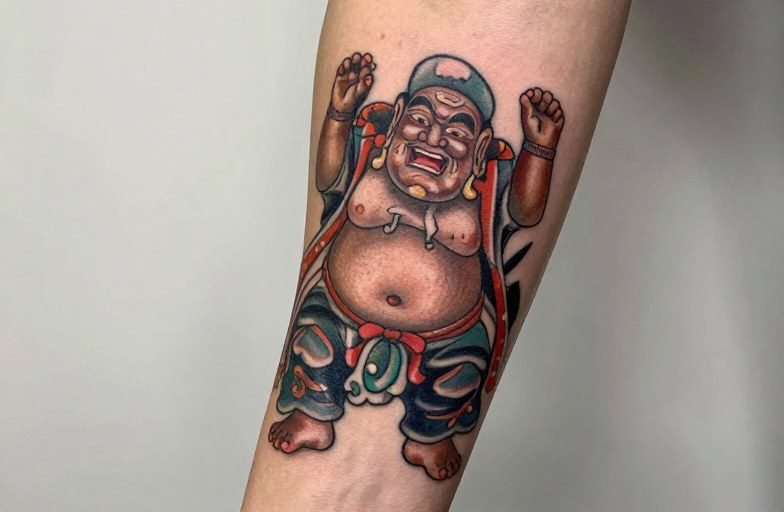
Contemporary tattooers have expanded the lucky motif while respecting the constraints that make traditional work readable. Neo-traditional approaches keep the bold outlines but introduce more complex color gradients and softer shading. Some artists incorporate Japanese elements, maneki-neko cats, daruma dolls, into traditional frameworks, creating hybrid pieces that honor multiple lineages.
Placement Trends
Small lucky pieces thrive on hands, fingers, and behind ears, though these placements present specific challenges. Finger skin is dense with collagen and sheds rapidly; even the boldest lines soften within a few years. The “lucky 13” on the side of a hand or between thumb and index finger remains popular but requires touch-ups. For longevity, forearms, calves, and upper arms offer more stable canvas. The flat planes of the outer forearm let a horseshoe or clover sit cleanly without the distortion that comes with curving muscle.
Color Evolution
Modern pigments offer more saturation than the iron oxide and carbon-based inks of the 1940s, but the traditional palette persists for a reason. Bright green clover leaves and saturated red ladybug shells age predictably. Trendy pastels or neons in lucky pieces tend to look dated fast and fade unevenly. The classic limited palette isn’t just nostalgia, it’s practical knowledge about how color behaves in skin over decades.
Aftercare Notes
Lucky tattoos follow the same healing trajectory as any bold traditional piece, but their common placement on high-movement areas deserves attention. Hand and finger tattoos are notorious for patchy healing because the skin is constantly flexing, contacting surfaces, and shedding faster than most body areas.
First Two Weeks
- Keep the area clean with fragrance-free soap; pat dry, never rub
- Thin layers of recommended aftercare product, over-greasing suffocates the wound
- Avoid submerging in water; showers are fine, baths and pools are not
- For hand placements, accept that some ink loss is likely; plan for a touch-up
Long-Term Aging
Traditional lucky tattoos age better than most styles because of their structural advantages. Thick black outlines create a “wall” that slows color bleeding. High contrast between black and limited bright colors maintains readability even as pigments shift. A green clover with a black outline will still read as a clover at twenty years; a photorealistic lucky piece with subtle gradients will likely become muddy. The simplicity that defines the style is also what preserves it.
Linework & Technique
The technical demands of traditional lucky tattoos are specific. Outlines must be consistent in weight, typically 7 to 14 round liner needles depending on scale, with no wavering that would break the visual confidence of the piece. A shaky line on a horseshoe reads immediately as amateur; the symbol itself is simple enough that technical flaws have nowhere to hide.
Needle Selection
Bold outlines demand sufficient saturation without overworking the skin. Experienced traditional tattooers often run liners slightly faster than for finer work, letting the needle do the work rather than forcing pigment. Color packing for solid green clovers or red ladybug shells uses larger magnum groupings, applied with a consistent circular motion to avoid streaking. The goal is flat, even color fields that look almost printed.
Skin Considerations
Darker skin tones require adjusted approaches to the traditional palette. Pure black outlines remain essential, but some artists shift greens toward teal for visibility and use deeper reds rather than bright scarlet. The core principle, high contrast, readable from distance, stays constant. What changes is the specific hue values that achieve that contrast against different melanin levels.
Key Characteristics & Motifs
Recognizing authentic traditional lucky work means knowing the visual vocabulary. These aren’t arbitrary choices; each element carries decades of accumulated meaning and technical refinement.
- Horseshoe: Usually shown open-end up, sometimes with nails or dots indicating fastening; simple, no extraneous detail
- Four-leaf clover: Three rounded leaves plus a smaller fourth; stem present but not dominant; often paired with a banner for names or dates
- Dice: Typically show seven (4+3) or eleven (5+6); white with black pips, or red with white pips; always in motion, never flat
- Ladybug: Red shell, black spots, simple head; sometimes with a leaf or vine; small scale, often filler or accent
- Wishbone: Two arms intact, not broken; sometimes held by a hand or bird; clean, symmetrical
- Number 13: Inside a clover, on a banner, or standalone; often with “lucky” preceding it; bold, blocky numerals
The banner is worth noting as a structural element. “Good Luck,” “Lucky You,” or personalized text on a flowing ribbon connects the symbol to the wearer without breaking the traditional visual language. Banners curve with the body part, follow the muscle flow, and provide negative space that lets the eye rest.
Common Mistakes to Avoid
Both clients and newer tattooers make predictable errors with lucky traditional pieces. Recognizing them beforehand saves rework and disappointment.
Design-Level Errors
- Overcomplicating the image: adding too many leaves, too many spots, too much shading; traditional work dies with excess detail
- Ignoring the “read” at distance: a clover that looks good at six inches but disappears at six feet has failed the primary test
- Misplacing the horseshoe: open-end down means luck running out, a detail most traditional clients know and will notice
- Mixing too many symbols: a horseshoe, clover, dice, and ladybug in one small piece becomes visual noise, not abundance
Technical Errors
Light, hesitant outlines that will blow out or fade unevenly. Color packed too deep, causing scarring and muddy healing. Insufficient black to separate color fields, leading to blending over time. On fingers specifically, going too large, designs that wrap to the sides or palm, guarantees rapid degradation because that skin turns over constantly.
Another frequent mistake: choosing a lucky tattoo for its “safe” symbolism without considering whether you actually respond to the image. The traditional style is bold, graphic, and permanent. If you don’t like how a horseshoe looks on a t-shirt, you won’t like it on your forearm in twenty years. The luck association only carries weight if the visual itself resonates.
Final Word
Traditional lucky tattoos work because they respect constraints. Limited colors, bold outlines, iconic imagery, and specific placement wisdom accumulated over generations. The symbols themselves, horseshoes, clovers, dice, the defiant 13, carry cultural weight without requiring explanation. What matters is execution: clean lines that hold, color that stays readable, and designs that function at the scale and location chosen. Get those right, and you’ve got something that looks as good at the shop door as it will decades later.
Frequently Asked Questions
Do traditional lucky tattoos actually bring good fortune?
The luck is symbolic and personal. The tattoos draw on cultural associations with protection and favorable outcomes, but there’s no mechanism by which ink in skin changes probability. People get them as reminders, talismans, or simply because they love the imagery.
Why is the number 13 considered lucky in traditional tattooing?
It’s a deliberate inversion of unlucky superstition. Friday the 13th flash events popularized the design, and tattoo culture embraced the contradiction. Getting 13 tattooed became an act of defiance against bad luck itself.
How much do hand and finger lucky tattoos fade compared to arm placement?
Significantly more. Finger skin regenerates faster and contacts more surfaces. Even perfectly applied traditional work on fingers typically needs touch-ups within 2-5 years, while the same design on a forearm might hold for decades.
Can a traditional lucky tattoo be covered up if I change my mind?
Bold black outlines and saturated colors make traditional work challenging to cover. The density of ink limits options. Laser removal is possible but requires more sessions than lighter styles. Think of traditional as especially permanent.
Related Style Guides
- Traditional Shellback Tattoos: A Complete Style Guide
- Traditional Tattoo Backgrounds: Style Guide
- Traditional Tattoo Wallpaper: Style Guide
- Explore more