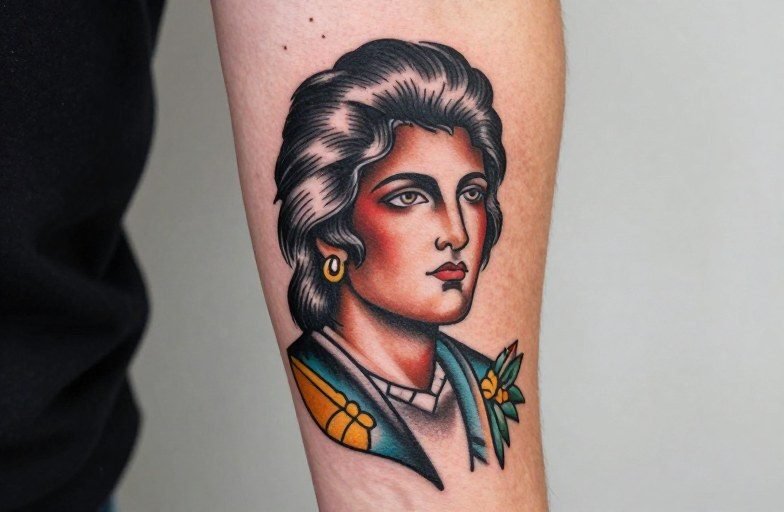
American traditional portrait tattooing takes the bold, graphic language of classic Americana, thick black outlines, saturated reds, yellows, and greens, minimal shading, and applies it to human faces. Think military memorials, pin-up girls, outlaw icons, or loved ones rendered with the same visual punch as a sailor’s swallow. The style demands simplification: skin tones become flat planes of peach or tan, shadows drop to near-black, and every feature must read instantly from across a room. It is not realism. It is recognition.
Choosing the Right Artist
Few tattooers handle both traditional fundamentals and likeness work well. The two skill sets pull in different directions, one toward abstraction, the other toward specificity. You need someone who has spent years building solid traditional tattoos and has developed a specific approach to faces within that framework.
What to Look For in a Portfolio
- Consistent, confident line weight throughout healed work, not just fresh photos
- Portraits that simplify rather than render, flat color blocks, minimal gradation
- Evidence of healed pieces: traditional ink spreads slightly, and a good artist plans for that
- Faces that remain recognizable without relying on graywash or photorealistic detail
- Backgrounds and secondary elements (roses, banners, daggers) integrated with the face, not floating beside it
Red Flags
Be cautious of portfolios heavy on realism that suddenly include one or two “traditional style” portraits. The learning curve is steep. Similarly, artists who primarily do bold traditional but have never tattooed a face may struggle with proportion and likeness. Ask directly: how many traditional portraits have they healed? Do they have photos at six months, not just fresh?
Linework & Technique
The line work in American traditional portraits carries more weight than in most other styles. Outlines are typically 7-11RL or 14RL, sometimes doubled for emphasis around the jaw, hairline, or brow. These lines do not describe subtle contour; they construct shape. A nose becomes a series of bold strokes, not soft modeling. The eye is a black circle with a white highlight, not a detailed iris.
Color Packing vs. Realism Approaches
Traditional color packing uses a “fill and seal” method: saturated color laid in with tight circular motions, then locked in with a surrounding outline. Skin tones are pre-mixed or limited to 2-3 values. There is no airbrushed transition. A cheek might be one flat peach, a shadow under the jaw a single dark brown or muted purple. This limitation is the style’s strength, it forces the artist to choose what matters.
Black and Gray Traditional Portraits
Some artists work strictly in black, using whip shading and sparse dotwork to suggest form. This sub-style ages exceptionally well on larger pieces but risks muddying if the contrast between black and skin tone is not aggressive enough. The best black and gray traditional portraits use large areas of negative space, letting untattooed skin read as light, to maintain that graphic punch.
Best Placements
Traditional portraits need room for the bold elements to breathe. The style’s graphic nature means small sizes often collapse into indistinguishable blobs as the ink settles and spreads over years.
Where It Works
- Upper arm/outer bicep: classic canvas, easy to build into a larger traditional sleeve
- Thigh front or side: ample flat space for faces with banners or floral frames
- Chest, centered or offset: traditional placement for memorial or partner portraits
- Outer calf: good for vertical compositions, holds detail well over time
- Upper back, between shoulder blades: space for larger faces with surrounding flash elements
Where It Struggles
Hands, feet, and fingers are poor choices. The skin is thin, sheds rapidly, and the small size forces detail that the style cannot support. Inner bicep and ribs are workable but challenging, thin skin and movement distort the bold lines that need stability. Neck and face placements are technically possible but require an artist with specific experience in those areas; the skin behaves differently, and the visibility demands flawless execution.
Modern Variations
Contemporary artists have stretched the traditional portrait in several directions without abandoning its core constraints. These variations are not separate styles but evolutionary branches.
Neo-Traditional Portraits
Neo-traditional allows more color range, softer edges, and occasional illustrative detail while keeping the bold outline and graphic composition. Faces in this style might include ornamental frames, unnatural color accents (teal shadows, magenta highlights), or more elaborate backgrounds. The likeness remains simplified but gains decorative complexity. This is the most common modern approach for clients wanting a traditional feel with more personalization.
Japanese-Traditional Fusion
Some artists incorporate Japanese compositional elements, wind bars, waves, or background patterns, around a traditional American face. The face itself stays bold and flat, but the surrounding space gains movement and density. This hybrid works best when the artist understands both systems thoroughly; otherwise the elements fight rather than complement.
Reclaimed and Reworked Vintage
Covering or refreshing old traditional portraits has become its own specialty. Faded 1980s military portraits, blurry pin-ups from the 1990s, artists now rebuild these with modern pigment and refined techniques while honoring the original intent. The challenge is working within existing lines and scar tissue, often requiring creative adaptation of the face to fit what remains.
Aftercare Notes
Traditional portraits heal like any bold color tattoo, but the flat color blocks create specific considerations. Large saturated areas are more prone to scabbing and patchy healing than fine-line work.
Healing the Flat Color
- Keep the first layer of ointment thin; heavy application suffocates large color fields
- Avoid soaking the tattoo for two weeks, baths, pools, and hot tubs pull pigment from healing skin
- Expect more peeling on solid color blocks than on outline-only areas; this is normal
- Do not pick scabs from flat skin-tone areas; they heal unevenly and require touch-ups
- Sleep with the tattoo exposed to air when possible, or use clean, loose cotton that will not stick
Long-Term Color Behavior
Traditional yellows and light skin tones are the first to fade or shift, often becoming slightly greenish or muddy as white blood cells break down the pigment over years. Reds and dark greens hold longer. A well-executed traditional portrait will remain readable for decades, but the “pop” of fresh color softens. This is accepted in the style; the bold structure carries the piece, not the brightness.
Who It Suits
This style appeals to specific sensibilities and practical situations. It is not universally flattering, nor should it be.
The Right Fit
Someone drawn to tattoo history and visual clarity over photographic accuracy. People who want a memorial that reads instantly, not one that requires close inspection. Collectors building traditional sleeves where the portrait must dialogue with surrounding flash. Those who understand that simplification is a choice, not a limitation.
The Wrong Fit
Anyone seeking an exact replica of a photograph. The style cannot and will not achieve that. People wanting subtle, intimate, or delicate imagery. Traditional portraits shout; they do not whisper. Clients with very dark skin tones should discuss modified approaches with their artist, flat “skin tone” colors may not be necessary or effective, and the style adapts better to high-contrast black and gray in those cases.
The Takeaway
American traditional portrait tattooing is a discipline of restraint. The artist must know what to remove from a face, not what to add. The result is a likeness that functions as an icon, readable, durable, and rooted in a visual language that has survived a century of tattooing. Choose an artist with healed work you can examine. Commit to the boldness. Let the lines do their job.
Frequently Asked Questions
How big does a traditional portrait need to be to hold up?
Most traditional portraits need at least palm-sized area for the face alone, with additional space for surrounding elements. Smaller than that, the bold lines merge and features become indistinct within a few years.
Can a traditional portrait be done of any person, or only certain types of faces?
Any face can be adapted, but the style favors strong bone structure and distinct features. Soft, rounded faces require more creative interpretation to maintain the graphic impact without losing likeness.
How do traditional portraits age compared to black and gray realism?
Traditional portraits typically age better because the bold outlines maintain structure even as color fades. Realism portraits often blur and lose definition faster since they rely on fine detail and subtle gradation.
Is it disrespectful to get a traditional portrait of a living person?
Not inherently, though the style’s roots in memorial and military tattooing give it a solemn association. Discuss the context with your artist; some incorporate celebratory elements like banners with names or birth dates to shift the tone.
Related Style Guides
- American Traditional Rat Tattoos: Style Guide
- American Traditional Tattoo Inspo: Style Guide
- American Traditional Letter Tattoos: Bold Script Guide
- Explore more