
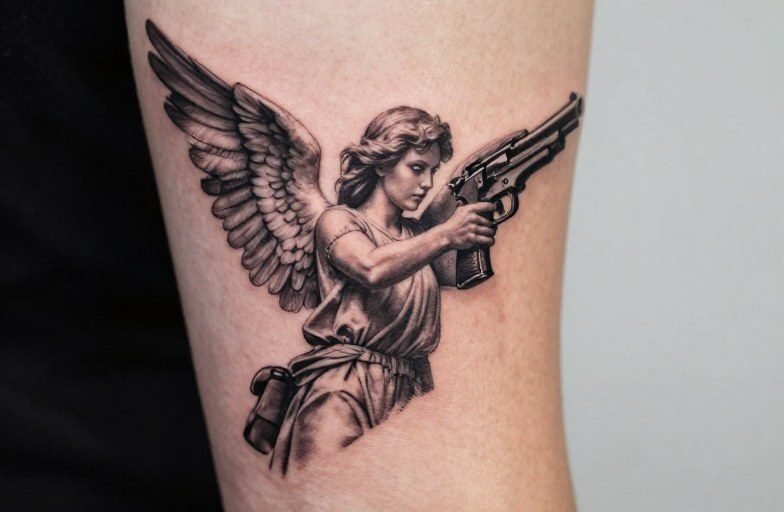
An angel with a gun tattoo typically represents the tension between divine goodness and necessary violence, protection that crosses into aggression, or righteousness that demands action. The image fuses a figure traditionally associated with mercy, guidance, and the afterlife with a weapon built for killing, creating an immediate visual paradox that resonates with anyone who has faced situations where doing the right thing required hardness. Meanings cluster around guardian defense (protecting others at any cost), moral conflict (the struggle between peace and justified force), and personal transformation (fallen or warrior angels who have seen too much).
Best Placements
Where this design sits on the body changes how it reads to others and how it functions for you.
High-Visibility vs. Concealed Spots
Forearms and calves make the imagery confrontational. People see it during handshakes, at counters, across tables. The gun becomes impossible to ignore, and the angel’s expression, serene, grim, or blank, sets the tone before you speak. These placements suit people who want the tattoo to start conversations or warn off threats.
Thighs, ribs, and upper back keep the design personal. You control who sees it. The rib cage in particular warps the angel’s wings during breathing, creating subtle motion that some find fitting for a design about internal conflict. Thighs offer the largest uninterrupted canvas for detailed wings and full weapon rendering without the distortion that comes with joints.
Scale and Flow Considerations
- Small (under 4 inches): Gun details muddy quickly; focus on silhouette and wing shape instead of trigger guards or magazine wells.
- Medium (4-8 inches): Sweet spot for most designs. Enough room for facial expression, feather texture, and recognizable firearm type.
- Large (8+ inches): Back pieces or full sleeves allow narrative elements, smoke, spent casings, broken chains, specific landscapes behind the figure.
Shoulder caps and chest plates follow the body’s natural musculature. Wings spread across collarbones read as protection of the heart. A gun pointed downward over the sternum carries different weight than one raised toward the throat.
Common Variations & Styles
The specific visual choices dramatically shift what the tattoo communicates.
Traditional and Neo-Traditional Approaches
American traditional renders the angel with bold black outlines, limited color palette (red roses, blue robes, yellow halos), and a stocky, almost sailor-like figure holding a revolver or Tommy gun. The style’s historical association with military service and working-class rebellion reinforces themes of righteous violence. Skin ages these well, the heavy lines hold for decades.
Neo-traditional allows more emotional nuance: tear-streaked faces, ornate Victorian firearms, wings with individual feather shading. The color saturation runs higher, and the compositions get more dynamic. These pieces demand touch-ups sooner as the fine color packing fades and softens.
Black and Grey Realism
Photographic rendering dominates this category. The angel might look like a specific person, deceased loved one, patron saint, the wearer themselves. Realistic gun details require reference photos; artists need to understand magazine release buttons, slide serrations, safety selectors. Shading creates metal reflection and wing translucency.
Common firearm choices carry subtle coding:
- Revolver: Old West justice, finality, limited shots meaning every one counts.
- 1911 pistol: Military service, American identity, 20th-century warfare.
- AR-platform rifle: Contemporary conflict, institutional violence, mass culture.
- Sawed-off shotgun: Desperation, close-quarters survival, criminal undertones.
Some designs swap the gun for a sword or bow, returning to classical angelic warfare imagery while keeping the modern aggressive stance.
How It Ages on Skin
All tattoos blur and fade. This design has specific vulnerabilities.
Line Weight and Detail Loss
Thin lines defining gun mechanisms disappear first. Trigger guards become blobs. Serial number engravings vanish entirely. Wing feathers that started distinct merge into grey masses. Artists compensate by building contrast, deep black shadows in the gun’s grip and barrel interior, negative space highlights on the angel’s face.
White ink highlights (on halos, eyes, gun glints) yellow or disappear within five to ten years depending on sun exposure and skin type. They rarely justify the extra pain and cost for longevity.
Placement-Specific Fading
Hands and fingers shed ink fastest here. The design becomes illegible. Inner biceps and thighs preserve detail longest due to minimal sun and friction. Stomach and side pieces distort with weight fluctuation, angels with six-pack abs look strange on changed bodies.
Touch-up strategy matters. Re-lining the gun’s hard edges every few years maintains readability. Letting the angel’s face soften while sharpening the weapon creates unintended emphasis over time.
Personal & Modern Meanings
Contemporary wearers layer individual significance onto the core duality.
Trauma and Survival Narratives
For some, the tattoo marks a moment when innocence ended and self-protection began. The angel represents who they were; the gun, who they had to become. This isn’t glorification, it’s documentation. The expression on the angel’s face often carries sadness or resignation rather than triumph.
Professional Identity Markers
Military veterans, law enforcement, and security professionals sometimes choose this imagery to reconcile their service with their beliefs. The angel justifies the gun; the gun complicates the angel. Neither element exists comfortably without the other, mirroring the psychological reality of jobs that require harming others while maintaining moral self-regard.
Street-level interpretations differ. In some communities, the design signals willingness to do violence while claiming spiritual protection or destiny. Context, surrounding imagery, placement, the wearer’s demeanor, determines which reading dominates.
Similar & Related Symbols
Understanding adjacent imagery clarifies what the angel-with-gun specifically adds.
- Angel with sword: Classical warfare, divine judgment, Michael and Gabriel’s traditional armament. Less personal conflict, more cosmic battle.
- Fallen angel with broken chains: Liberation through rebellion, no weapon needed. The gun adds active threat rather than passive defiance.
- Saint with rifle (Santería/Catholic folk): Often linked to syncretic traditions where spirits receive modern offerings. The angel specifically maintains Christian or Abrahamic framing.
- Grim reaper with gun: Death as active killer rather than passive collector. The angel preserves hope or moral justification that the reaper abandons.
- Cherub with weapon: Irony, absurdity, or corrupted innocence. The full adult angel carries weight and seriousness that baby-faced Cupid variants mock.
Pairing the angel with specific objects modifies meaning: rosary beads in the off-hand suggest prayer and violence intertwined; scales or broken scales indicate corrupted justice; a clock or hourglass adds mortality pressure.
Religious & Spiritual Angles
The design sits uncomfortably within most formal religious traditions, which creates part of its power.
Abrahamic Textual Sources
Angels in Hebrew Bible and Quranic texts function as messengers, warriors, and destroyers. The angel of death, angels battling Satan’s forces, angels annihilating Sodom, these precede the Victorian softening into winged babies. Some trace warrior angel imagery to Michael’s military role, though firearms obviously postdate scriptural description by millennia.
Christian iconography sometimes depicts angels with swords, spears, or flaming weapons. The gun represents technological continuation of this function, modern method, ancient mandate. Whether this constitutes legitimate evolution or sacrilegious corruption depends on the viewer’s theology.
Secular and Spiritual-But-Not-Religious Use
Many wearers abandon specific religious reference entirely. The angel becomes a generalized symbol of higher purpose or better nature; the gun, the necessary compromise with reality. This usage risks aesthetic incoherence, the power of the image depends on the genuine tension between sacred and profane, not merely combining cool elements.
Some modern practitioners of chaos magick or syncretic spirituality adopt the image as a personal sigil: the angel as higher self, the gun as will directed outward, the combination as integrated power.
The Bottom Line
An angel with a gun tattoo works when the contradiction feels lived rather than performed. The design fails when it reads as edgelord posturing or thoughtless combination of popular motifs. Successful pieces commit to one emotional register: mournful guardian, vengeful protector, corrupted saint, or reluctant warrior. The gun’s specific type, the angel’s expression, the placement, and the style all need to align with that chosen tone.
Before committing, consider which element you would sacrifice if the tattoo had to simplify. If the gun must remain recognizable, prioritize bold black work and larger scale. If the angel’s face carries the meaning, protect it from sun and plan for periodic refresh. The image will outlast whatever immediate impulse produced it, make sure the contradiction it embodies is one you can carry for decades.
Frequently Asked Questions
Does an angel with a gun tattoo have to mean I’m religious?
No. Many wearers use the angel as a general symbol of conscience or higher purpose rather than specific faith. The power comes from the tension between sacred and violent imagery, not doctrinal alignment. Non-religious interpretations focus on moral conflict and personal transformation.
What style lasts longest for this detailed design?
Bold traditional or neo-traditional with heavy black outlines preserve readability for decades. Fine-line realism and delicate shading blur fastest, especially on gun details and feather textures. Prioritize contrast over subtlety if longevity matters.
Will people assume I’m violent or criminal if I get this tattoo?
Some will, depending on placement, your demeanor, and their background. Visible forearm or hand placement invites more assumptions than concealed thigh or back work. The specific firearm choice also codes differently, revolvers read more romantic or historical than modern tactical rifles.
Can the angel be a specific person instead of a generic figure?
Yes, portrait-based designs are common, especially memorializing deceased loved ones who were protective figures. This intensifies the personal meaning but requires a skilled realism artist. The face must read clearly as that specific person, or the tattoo becomes an unrecognizable generic angel.
Related Tattoo Meanings
- Con Safos Tattoo Meaning: Origins, Symbolism Style
- Dreaming Tattoo Meaning: Symbolism, Design Cultural Roots
- Goose Tattoo Meaning: Loyalty, Migration Guardianship
- Explore more









