
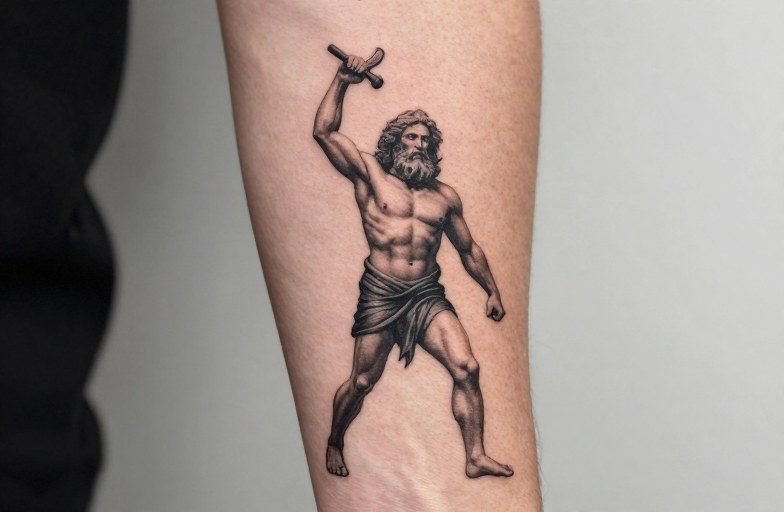
The Sisyphus tattoo means refusing to surrender to futility. It marks the choice to keep pushing despite knowing the boulder rolls back down, finding purpose not in victory but in the act itself. Most people who wear it aren’t celebrating suffering; they’re reclaiming agency inside it.
Symbolism & Core Meaning
Camus made Sisyphus famous as the absurd hero, but the image works deeper than philosophy homework. The boulder, the slope, the bowed shoulders, these read instantly even to someone who’s never opened The Myth of Sisyphus. The tattoo functions as a private acknowledgment that your work may never “finish,” yet you return to it anyway.
Some wearers focus on the punishment aspect: depression, chronic illness, addiction recovery, dead-end jobs survived one shift at a time. Others flip it toward the defiance Camus actually emphasized, Sisyphus is happy because the struggle itself is enough. The tattoo lives in that tension between burden and will.
The Moment of Pause
The most powerful versions capture the walk back down. Not straining at the boulder, but the descent between attempts, shoulders loosened, eyes on the valley, collecting himself before the next push. That interval contains the actual meaning. Anyone can render exertion; the tattoo’s weight sits in the choice to turn around and climb again.
What the Boulder Actually Represents
Skin makes this flexible. The boulder can read as grief, creative block, debt, caretaking, or simply Monday morning. Unlike more prescriptive symbols, Sisyphus invites projection without collapsing into vagueness. The figure’s specificity, naked, muscular, classical, grounds whatever load the viewer brings.
Best Placements
Where this goes changes how it reads. The ribcage, hidden and breathing, suits someone carrying something they don’t discuss openly. The forearm, visible during work, functions almost as accountability, others see the struggle, not just the person. The calf or thigh handles larger compositions well, giving space for the full slope and sky.
- Upper back/shoulder blade: Natural fit for the pushing posture; the body’s own architecture mirrors the pose. Heals relatively easily, though the blade area moves constantly during recovery.
- Forearm (inner or outer): Daily visibility. Outer reads more public, inner more intimate. Line-heavy versions age cleaner here than heavy black fill.
- Ribcage: Painful, slow to heal, but the concealment matters to people who want this meaning without explanation. The curve of ribs can echo the hill’s slope.
- Thigh: Accommodates landscape, distant peaks, falling light, the boulder mid-roll. Less sun exposure means slower fading.
Small single-needle pieces work on wrists or behind ears, but the image loses narrative weight below two inches. The boulder becomes a dot; the figure, a stick. If you want minimal, consider just the boulder and slope, abstracted, rather than a micro-figurative attempt.
Common Variations & Styles
Line work dominates. Fine lines capture the classical form with elegance; heavier traditional or neo-traditional builds weight into the muscles and stone. Black and grey realism can render sweat, dust, the particular exhaustion of the face, but requires a specialist, bad realism here looks like a smudged textbook illustration.
Stylistic Approaches That Work
- Engraving/etching style: Crosshatching references the myth’s ancient origins without defaulting to generic Greek vase aesthetics.
- Contemporary minimalism: Single continuous line forming both figure and boulder. Demands perfect execution; one waver ruins the conceit.
- Trash polka or mixed media: Splattered red or text fragments (Camus quotes, coordinates, dates) layered over the figure. High risk of visual noise; best when the text actually matters to the wearer.
- Negative space compositions: The boulder as un-inked skin, the figure pushing darkness uphill. Striking when healed, tricky to balance during design.
What Typically Fails
Overly heroic renderings, Sisyphus as bodybuilder, the boulder tiny and incidental, betray the concept. The image needs vulnerability. Similarly, adding wings, crowns, or other “redemption” symbols usually muddies the point. The tattoo’s power is precisely that there is no rescue.
Mythology & Folklore
Homer’s Odyssey gives the earliest surviving mention: Sisyphus rolls his stone in the underworld, no explanation offered. Later sources, Virgil, later Greek poets, add the backstory: punished for tricking death twice, chaining Thanatos, escaping Hades temporarily. The boulder itself is sometimes said to be a trick that backfired, a stone he believed would buy freedom.
The myth’s endurance likely stems from its structural simplicity. No complex family drama, no monster slaying, just one man, one weight, one hill. That bareness makes it adaptable across cultures. Modern retellings often omit the specific crime entirely, focusing on the image as universal.
Camus and the Modern Frame
Albert Camus’s 1942 essay redefined Sisyphus for the twentieth century, but the tattoo predates that revival. Sailors and soldiers in the early 1900s sometimes wore the image, often linked to endless military drills or shipboard labor. The philosophical overlay arrived later; the visual recognition existed before.
Who Chooses This Tattoo
Patterns emerge without being absolute. People in long-term recovery often gravitate toward the walk-downhill moment. Caregivers, parents of disabled children, adult children of declining parents, sometimes choose the pushing posture, the boulder as duty that won’t resolve. Writers and musicians facing blocked projects wear it as ironic self-awareness or genuine commiseration.
Age tends to skew slightly older than typical first-tattoo demographics. The concept requires enough life to recognize genuine repetition from temporary struggle. Teenagers occasionally request it, usually tied to specific Camus coursework; the commitment level varies.
Gender and Presentation
The classical figure is male, but the tattoo translates across bodies without awkwardness. Some women adapt the figure to female anatomy; others keep the original and let the symbolism override identification. Abstract or partial versions, a pair of hands on stone, just the slope and shadow, remove figuration entirely.
History & Cultural Roots
The image circulated in Western tattooing through the twentieth century as part of a broader classical revival. Greek and Roman figures offered “respectable” subject matter when religious or patriotic imagery dominated. Sisyphus specifically appeared in European flash sets by the 1950s, often linked to sailor or laborer clientele who understood repetitive physical work.
The tattoo’s philosophical associations grew through the 1960s and 70s as existentialism entered broader culture. By the 1990s, it had become common enough in literary circles to risk pretension. The contemporary resurgence seems partly driven by economic precarity, gig work, debt, housing instability, making the myth feel newly literal.
Regional Variations
Japanese tattooing occasionally incorporated the figure into larger Western-themed compositions, though never with native mythological integration. Russian prison tattoos reportedly used the image for sentences perceived as unjust, though documentation remains sparse and often linked to specific rather than widespread usage. In contemporary American and European shops, it appears across all demographics without subcultural gatekeeping.
Final Thoughts
The Sisyphus tattoo endures because it refuses easy resolution. It doesn’t promise triumph, transformation, or peace. It marks the choice to continue without guarantee, which is, for many people, the most honest description of their actual lives.
If you’re considering this, sit with which moment you want: the push, the pause, or the long walk back down. That choice determines placement, style, and whether the tattoo will still speak to you when the specific struggle changes. The boulder rolls back. The question is whether you turn around.
Frequently Asked Questions
Does a Sisyphus tattoo always reference Camus or can it mean something else?
It absolutely doesn’t require Camus. The image predates his essay by millennia and functions on pure visual recognition, endless effort, no reward. Many wearers have never read the essay; they respond to the figure itself.
How well does fine line work hold up for this design?
Fine line Sisyphus tattoos need strategic placement away from sun and friction. The figure’s musculature requires consistent line weight to read; blurring turns anatomy into indistinct grey. Expect touch-ups within 5-7 years for delicate versions.
Can the boulder be replaced with something personal?
Yes, but carefully. A laptop, pill bottle, or child’s face can work but risks becoming dated or literal. The boulder’s abstraction lets it shift meaning over time; specificity fixes it to one moment that may eventually feel distant.
Is this tattoo considered overdone or cliché?
It’s recognizable but not saturated like roses or anchors. The meaning varies enough between wearers that repetition matters less. Cliché arrives in execution, heroic Sisyphus, generic Greek font, rather than concept.
Related Tattoo Meanings
- Greek Mythology Tattoo Meanings: Symbols That Last
- Snake Biting Hand Tattoo Meaning: Symbolism Significance
- Snow Leopard Tattoo Meaning: Solitude, Stealth, and Mountain Strength
- Explore more









