Antler tattoos most commonly symbolize regeneration, natural cycles, and quiet strength. Unlike horns, which animals keep for life, antlers shed and regrow annually, making them a powerful visual metaphor for renewal, resilience, and the ability to start fresh. The meaning shifts depending on species, style, and what the wearer connects to: a stag’s branching rack reads differently than a simple pair of shed antlers or a skull mount.
Symbolism & History
The Shedding Cycle
Antlers are bone, not keratin like horns. They grow fast, get covered in velvet, harden, and drop off completely, only to rebuild from scratch. That biological reality shapes most of their tattoo symbolism. People drawn to this imagery often resonate with themes of letting go, rebuilding, or surviving rough seasons. The cycle isn’t gentle; antlers can bleed during velvet shedding, and the regrowth demands enormous metabolic energy. That rawness appeals to folks who’ve clawed back from something, addiction, grief, bankruptcy, divorce, not just the spiritually inclined.
Across Northern European traditions, the stag and its antlers carry weight. Celtic iconography often linked the stag to the forest’s wild sovereignty. Norse sources associate antlers with Eikþyrnir, the stag who gnaws the branches of Yggdrasil. Some trace deer-antler shamanism to Siberian and Central Asian practices, though the historical thread gets tangled with modern reconstruction. What’s solid: antlers as crown-like natural architecture have signified nobility, otherworldly passage, and male fertility in scattered European folk traditions for centuries.
Gender and Energy Associations
Antlers are male-only structures in most deer species (reindeer/caribou being the exception, where females also grow them). This biological fact means antler tattoos often get coded masculine, strength, the hunt, fatherhood, provision. But the symbolism isn’t locked. Women and nonbinary folks choose antler work to claim wildness, independence, or connection to untamed spaces without subscribing to gendered narratives. The reindeer exception actually matters here: in Arctic indigenous contexts, female antlers signal survival and adaptation, a nuance some tattoo seekers specifically request.
- Regeneration and cyclical rebirth (the annual shed)
- Natural authority without domination (the “crown” that grows from the body)
- Connection to forest, wilderness, and pre-agrarian life
- The hunt as sustenance, not sport, respect for what feeds you
- Transition points: adulthood, fatherhood, recovery, relocation
Common Variations & Styles
Species-Specific Imagery
Not all antlers read the same. Elk antlers are palmated, broad, flattened, almost geological, suggesting age and endurance. Mule deer forks feel Southwestern, craggy, American. Whitetail tines are elegant, symmetrical, classic. Moose paddles are alien, massive, almost absurd. Each species carries regional and ecological baggage. A Pacific Northwest native might gravitate toward blacktail or Roosevelt elk; someone from the Rockies, mule deer or Shiras moose. The choice signals place as much as personal meaning.
Style Breakdowns
Line-work antlers, unshaded, emphasize structure and geometry. They age cleanly on high-movement areas like forearms and calves, though fine interior detail can blur over time. Heavy blackwork or dotwork antlers feel more graphic, more aggressive, more suited to larger pieces where the negative space between tines matters as much as the lines themselves. Watercolor backgrounds behind antlers, forest greens, autumn oranges, blood reds, were trendy 2015-2020 and now read dated; solid, limited palettes hold up better. Photorealistic antler tattoos demand large scale and skilled shading; small, they muddy into gray blobs within five years.
- Skull mounts: mortality, the hunt’s full cycle, sometimes memorial
- Shed antlers alone: finding, gathering, the forest’s gifts
- Antlers with flowers: the masculine-feminine balance, seasonal juxtaposition
- Geometric antlers: modern abstraction, stripping symbolism to form
- Antlers framing another image: portals, thresholds, protection
Best Placements
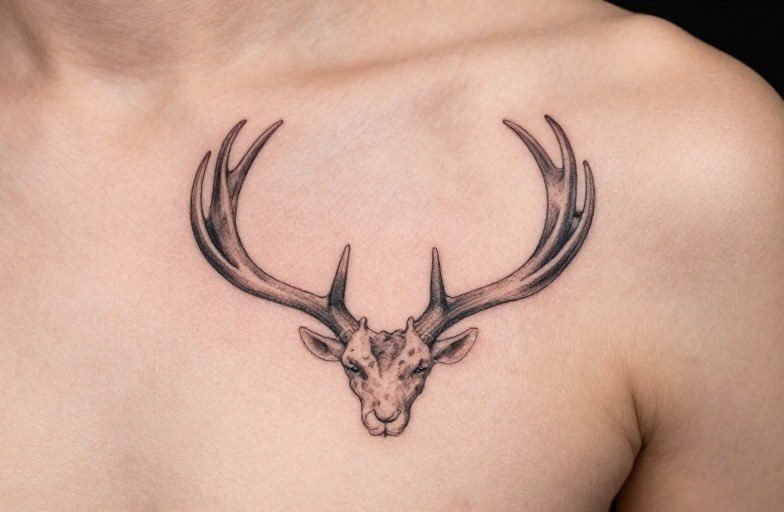
Antler tattoos work across the body, but the branching structure creates natural constraints. Vertical compositions, antlers rising upward, fit forearms, calves, ribs, and the spine. Horizontal spreads across the chest or upper back can frame other work or stand alone as a mantle. The collarbone area, with its natural V, echoes antler divergence but hurts significantly and shows wear from sun and clothing friction.
Small antler tattoos (under 3 inches) generally fail. The tine spacing becomes illegible; what reads as delicate detail fresh heals into indistinct gray. Minimum viable size for recognizable antler structure: about 4 inches vertical for simple two-point designs, larger for complex racks. Finger and hand placements are popular but problematic, antlers there blur fast, require frequent touch-ups, and carry “jobstopper” stigma in conservative fields.
- Forearm (inner or outer): visible, moderate pain, good for vertical compositions
- Calf: muscular canvas, less sun exposure than arms, heals well
- Upper back/shoulders: space for spread racks, connects to wing or cape imagery
- Ribs: painful, private, suited to personal rather than display pieces
- Thigh: large scale possible, less distortion from aging than abdomen
Who Chooses This Tattoo / Personal Meanings
Hunters get antler tattoos, obviously, but the demographic’s broader. Foragers, wildlife biologists, foresters, and backcountry guides often choose species-accurate antlers marking their working landscape. People in recovery sometimes select shed antlers specifically, the dropped, found quality, not the mounted trophy. Fathers get them after children’s births, linking the stag’s seasonal cycle to family time. Military veterans occasionally use antler skull imagery as hunting-culture camouflage for PTSD or loss processing, though this overlaps heavily with other skull traditions.
The “found shed” motif attracts a particular personality: patient observers, trail walkers, people who value what’s given over what’s taken. There’s a quiet ethics to it. Conversely, skull-mount tattoos can read as dominance display, successful kill, conquest, which some wearers intend and others don’t consider. Context, surrounding imagery, and the wearer’s own explanation shape reception more than the antlers alone.
Similar Symbols
Horns (permanent, keratin) carry different energy, bull, ram, goat. They’re defiance, stubbornness, fertility deities, Satanic or pagan rebellion depending on era and culture. Horns don’t shed; they accumulate, layer, thicken. That permanence appeals to different psychology than antlers’ cyclical loss.
Branching trees overlap visually and symbolically, Yggdrasil, family trees, dendritic nerve patterns, but lack the animal urgency, the seasonal hormone drive that grows and drops antlers. Trees are slower, more patient, less bloody.
Feathers share the found-object quality, the lightness, the connection to non-human life. But feathers signal flight, transcendence, air; antlers are grounded, territorial, rooted in the body’s cycles and the forest floor’s decay.
- Horns: permanent, defensive, often coded feminine/maternal (cow, lunar) or aggressive (bull, combat)
- Trees/branches: slower growth, lineage, rootedness, less individual mortality
- Feathers: ascension, communication, lightness, less bodily cycle emphasis
- Skulls (general): memento mori, less species-specific ecological connection
Final Thoughts
Antler tattoos reward specificity. Generic “deer antler” flash misses what makes this imagery potent: the exact species, the found or hunted context, the style that matches your skin’s aging and your body’s movement. Meaning here isn’t imposed from outside, it’s built from the biological fact of shedding, the regional ecology you actually inhabit, and whether you want the skull attached or the antlers alone. Get the species right. Get the scale right. Let the natural form do its work without overloading it with text or secondary symbols that compete rather than clarify. The best antler tattoos look like they grew there, not like they were applied, and that’s as much about placement and restraint as technical skill.
Frequently Asked Questions
Do antler tattoos age worse than other nature designs?
They can, if done too small or with excessive interior detail. The negative space between tines is crucial; as lines blur, that space closes and the antler shape loses definition. Bold outlines and adequate sizing prevent this.
What’s the difference between antler and horn tattoo symbolism?
Antlers shed and regrow annually, symbolizing cycles and renewal. Horns are permanent keratin structures, associated with steadfastness, defense, and sometimes fertility or rebellion depending on the animal.
Is it cultural appropriation to get antler tattoos from indigenous traditions?
Specific ceremonial antler headdresses or shamanic imagery belong to particular cultures. Generic naturalistic antlers, especially of species from your own region, don’t carry the same weight. Research any specific motif’s origins before committing.
Why do some antler tattoos include flowers or feminine imagery?
The contrast highlights balance between traditionally masculine and feminine associations, or marks seasonal cycles, antlers dropping in winter, flowers emerging in spring. It’s a common compositional choice without fixed universal meaning.
Related Tattoo Meanings
- Longhorn Tattoo Meaning: Symbolism, Styles Placement
- Ram Head Tattoo Meaning: Power, Stubbornness Astrology
- Baphomet Tattoo Meaning: Symbolism, Styles Shop Talk
- Explore more