The bison is one of the most loaded symbols in American tattooing. It reads as raw power right away, but there’s a lot more going on underneath. Strength, survival, abundance, connection to the land. People who get a bison tattoo usually feel something personal about what this animal represents, and that comes through in the ink.
It’s not a trendy flash piece. A bison tattoo carries weight. If you’re drawn to Native American symbolism, the idea of resilience after near-extinction, or just the pure visual impact of a massive animal rendered in black and grey, this is a piece with staying power. Let’s break down what it actually means.
Core Symbolism: What a Bison Tattoo Stands For
Bison tattoos most commonly represent strength, endurance, and grounded power. Not flashy, explosive strength. Steady, immovable strength. The kind that holds under pressure. A bison doesn’t flinch. It lowers its head and walks into the storm literally, which is why that pose shows up constantly in tattoo designs as a symbol of facing hardship head-on.
Abundance and provision are big themes too. Historically, the bison fed, clothed, and sustained entire peoples. That legacy of sustenance translates into a tattoo meaning for people who see themselves as providers or protectors. Gratitude, generosity, and the idea of giving without running dry all fall under the bison’s symbolic umbrella.
Indigenous and Historical Roots
Nothing else in American ink carries this much history on four legs.
In Plains Indigenous cultures including the Lakota, Comanche, Cheyenne, and many others, the bison was sacred. It wasn’t just food. It was spiritual sustenance. The White Buffalo, in particular, is considered a deeply sacred omen in Lakota tradition, representing purity, hope, and a new era. People getting bison tattoos rooted in this context should understand what they’re drawing from and approach it with respect.
The near-extinction of the American bison in the late 1800s, driven by mass slaughter during westward expansion, layers in another meaning: survival against all odds. The species came back from fewer than 1,000 animals. That story of collapse and comeback resonates hard with people in recovery, people rebuilding after loss, or anyone who’s come through something that nearly broke them.
Popular Design Variations
Traditional American style bison tattoos are bold, clean, and built to last. Thick outlines, solid fills, limited color palette. They read from across the room and hold up over decades. You’ll see these on thighs, upper arms, and chests where there’s enough real estate to let the design breathe. The profile view is classic, showing the full silhouette of the hump and horns.
Geometric bison tattoos have been popular for the past decade, breaking the animal into sharp angles, dotwork, and mandala-inspired patterns. Fine line bison pieces are on the rise too, showing incredible fur texture and detail. Skull versions carry a memento mori angle. Charging bison, standing bison, bison mid-storm. Each pose shifts the meaning slightly, so it’s worth talking through what you want the piece to say before your artist draws it up.
Black and Grey vs. Color
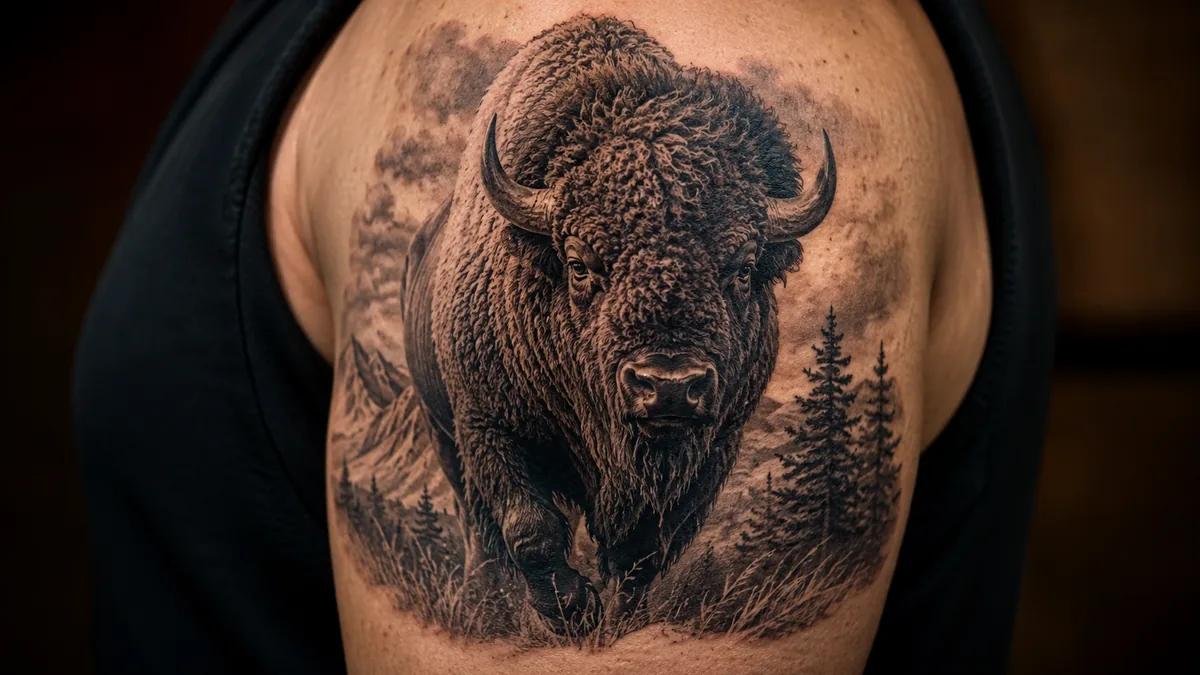
Black and grey is the dominant choice for bison tattoos, and it makes sense. The fur, the shading on that massive chest and hump, the drama of the horns. Black and grey lets your artist use whip shading and detailed texturing to really sell the weight of the animal. A skilled artist can make a bison tattoo look like it has gravity. It also ages more predictably, especially in high-wear zones.
Color bison tattoos lean toward two directions: traditional American with bold reds, yellows, and greens, or realistic with warm browns and ochres that try to capture actual bison coloring. Saturated color in realistic pieces can be stunning fresh, but needs solid upkeep in sun-exposed spots. If you’re going color, talk to your artist about longevity. Some pigments fade faster than others, and a bison with a blown-out snout in five years is not the move.
Placement and How It Ages
The thigh is probably the best real estate for a bison tattoo. It gives your artist room to go large, the skin is relatively flat, and it’s a lower-wear zone so detail holds. The upper arm and shoulder are classics for a reason: they have enough muscle structure to complement the bison’s own mass. Chest pieces work well for the right design, especially profile or charging compositions.
Avoid extremely fine-line bison work on hands, fingers, or the inside of your wrist if you want it to still look clean in ten years. Those are high-wear, high-sun, high-movement zones. Blowout risk goes up, fine lines spread, and you’ll be back for touch-ups sooner than you’d like. A bison built with bold lines and solid blacks will hold. Crispy details in low-wear spots stay crispy. That’s just the reality of tattooing.
Pain Levels by Placement
The thigh is manageable for most people, a solid 4 to 6 out of 10 depending on how close your artist gets to the inner thigh or knee. The outer thigh is one of the more comfortable spots you can get tattooed, which is a real bonus when you’re committing to a large piece with a lot of session time. Upper arm is similar, pretty workable.
Ribs are spicy, no way around it. Chest work over the sternum gets uncomfortable fast. If your artist is working over the spine for a back piece, that’s going to get real. Shin work is notoriously rough. Know your zone before you commit, budget your sessions, and eat a full meal before you sit. A bison tattoo done over multiple sessions always beats rushing a large piece and ending up with a tired, blown-out result.
Who Gets Bison Tattoos and How to Make It Personal
People who connect with this tattoo tend to have a theme running through their life: resilience, survival, coming back from something hard, or a deep tie to the American West and its landscape. Veterans, people in recovery, ranchers, outdoor workers, and those with Indigenous heritage all find meaning in it, but you don’t need any particular background. The symbolism is accessible.
To make it personal, think about pose and context. A lone bison in snow reads differently than a herd in motion. Add elements that mean something to you: a specific landscape, a birth flower in the background, a phrase worked into the design. Talk to your artist about negative space and how the piece fits your body’s natural lines. The best bison tattoos feel like they belong on that specific person, not just a design dropped on skin.