
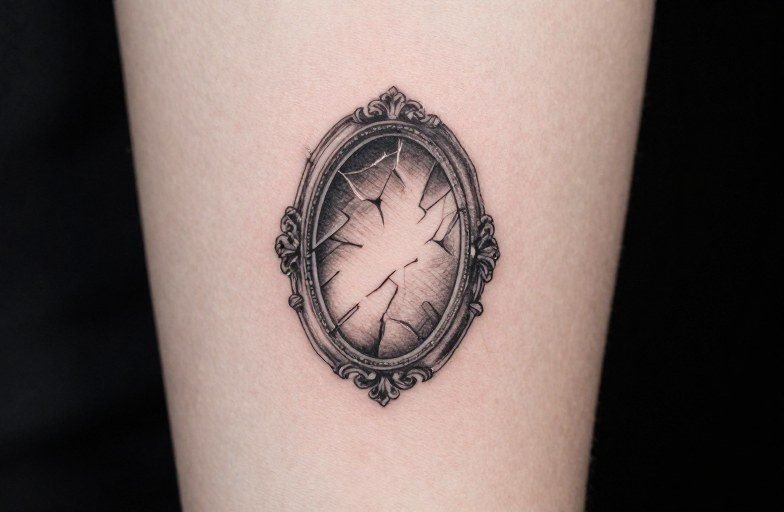
A broken mirror tattoo most commonly symbolizes bad luck overcome, a fractured sense of self, or the deliberate shattering of old identities. The image pulls from the ancient superstition of seven years’ misfortune, but in ink it usually gets flipped, becoming a mark of survival, transformation, or the beauty found in damage rather than a curse to fear.
Symbolism & History
The broken mirror carries weight across several layers of meaning, some rooted in folklore and others entirely modern.
The Luck Reversal
Mirror-breaking superstition runs deep in Western culture, often linked to Roman beliefs about the soul’s reflection. A tattoo of a shattered mirror frequently inverts this: the wearer claims the bad luck, owns it, or declares it finished. The cracks become proof you survived what the mirror foretold. Some trace the seven-year figure to a Roman belief about life cycles, though the exact origin remains murky. What matters for tattooing is how people use it now, as a middle finger to fate, or a memento of a rough period now closed.
Identity & Self-Image
Glass that no longer reflects cleanly speaks to distorted self-perception. This resonates with people who’ve rebuilt themselves after trauma, addiction, major loss, or profound change. The fragments suggest a self that was whole, broke, and now exists differently, not necessarily worse, but reassembled. The mirror frame often stays intact in these designs, implying the structure of identity holds even when the surface cracks.
Truth & Deception
Less commonly, broken mirrors reference the inability to trust what you see, whether in others or yourself. A spiderweb of cracks across a reflection distorts reality, making this a choice for those who’ve learned hard lessons about surface appearances.
Common Variations & Styles
The broken mirror adapts to nearly every tattoo approach, but some treatments suit the subject better than others.
- Realistic shattered glass: Sharp highlights, deep black shadows, and careful white ink for glare. This demands technical precision; poorly executed glass looks like random lines. Best in black and grey with limited color.
- Art Deco or ornate framed mirror: The frame provides structure and contrast to chaotic cracks. Victorian or rococo frames add narrative weight, something precious, inherited, now damaged.
- Minimalist line work: A simple oval or rectangle with clean fracture lines. Faster to execute, easier to place small, but the cracks must be deliberate; messy lines read as error, not breakage.
- Mirror reflecting something unexpected: Skulls, eyes, empty space, or a different face than the wearer’s. This adds symbolic layering but complicates the design significantly.
- 3D or trompe l’oeil: Shards appearing to lift off skin, sometimes with blood droplets or falling pieces. High impact, high maintenance, white ink fades, and dimensional effects flatten over time.
Color choices matter. Silver and grey dominate naturally, but some add subtle blue for coldness or red at crack origins for violence. Gold frames with black cracks create striking contrast on darker skin tones.
Best Placements
Where you put this design changes how it reads and how well it ages.
High-Detail Areas
Forearms, outer upper arms, and calves offer flat surfaces where glass reflections and sharp cracks stay readable. The forearm’s visibility suits the mirror’s self-examination theme, you see it, others see it. Thighs and ribs work for larger pieces but hurt more; the ribcage’s movement can distort fine crack lines during healing.
Small & Subtle Options
Wrists, behind ears, or along collarbones suit minimalist versions. Be cautious: tiny glass details blur within years. A 2-inch wrist mirror with hairline cracks becomes mushy by year five. Scale the fracture lines thicker than you think necessary for longevity.
Areas to Avoid
Hands and feet fade fastest and distort the precise geometry glass requires. Elbows and knees move too much for clean healing. The neck works only if you’re committed to visibility and touch-ups.
One practical note: white ink, often used for glass highlights, yellows or disappears faster than black. Expect refresh sessions every few years if your design relies heavily on it.
Who Chooses This Tattoo / Personal Meanings
There’s no single profile, but patterns emerge in who sits for this image.
People marking survival of a genuinely difficult period, divorce, recovery, psychiatric crisis, bereavement, often gravitate here. The mirror’s specificity helps: it’s not a generic “strength” symbol but something about how they saw themselves, how that broke, and what came after. The bad-luck reversal appeals to those with dark humor or who’ve had enough of being told they’re cursed.
Some choose it during major transitions, less from trauma than from deliberate reinvention. Leaving a career, a religion, a family role. The broken mirror says the old reflection no longer applies.
A smaller group connects it to creative or performative identity, actors, musicians, people whose livelihood depends on mutable self-presentation. For them, the cracks might represent the necessary fragmentation of playing many roles.
What unifies these choices is specificity. The broken mirror rarely works as a first tattoo or an impulse pick. It carries enough cultural baggage and visual drama that people tend to arrive at it thoughtfully, with a particular personal bridge to the symbol.
Similar Symbols
Related imagery sometimes gets chosen instead, or combined with the broken mirror.
- Kintsugi: Japanese gold-repaired pottery, often paired with or replacing the mirror to emphasize healing rather than breakage.
- Shattered hourglass: Time broken, interrupted, or escaped, more fatalistic, less about identity.
- Cracked masks: Theatrical faces split open, revealing another face beneath. More about deception and performance.
- Broken chains: Direct liberation symbolism, less ambiguous, more universally positive.
- Mirror intact but fogged or water-streaked: Uncertainty rather than rupture; gentler, less dramatic.
Some designs combine mirror shards with eyes, suggesting watched or watching. Others scatter the broken pieces across a larger composition, each fragment reflecting a different moment or face.
Final Thoughts
The broken mirror tattoo works because it balances visual drama with genuine symbolic flexibility. It can mourn, defy, celebrate, or warn, depending on frame, cracks, and what the glass shows or refuses to show. The technical demands are real: glass is unforgiving, white ink fades, and small details blur. But executed well, it remains one of the more intellectually layered choices in contemporary tattooing, carrying centuries of superstition while speaking to distinctly modern experiences of fracture and reassembly. If you’re drawn to it, know exactly which version of broken you mean, the luck, the self, the truth, or all three intertwined.
Frequently Asked Questions
Does a broken mirror tattoo always mean bad luck?
No, most people use it to reverse or reclaim that superstition. The design typically signals survival through difficulty rather than inviting misfortune. Personal intent matters more than any fixed dictionary meaning.
How well does white ink hold up in glass-effect tattoos?
White ink fades faster than black and can yellow or disappear entirely within a few years. Plan for touch-ups, and don’t make your design depend solely on white highlights for readability.
Can a broken mirror tattoo work in color?
Yes, but black and grey remains most common and technically effective. Color can frame the mirror or tint the reflection, though realistic glass relies heavily on contrast that color sometimes muddies.
What’s the difference between a broken mirror and a cracked mirror tattoo?
“Broken” usually implies shattered pieces, gaps, or falling shards; “cracked” suggests spiderweb fractures across an intact surface. Broken reads more dramatic and irreversible; cracked suggests damage still contained.
Related Tattoo Meanings
- Chevron Tattoo Meaning: Symbolism, Styles Placement Guide
- Chucky Tattoo Meaning: Horror, Rebellion Dark Playfulness
- Constantine Tattoo Meaning: Symbolism, Style Placement
- Explore more









