
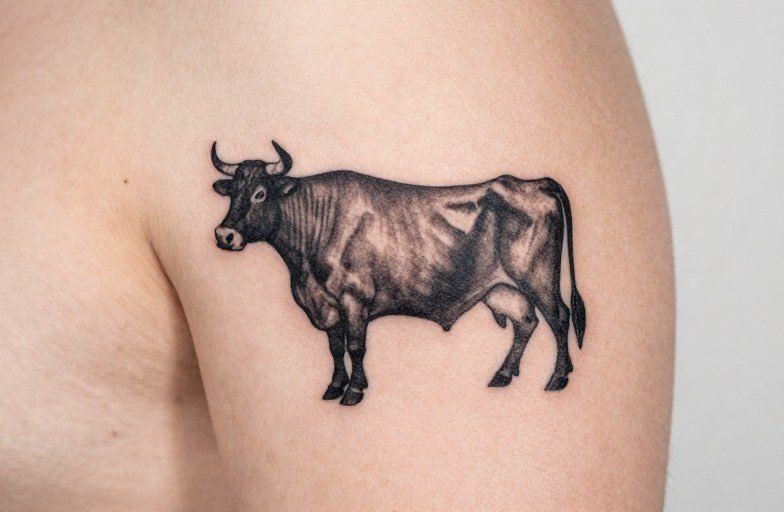
Cattle branding symbols in tattoo form translate livestock marks into personal emblems of ownership, resilience, and identity. The stark geometry of a brand, designed to be read at distance, burned through hair, and endured, lends itself naturally to skin. These tattoos typically signify self-possession, survival through hardship, agricultural heritage, or a deliberate claim on one’s own body and narrative.
Symbolism & History
Brand marks developed as functional tools: ranchers needed permanent, visible proof of ownership that wouldn’t fade, alter, or transfer. The symbols evolved regional dialects, the running W of the King Ranch, the lazy and flying prefixes denoting tilt, the bar and rocking modifiers that changed a letter’s meaning entirely. This language was never decorative. A misplaced mark meant legal dispute, lost stock, or range war.
That utility carries into tattoo meaning. The person who chooses a brand symbol often connects to that ethic of clarity, permanence, and consequence. There’s no hiding a brand. There’s no revision.
From Ranch to Skin
The migration from livestock to human skin happened organically. Cowboys and ranch hands occasionally marked themselves with their employer’s brand, a practice sometimes voluntary, sometimes coerced. Contemporary wearers may inherit family brands, adopt symbols from regions they left, or design original marks that function as personal sigils. The visual vocabulary remains consistent: Roman letters, numerals, geometric frames, and combinations thereof.
Specific Marks and Their Weight
- Single letters, Often initials or ranch abbreviations; simplest to execute and read
- Connected characters, Two or three elements fused, requiring precise spacing to maintain legibility
- Symbols (cross, anchor, diamond), Less common historically; more frequent in modern personal designs
- Numbers and dates, Birth years, ranch founding dates, or significant numerals
Some designs incorporate the “burned” effect through heavy black fill or scarred texturing, though this risks muddying the clean lines that make brands readable.
Common Variations & Styles
Authenticity in rendering matters. A brand tattoo that ignores the structural logic of actual livestock marks reads as costume rather than claim. The best work respects the constraints: lines must hold at small scale, negative space must remain deliberate, and the mark should scan instantly.
Line-Only vs. Filled
Traditional brands are burned, not inked, so the purest tattoo translation uses single-weight black lines without shading. This ages exceptionally well; the mark stays crisp as surrounding skin changes. Filled versions (solid black shapes) create stronger immediate impact but blur faster, especially on high-movement areas. A compromise approach uses “strike-through” or “rocking” techniques where partial fill suggests the burn without full saturation.
Textural Approaches
- Scar simulation, Raised-line technique through heavy passwork; visually convincing but unpredictable in healing
- Weathered/aged, Slight irregularity in line weight to suggest decades of sun and use
- Clean registry, Precise, uniform lines as if freshly stamped; best for smaller sizes
Color is rare and generally inadvisable. The brand lexicon is black on hide, black on skin. Red appears occasionally in modern interpretations but sacrifices the historical resonance.
Best Placements
Brand placement on cattle follows function: visible to riders at distance, hard to alter by thieves. Human adaptation varies by intent.
- Upper arm, outer shoulder, Most common; echoes cattle shoulder placement, easily displayed or covered
- Forearm, Direct visibility, confrontational in the original sense; the mark faces outward
- Chest, over pectoral, Close to heart for family brands; scales well for larger connected marks
- Ribcage, Painful, private; the mark exists for the wearer more than observers
- Calf or thigh, Literal correspondence to livestock placement; often larger scale
Small brands (under 2 inches) fail. The minimum readable size for most characters is roughly 2.5 to 3 inches in height, with proportionate width. Crowding multiple elements into a small space destroys the instant recognition that defines the form.
Who Chooses This Tattoo / Personal Meanings
The wearer profile spans broader than agricultural background. You’ll find these on fifth-generation ranchers, certainly, but also on urban Texans reclaiming displaced heritage, on adopted children using designed marks as invented family crests, on survivors of illness or incarceration marking a body reclaimed.
Heritage and Belonging
For those with actual ranch history, the brand functions as genealogical record. Family brands are registered with state livestock associations; the tattoo reproduces a documented, government-filed symbol. That specificity matters. A random “western” design chosen from flash sheets lacks the documentary weight of a registered mark with a known provenance.
Reclamation and Autonomy
The darker resonance of branding, human chattel, forced marking, institutional ownership, gets deliberately inverted by some wearers. The self-applied brand asserts control over a body that was marked by others. This meaning layer requires no explanation to those who carry it; the symbol’s history of coercion makes the personal reclamation more acute.
Group and Subcultural Use
Military units, fire crews, and tight-knit construction teams occasionally adopt brand-style marks for members. The ethic translates: shared ordeal, permanent inclusion, no easy exit. These function as unofficial insignia, readable to insiders, opaque to outsiders.
Similar Symbols
Several tattoo traditions overlap with cattle branding in visual language or intent.
- Japanese kaku (角) marks, Cattle horn brands, sometimes adapted into tattoo; similar geometric reduction but different cultural context
- Prison tattoos, Often applied with improvised tools, carrying ownership/punishment connotations; the line quality differs (uneven, scarred) but the social function parallels
- Livestock ear notches, Occasionally rendered as small edge tattoos; less common, more cryptic
- Blacksmith’s touch marks, Maker’s marks on forged metal; similar registration systems, similar pride in craft lineage
- Hobo symbols, Transient communication marks; shared ethic of simple, urgent readability
These parallels illuminate what distinguishes the cattle brand: its legal formalism, its agricultural specificity, and its extraordinary durability as a marking system. The symbol has functioned continuously since medieval Europe, adapted across continents, without fundamental change to its core grammar.
Final Thoughts
A cattle branding symbol tattoo succeeds or fails on the strength of its specificity. Generic “western” iconography, skulls, feathers, sunsets framing a vaguely brand-like shape, misses the point. The power lives in the system’s rigor: every mark registered, every line accountable, every symbol carrying consequence.
If you’re drawn to this form, do the research. State livestock associations maintain brand registries; many are digitized. Family records may hold marks you never knew were yours. Design an original only if you understand the structural rules, how lazy tilts, how flying extends, how connected characters must balance for legibility. The best brand tattoo doesn’t borrow aesthetic. It participates in a living system of marks that have always meant exactly what they say.
Frequently Asked Questions
Do I need to have ranching heritage to get a cattle brand tattoo?
No. Many wearers choose original designs or adopt symbols for personal meaning. The key is understanding the form’s history and respecting its structural logic rather than treating it as generic western decoration.
How small can a brand tattoo be before it becomes unreadable?
Most characters need at least 2.5 to 3 inches in height to maintain the instant recognition that defines a brand. Below that, lines blur together and the mark loses its essential function.
Why are most brand tattoos black only?
The historical source material is burned hide, not inked color. Black line work honors that origin and ages significantly better than filled or colored alternatives, which tend to spread and muddy over time.
Can I use my family’s actual registered livestock brand?
Yes, and this carries the most authentic weight. State livestock associations maintain registries; using a documented family mark connects you to a specific, traceable history rather than invented symbolism.
Related Tattoo Meanings
- Longhorn Tattoo Meaning: Symbolism, Styles Placement
- Bull Skull Tattoo Meaning
- Chameleon Tattoo Meaning: Adaptation, Patience Disguise
- Explore more









