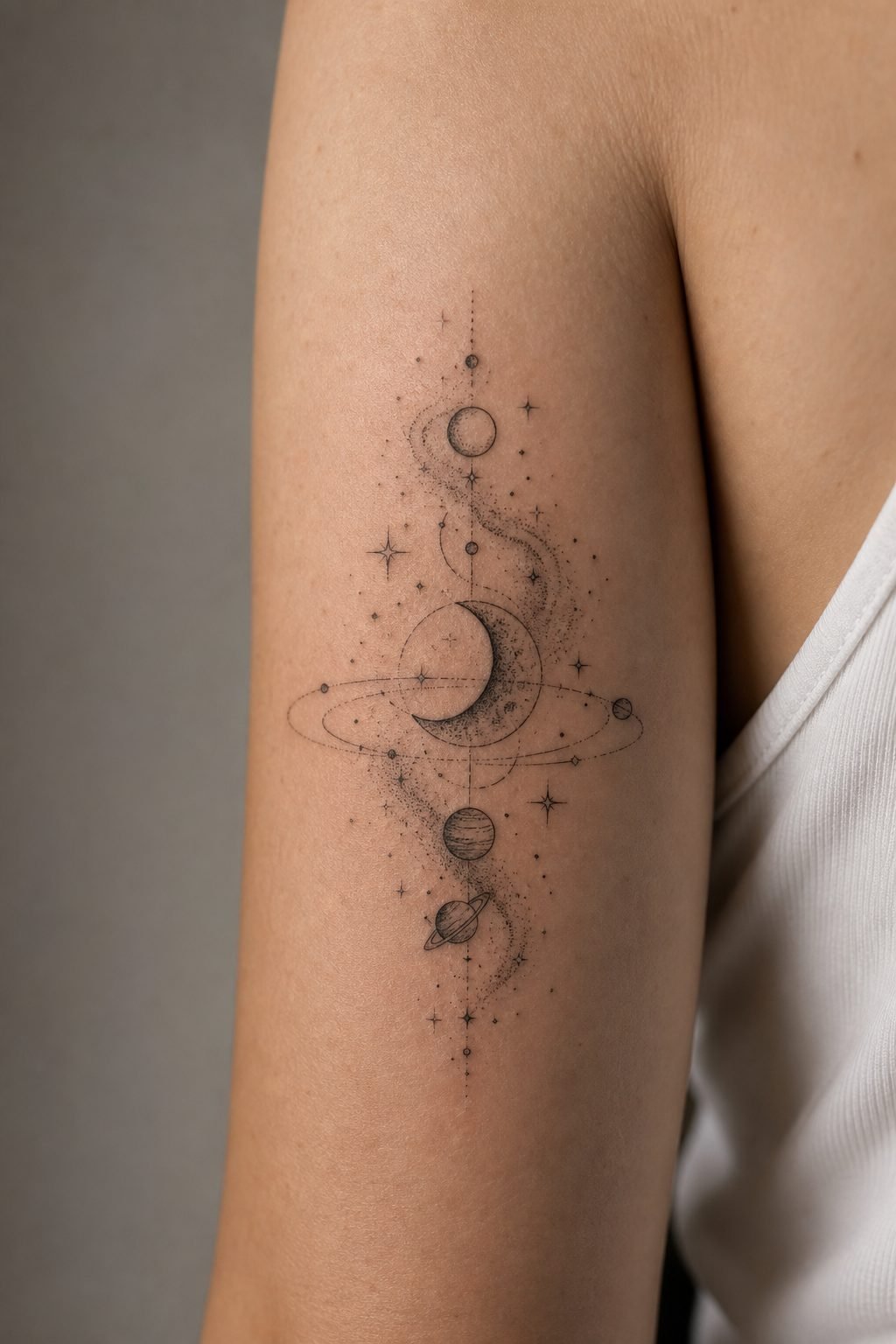
Cosmic tattoos pull from the actual visual language of astronomy, swirling gas clouds, stellar remnants, orbital mechanics, light bending around gravity. The subject matter offers nearly infinite variation, but that freedom can paralyze decision-making. What actually works on skin? Which cosmic elements hold up over years? This guide breaks down the real options, from delicate constellation linework to saturated nebula sleeves, with specifics on placement, color behavior, and how these designs translate from screen to body.
Popular Styles
Cosmic imagery adapts to nearly every tattoo approach, but some pairings work better than others. The style you choose determines how much detail survives, how quickly the piece ages, and what kind of maintenance it needs.
Black and Gray Realism
Galactic cores, planetary surfaces, and moon phases render beautifully in monochrome. The style relies on smooth gradients and precise white ink highlights for stars. Black and gray holds its value longer than color in most cases, and touch-ups are simpler. The downside: without careful contrast, deep space can read as muddy gray blobs after a few years. A skilled artist builds depth through deliberate negative space, not just darker blacks.
Watercolor Nebulas
Loose, bleeding color fields mimic actual Hubble imagery, pinks, teals, and violets bleeding into black backgrounds. The effect is striking fresh. The reality: watercolor tattoos fade faster, blur at edges, and require a heavy hand with black anchoring elements to prevent them from becoming unrecognizable washes. Best reserved for collectors who accept periodic refresh sessions.
Dotwork and Stippling
Thousands of tiny dots build texture for star fields, planetary rings, and atmospheric haze. The technique is slow but creates a genuinely different visual texture than shading. On cosmic subjects, dotwork excels at rendering the granular quality of distant galaxies. It heals slightly raised in spots, which is normal, and ages with a soft, almost photographic quality.
- Linework constellations: clean, minimal, prone to spreading if lines are too thin
- Japanese-influenced cosmic motifs: waves reimagined as spiral arms, dragons as stellar phenomena
- Biomechanical space: fused machinery and orbital elements, heavy black saturation
Design Ideas
Moving beyond generic “galaxy background” requires understanding what specific cosmic phenomena actually look like and how they simplify to tattoo scale.
Celestial Mechanics
Orbital paths, Lagrange points, and phase diagrams translate to elegant geometric work. A moon in exact phase sequence across a forearm. A planet’s rings rendered with accurate inclination angle. These designs reward the wearer who actually cares about the science, the accuracy is invisible to most viewers but deeply satisfying to those who recognize it.
Deep Space Phenomena
Supernova remnants, accretion disks around black holes, and gravitational lensing effects offer dramatic visual possibilities. The Einstein ring, light bent around massive objects into a perfect circle, makes for a compelling frame or standalone piece. Pulsar maps, showing Earth’s location relative to spinning neutron stars, carry the Voyager golden record aesthetic without being cliché.
- Helix nebula: the “eye of God” structure, recognizable, works at medium to large scale
- Crab nebula: filamentary structure that translates well to linework or dotwork
- Sagittarius A*: the Milky Way’s supermassive black hole, recently imaged, now visually referenceable
- Exoplanet transit diagrams: minimalist, scientifically grounded, highly personal
Best Placements
Cosmic imagery has natural flow directions. Spiral arms want to wrap. Orbital paths want to curve with body contours. Ignoring this creates awkward, distorted results.
The outer upper arm and shoulder cap handle spherical subjects well, planets, moons, full nebula portraits. The curve of the deltoid echoes planetary curvature. Forearms and calves work for linear compositions: constellation chains, phase sequences, trajectory arcs. The ribs and side accommodate large, uninterrupted fields where a nebula can breathe without wrapping distortion.
Hands and fingers present problems. Small cosmic symbols here blur quickly, and the near-constant movement and sun exposure accelerates fading. If you want a tiny planet or star, expect it to need redoing within a few years. The sternum and center chest can carry a symmetrical cosmic piece, think binary star systems, mirrored nebula formations, but the bone proximity makes the session genuinely uncomfortable.
Color Choices
Space is not actually colorful to the human eye. Hubble’s palette is assigned, ionized hydrogen in red, oxygen in blue-green, sulfur in red. Understanding this helps you choose deliberately rather than defaulting to “purple and blue because galaxy.”
What Lasts
Deep blues and true blacks hold longest. Crimson and magenta fade to pinkish-gray. Bright teals and yellow-greens often shift toward blue or muddy green within two years. White ink for stars is nearly universal in cosmic work, but it yellows on some skin tones and can disappear entirely into darker complexions. Some artists now use light gray instead of pure white for more reliable longevity.
Working With Skin Tone
On darker skin, the highest-contrast cosmic pieces use solid black space with strategic negative space stars, or lean into gold and white ink for celestial bodies. Saturated color nebulas can work but require heavier saturation and more frequent maintenance. The industry has historically underrepresented what cosmic color work looks like healed on deep skin, seek artists with documented healed results, not just fresh photos.
Tips for Choosing
Reference material matters more here than with many subjects. Bring actual astrophotography, not other people’s tattoos. The best cosmic artists study source imagery and understand how to simplify without losing the phenomenon’s character.
- Ask to see healed photos of their space work, especially any color pieces from 2+ years prior
- Discuss whether white highlights will be pure white or light gray for your skin tone
- Consider the negative space: cosmic tattoos often fail when the “space between” isn’t planned as carefully as the stars
- Scale appropriately: a spiral galaxy needs room for the arms to read as spiral, not circular smudge
- Think about the background: solid black, gradient gray, or skin-tone negative space each create different moods and maintenance profiles
One consideration often overlooked: cosmic imagery can feel cold or impersonal if it lacks some grounding element. A sliver of spacecraft, a silhouette of an observer, a specific date rendered in pulsar coordinates, these anchors prevent the piece from becoming generic space wallpaper. The universe is vast; your tattoo occupies specific, finite skin. The best pieces find the right scale of personal connection without forced sentiment.
Final Thoughts
Cosmic tattoos succeed when they balance astronomical accuracy with the practical constraints of skin. The most stunning nebula on screen may translate to a muddy blur if over-saturated or under-scaled. Conversely, a simple orbital diagram executed with precision can hold visual power for decades. Choose your specific phenomenon, understand how your chosen style will age, and work with an artist who has actually rendered space before, not just theoretically, but with healed results you can examine. The universe offers infinite reference; your job is selecting what genuinely moves you and what can live on your particular canvas.
Frequently Asked Questions
How well do watercolor nebula tattoos hold up over time?
They fade faster than traditional approaches, with edges softening and colors shifting within two to four years. Solid black anchoring elements help maintain structure, but expect periodic refresh sessions to keep the piece readable.
What’s the best size for a spiral galaxy tattoo?
Spiral arms need enough room to resolve as distinct curves rather than circular blurs. At minimum, palm-sized for simple galaxies, larger for detailed structure. Forearms, thighs, and upper backs provide adequate uninterrupted space.
Can cosmic tattoos work on darker skin tones?
Absolutely, but the approach shifts. High-contrast blackwork with negative space stars, or gold and white ink for celestial bodies, often reads more clearly than attempting to replicate pastel Hubble palettes that may heal muted.
Do white ink stars stay visible long-term?
White ink yellows on some skin tones and can disappear entirely into melanin-rich skin. Light gray often proves more reliable. Location matters too, white on high-movement areas like fingers or inner arms fades fastest.
More Tattoo Ideas
- Pinterest Tattoo Ideas for Women That Actually Work
- Chaos Tattoo Ideas for Unruly Ink
- Traditional Indian Tattoos: A Working Artist s Guide
- Explore more