
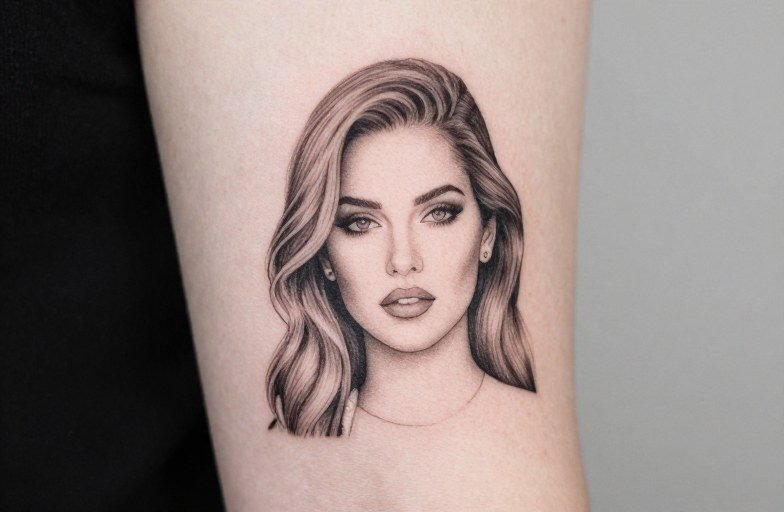
The “Say” tattoo, popularized by actress Courtney Hope, is a single-word design that functions as a personal prompt toward self-expression and authenticity. It typically appears in clean, handwritten-style script and carries different weight depending on placement and context. The meaning centers on permission to speak, to name truth, and to reject silence.
Symbolism & History
The Word as Command and Permission
Single-word tattoos operate differently from images. They lack visual ambiguity. “Say” demands action. For many who choose it, the word serves as a counterweight to hesitation, self-censorship, or environments where their voice was diminished. The tattoo becomes a physical reminder that sits at the edge of vision, on a wrist, a rib, a collarbone, visible enough to catch during moments of doubt.
The specific association with Courtney Hope emerged from her public visibility with the design, though the word’s appeal predates any single celebrity adoption. Its power lies in its grammatical openness. “Say” is an imperative, but also the beginning of an unfinished sentence. That incompleteness invites the wearer to fill in the rest privately.
Connections to Broader Tattoo Traditions
Word tattoos have a long history in Western tattooing, particularly from the mid-20th century onward. Sailors and soldiers carried names, slogans, and religious phrases. The shift toward abstract or single-word designs accelerated in the 1990s and 2000s as fine-line tattooing gained technical precision. “Say” fits this lineage but strips away the declarative certainty of earlier text tattoos. It offers process rather than conclusion.
- Imperative verbs as tattoos create ongoing psychological engagement
- Short words age better than long phrases, less ink spread, more legibility over decades
- The hand-lettered style associated with this design connects to contemporary fine-line aesthetics
Common Variations & Styles
Lettering Approaches
The most recognizable version uses loose, unconnected script that mimics natural handwriting. Some artists tighten the letterforms for a more architectural feel. Others exaggerate the “S” with a sweeping initial stroke that can wrap toward secondary imagery, birds, speech bubbles, or open mouths. The “y” descender offers design opportunity; it can terminate in a small flourish, a period, or simply end clean.
Black ink dominates, but some choose a single letter in red or a muted color to emphasize a specific syllable. This works best when the color choice has private significance rather than following trend.
Scale and Composition
Most “Say” tattoos measure between two and four inches in width. At smaller scales, the word risks blurring as skin ages and ink migrates. The “a” and “y” are particularly vulnerable, their enclosed and descending forms can close up or lose definition. Experienced artists will adjust letter spacing slightly wider than natural handwriting to account for this inevitable spread.
- Standalone word: maximum legibility, minimal maintenance
- Word with quotation marks: adds literary framing, slightly more visual complexity
- Word breaking across two lines (“Sa” / “y”): higher risk of misreading, requires careful spacing
Best Placements
Wrist and forearm placements dominate for this design because they position the word where the wearer can see it during writing, typing, or gesturing. The inner forearm offers flatter skin that ages more predictably than the wrist’s thinner, more mobile surface. Ribs and collarbones provide concealment but introduce significant pain during application and more variable long-term clarity due to skin movement and stretching.
Behind the ear and along the finger have gained popularity, though both locations present problems. Finger tattoos fade rapidly from constant use and sun exposure. Behind the ear, the word becomes partially obscured by hair and the curvature of the skull can distort letterforms. If choosing either location, accept that touch-ups will be necessary and that the design may need simplification to maintain readability.
- Inner forearm: best balance of visibility, flat skin, and aging potential
- Outer wrist: highly visible, but prone to sun exposure and fading
- Rib cage: private, painful, requires larger scale for clarity
- Upper arm/shoulder: traditional placement, less personal visibility
Who Chooses This Tattoo / Personal Meanings
Patterns in Motivation
People drawn to “Say” often describe a specific period of enforced silence, family dynamics that punished honesty, professional environments that rewarded compliance, or relationships where their needs went unspoken. The tattoo marks a transition out of that period rather than dwelling in it. It tends to attract those who process experience through language, who write or teach or advocate, and who want external accountability for a behavioral shift.
The design also appeals to performers and public speakers, though for different reasons. Where some use it to find voice, others use it to remember restraint, to speak with intention rather than impulse. The same word accommodates opposite needs.
Gender and Demographics
Visible data suggests this design skews slightly female, though the gap is narrowing. The fine-line, handwritten aesthetic has been coded feminine in contemporary tattoo culture, but the word itself carries no inherent gender association. Men who choose it often opt for heavier line weights or more angular lettering to distance the design from its common visual presentation.
- Survivors of emotional suppression or controlling relationships
- Writers, journalists, teachers, and therapists
- People in recovery from addiction, where honesty is a practiced behavior
- Young adults establishing independent identity from family of origin
Similar Symbols
Other single-word tattoos occupy adjacent territory. “Speak” is more direct but less open-ended. “Truth” asserts a value rather than an action. “Voice” names the instrument rather than the act of using it. “Breathe” shares the imperative structure and self-regulatory function but addresses a different need.
Visual alternatives include open mouths, unzipped lips, or birds in flight, each more literal than the word itself. The abstraction of text allows privacy that imagery sometimes sacrifices. A bird means flight to most observers; “Say” reveals its specific meaning only to the extent the wearer chooses to explain.
For those considering pairing, “Say” works with small punctuation marks, a period for finality, an ellipsis for ongoing process, quotation marks for the mediated nature of all speech. These additions should be chosen for personal grammar, not decorative effect.
Final Thoughts
The “Say” tattoo succeeds because it does not resolve. It hangs in the imperative mood, demanding repetition, asking the wearer to keep choosing voice over silence. Its technical simplicity, three letters, minimal ink, quick application, belies the psychological weight it can carry. Like all good word tattoos, it functions as a private contract written in public ink, visible enough to matter, small enough to belong entirely to the person who wears it.
Choose an artist who specializes in lettering and can show you healed examples of their script work. Fresh tattoos always look sharper than they will in five years. Ask to see how their fine lines have aged. The difference between a “Say” that lasts and one that blurs into illegibility is often invisible at the appointment, but permanent afterward.
Frequently Asked Questions
Does the Courtney Hope ‘Say’ tattoo have a specific font or can it be customized?
There’s no single official font. Most versions use custom hand-lettering designed by the tattoo artist to match your handwriting or preferred style. Bring reference images, but expect the artist to adapt the letterforms for your specific skin and placement.
How well does a small word tattoo like this age over time?
Three-letter designs age better than longer phrases, but fine lines still spread. The ‘a’ and ‘y’ are most vulnerable to blurring. Wider letter spacing and slightly heavier line weight help, as does placement on flatter, less sun-exposed skin.
Can I add to this tattoo later if I want more text or imagery?
Yes, but plan ahead. The open ‘S’ and descending ‘y’ offer natural connection points for future additions. Work with an artist who can design the initial piece with expansion in mind, even if you never use that space.
Is there a standard meaning, or does it vary by person?
The meaning varies significantly. While commonly associated with finding one’s voice and speaking truth, some choose it to practice restraint in speech. The word’s grammatical openness allows multiple, even opposite, personal interpretations.
Related Tattoo Meanings
- Lindsey Slater Say Tattoo Meaning: Symbolism Design Guide
- Puff Daddy Tattoo Meaning: Symbolism, Styles Placement
- Scarring Look Like Tattoo Meaning: Symbolism Design Guide
- Explore more









