
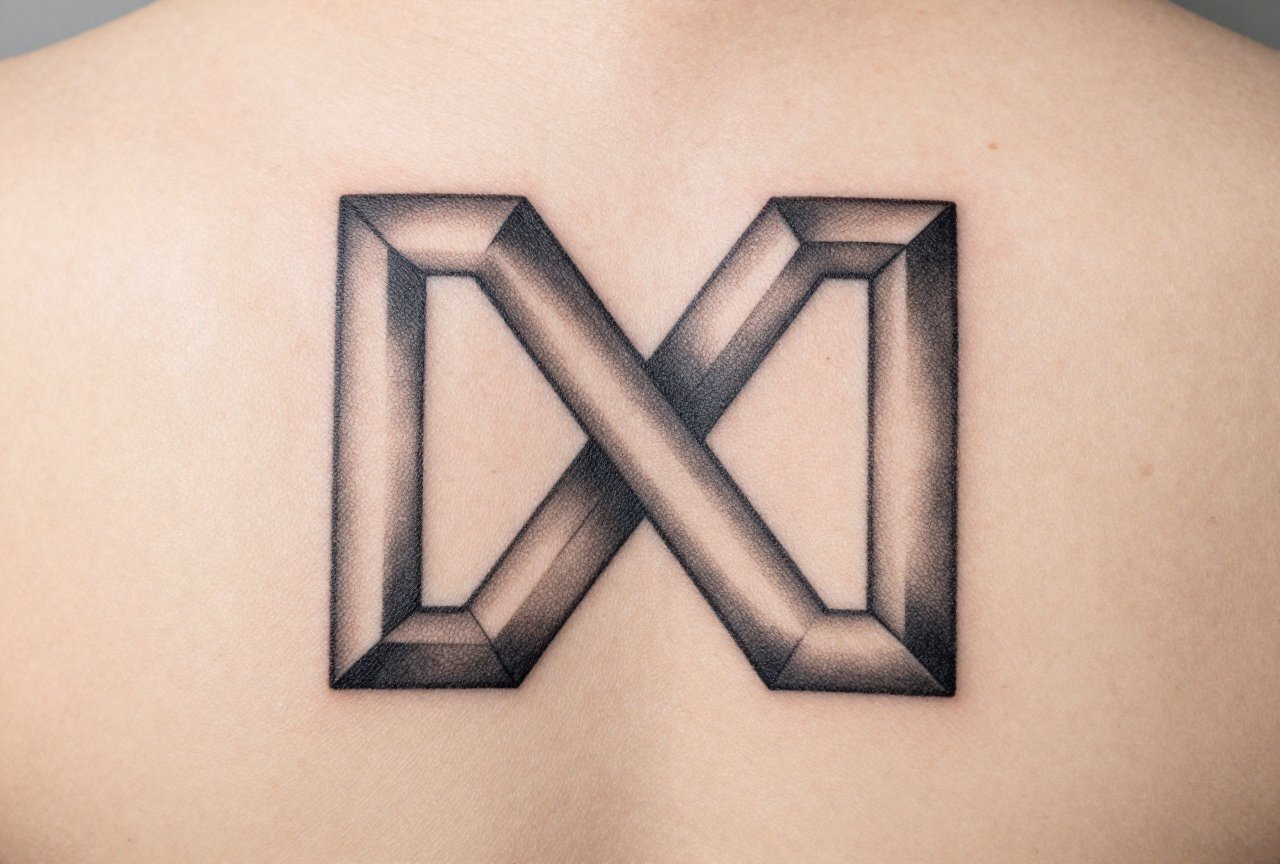
A double meaning ambigram tattoo is a single word or phrase designed to read as something completely different when flipped upside down, mirrored, or rotated 180 degrees. It’s visual wordplay permanently etched into skin, two messages living in the same space, dependent on perspective. I’ve tattooed these for fifteen years, and they always draw people in; there’s something magnetic about a secret hiding in plain sight.
Symbolism & History
The ambigram’s roots stretch back to Renaissance artists playing with mirror writing and rotational calligraphy, but the form exploded in modern tattoo culture after Dan Brown’s Angels & Demons put the word in mainstream mouths. In my chair, though, the meaning runs deeper than novelty.
Duality as Life’s Truth
People who choose these tattoos are often grappling with genuine contradiction. I’ve heard it all: “I’m a mother and I’m still me,” “I was weak, now I’m strong,” “love became pain became love again.” The ambigram doesn’t resolve that tension, it honors it. The design says you contain multitudes, that flipping the script is literally possible.
Hidden Depths, Public Faces
There’s something deliciously private about an ambigram. Someone sees “STRENGTH” across your forearm; only you know it reads “VULNERABLE” in the mirror every morning. That duality between public presentation and private reality resonates hard with clients who’ve learned to code-switch, to survive, to protect their core.
- Transformation and change, who you were versus who you’ve become
- Balance between opposing forces: light/dark, chaos/order, grief/joy
- Secrecy and revelation, control over who sees which version of you
- Resilience through perspective, meaning shifts when you shift your stance
Common Variations & Styles
Not all ambigrams work the same way, and the style you pick changes everything about how it ages and how it reads.
Rotational (180-Degree Flip)
This is the classic. The word reads normally, you rotate the arm or the paper, and a second word appears. These demand serious design skill, I’ve seen artists spend hours kerning letterforms that have to function as two completely different shapes. The best rotational ambigrams use symmetrical letters: M/W, H/I, N/U. Script styles work better than block letters because the curves give more flexibility. On skin, these hold up well because the negative space stays balanced; too dense and the flip gets muddy after healing.
Mirror (Reflective) Ambigrams
These read one way in a mirror, another way directly. Placements matter enormously here, inner bicep, chest pieces where the client checks the mirror daily. I’ve done “LIVE” that reads “EVIL” reflected back, and the placement on the left pec was intentional. The client wanted to confront that particular demon every morning shaving.
Other styles we see:
- Chain ambigrams, multiple words interlocking in a circle, readable at any rotation point
- Perceptual shift designs, figure-ground illusions where the “background” forms a second word
- 3D ambigrams, shadow and dimensionality create the flip, extremely challenging to tattoo cleanly
- Single-word self-ambigrams, the same word reads upside down, like “SWIMS” or custom names
Line weight is crucial. In my shop, we always talk clients out of ultra-fine lines for ambigrams. The complexity needs to survive the blowout and the years. Bold traditional lines or solid blackletter styles age way better than the delicate ornamental stuff that looks gorgeous on paper and blurry by year three.
Best Placements
Where you put an ambigram changes how often you interact with its secret meaning.
Forearms are popular for rotational pieces because you can physically turn your arm to show someone the flip. It’s performative, social. I’ve tattooed “FAMILY” that becomes “FOREVER” on a dad’s forearm, he shows it to his kids by rotating his wrist, and that gesture becomes part of the story.
Chest and ribs work for mirror ambigrams, the private confrontation. Upper back, between shoulder blades, puts the message behind you, literally something you’re moving past or carrying forward. One client got “FEAR” that read “FAITH” flipped, placed where she couldn’t see it without a mirror. She told me: “I need to work to see the second word. That’s the point.”
Finger and hand placements are tricky. The small canvas limits letter complexity, and hands take brutal abuse. I’ve watched beautiful ambigram knuckle pieces blur into illegibility within five years. If someone’s set on it, we simplify aggressively, maybe two letters max per finger, heavy black.
- Forearm: social reveal, easy demonstration, good canvas size
- Chest/ribs: intimate, mirror-dependent, personal ritual
- Upper back: symbolic, requires intention to view
- Calf: stable skin, less sun exposure, works for longer words
- Avoid: hands, feet, neck (unless extremely simple design)
Who Chooses This Tattoo / Personal Meanings
After years of consultation conversations, patterns emerge. The people drawn to double meaning ambigrams aren’t usually impulse buyers. They’ve thought about this.
The Survivors
I’ve tattooed “PAIN” into “POWER” on survivors of everything from addiction to abusive relationships. The ambigram becomes a credential, a transformation narrative they can show without speaking. One guy, sober eight years, got “CHAOS” that flipped to “ORDER” across his chest. He said: “I don’t forget what I came from. I just don’t live there.”
The Paradoxical
Some people genuinely exist in contradiction and refuse to apologize. Artists, parents who sacrificed careers, religious doubters, gender explorers. “SAINT” and “SINNER” on a woman’s ribs, she laughed and said both were true simultaneously. These clients don’t want resolution. They want representation.
Common personal narratives:
- Names that transform, “MOM” becoming “DAD” for a child of divorce who found new family
- Life stages, “CHILD” into “PARENT,” marking the shift in identity
- Emotional states, “LOST” into “FOUND,” “BROKEN” into “WHOLE”
- Philosophical positions, “DOUBT” into “FAITH,” “MORTAL” into “ETERNAL”
The design process itself becomes therapeutic. I always ask clients to write both words in their own handwriting first. There’s something about seeing your own script that clarifies which word actually matters more, which transformation is real versus aspirational.
Similar Symbols
Clients considering ambigrams often gravitate toward other duality symbols too. Understanding the cousins helps clarify what makes ambigrams distinct.
The yin-yang is the obvious parallel, interlocking halves, each containing the seed of the other. But yin-yang is static, eternal balance. An ambigram is dynamic, perspectival. You have to move, or the world has to move, to see the whole picture.
Ouroboros, the serpent eating its tail, speaks to cycles and self-consumption. Ambigrams share that circularity but add linguistic specificity, your exact words, your exact transformation.
Memento mori imagery (skulls, hourglasses) confronts mortality. Ambigrams can do this too, “LIFE” into “DEATH” is a request I’ve gotten, but they do it interactively. The viewer participates in the revelation.
- Yin-yang: cosmic balance, less personal, more universal
- Ouroboros: cyclical return, less about transformation than repetition
- Memento mori: mortality reminder, less about dual identity
- Semicolon: survival and continuation, single meaning, no hidden layer
- Mobius strip: infinite loop, spatial rather than linguistic
What ambigrams offer that these don’t is the element of surprise and the specificity of language. You’re not wearing a symbol of duality; you’re wearing your exact duality, encoded.
Final Thoughts
Double meaning ambigram tattoos ask more of the wearer than most designs. They require you to explain, to demonstrate, to physically engage with your own ink. In my shop, that’s a feature, not a bug. The best tattoos aren’t passive decoration; they’re conversation, confrontation, ritual.
I’ve watched clients cry when they first see the flipped word in a mirror. I’ve watched them laugh showing friends. I’ve watched them grow into one meaning and out of another, the tattoo becoming a timeline rather than a statement. The ambigram’s genius is that it never settles. It demands you keep looking, keep rotating, keep questioning which version is real.
Usually, the answer is both. That’s the point.
Frequently Asked Questions
How do I know if my two words will work as an ambigram?
Not every word pair works visually. Letters with natural symmetry help, M, W, H, I, N, U, O, S. Your artist can sketch rough letterforms to test viability before you commit. Some pairs need custom typography that stretches legibility; honest artists will tell you when a pairing fights too hard.
Do ambigram tattoos cost more than regular text tattoos?
They often do, because the design phase is intensive. Creating functional ambigrams requires specialized skill, some artists charge separately for custom lettering design. Expect longer consultation time and possibly multiple drafts before needle touches skin.
Will my ambigram still be readable as I age and my skin changes?
Aging affects all tattoos, but ambigrams are particularly vulnerable to blurring because legibility depends on precise letterform relationships. Bold lines, adequate spacing, and avoiding high-movement areas help preserve the flip effect. Your artist should design with ten-year visibility in mind, not just fresh crispness.
Can an ambigram include more than two words?
Chain ambigrams can cycle through multiple words in a circular design, but each additional word exponentially increases complexity. Most successful tattoo ambigrams stick to two words. If you want more meanings, consider separate tattoos or a design that incorporates additional symbolic elements beyond the ambigram itself.
Related Tattoo Meanings
- Line Chin Tattoo Meaning: Symbolism, Style Why People Get It
- Match Tattoo Meaning: Symbolism, Fire Fragility
- Nice Meanings Tattoo Meaning: Symbolism, Styles Placement
- Explore more









