
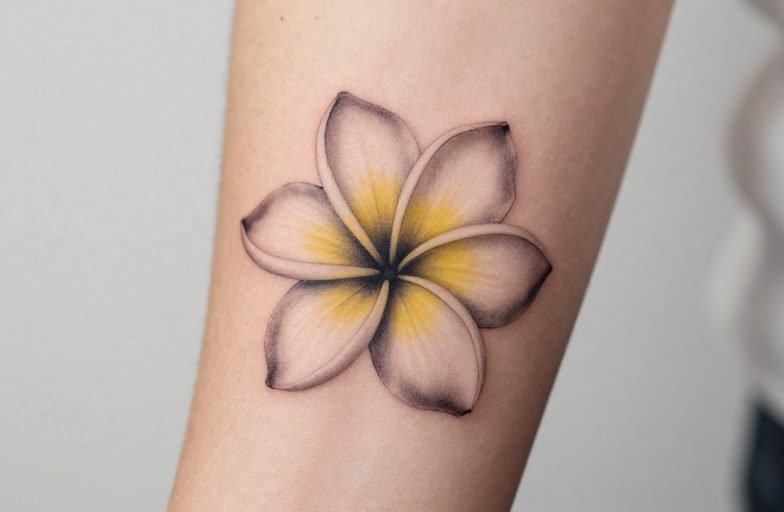
A frangipani tattoo most commonly represents the full cycle of life, birth, death, and rebirth, rooted in its tropical habit of shedding and regrowing blooms year-round. The flower’s five waxy petals and powerful fragrance have made it a symbol of immortality, devotion, and the soul’s persistence across Hindu, Buddhist, and Polynesian traditions. What you choose to emphasize depends on color, pairing, and where you place it on the body.
Symbolism & Core Meaning
The frangipani (Plumeria) carries its weight through biology as much as culture. The plant flowers on bare branches, often before leaves appear, creating a visual paradox of life emerging from apparent dormancy. This made it a natural emblem for resilience and return.
Color as Meaning
White frangipani dominates symbolism in most cultures, purity, the divine, and ancestral presence. Yellow and gold shades tie to solar energy and abundance in Southeast Asian contexts. Deep pink or red varieties, less common in the wild, read as passion or intensity when chosen for tattoo work. Black and grey renditions strip away color-coded meaning entirely, forcing the form itself to carry the symbolism: the five-petaled structure, the spiral center, the way the bloom cups upward.
The Five Petals
The consistent five-petal structure isn’t decorative accident. In Balinese Hindu practice, the five petals map to the panca maha butha, the five elements of earth, water, fire, air, and ether. Tattoo designs that emphasize this geometry, either through dotwork at the petal joints or by separating the petals slightly, can quietly signal this elemental reading without explicit iconography.
History & Cultural Roots
The flower’s name itself carries colonial weight. “Frangipani” derives from an Italian nobleman, Marquis Frangipani, whose perfumed gloves became fashionable in sixteenth-century Europe. The flower, already known in the Americas and Asia, got saddled with this European label during expansion. The plant itself is native to Central America and the Caribbean, spread by Polynesian voyagers and later colonial trade routes.
Southeast Asian Adoption
In Thailand, Laos, and Cambodia, the flower (called dok champa or similar variants) became the national bloom of Laos and deeply embedded in Buddhist temple architecture. Stone carvings at Angkor Wat and contemporary Lao temples feature stylized frangipani as temple ground decoration. A tattoo drawing from this lineage often carries the flower with a more elongated, architectural petal structure than the rounded Hawaiian-style plumeria common in American shops.
Polynesian Spread
Polynesian navigators carried the plant across the Pacific. In Hawaii, it became the plumeria of leis and greeting, though this association is relatively recent, nineteenth-century plantation era rather than ancient kapu system. The distinction matters for tattoo wearers seeking authentic cultural connection versus tourist-era symbolism.
Mythology & Folklore
Hindu mythology often links the frangipani to immortality through its association with the kalpavriksha, the wish-fulfilling tree. Some trace the flower’s nighttime fragrance to the belief that it attracts spirits and deities when other blooms sleep. In Balinese tradition, the flower is the preferred offering for certain temple ceremonies precisely because its fragrance is said to please specific deities more than other available blooms.
The Ghost Flower Connection
Indonesian and Malaysian folklore sometimes calls the frangipani “kamboja” or associates it with graveyard plantings. The tree’s tolerance for poor soil and its ability to root from cuttings made it practical for cemetery borders. This practical origin fed darker folklore, stories of the flower blooming from graves, or its scent luring the living toward death. A tattoo playing into this angle might pair the bloom with skulls, moths, or nocturnal imagery, though the association is regional rather than universal.
Religious & Spiritual Angles
Buddhist practice across Theravada countries uses frangipani as temple offering, but with specific rules. The flower must be fresh, the stem cut clean, the mind focused during offering. A tattoo referencing this practice carries devotional weight only if the wearer understands the offering context, otherwise it risks empty appropriation.
Hindu Temple Symbolism
In Balinese Hinduism, the flower’s placement matters. Offerings at the base of statues use whole flowers; priests tuck single blooms behind the ear during ceremony. The direction the flower faces, the color chosen, the number included, all carry specific ritual meaning that doesn’t automatically transfer to skin.
Modern Spiritual Use
Contemporary yoga and wellness culture has adopted the frangipani as generic “tropical spirituality” shorthand. This usage, common in Western tattoo shops, often strips the specific religious context. The result isn’t invalid, personal meaning is personal, but it’s worth knowing the difference between a culturally situated symbol and a commercially flattened one.
Personal & Modern Meanings
Outside religious frameworks, the frangipani functions as memorial flower, travel marker, and resilience symbol. Its hardiness, surviving drought, salt, and poor soil, translates directly to personal narrative for many wearers. The bloom’s brief individual life (a single flower lasts days) versus the plant’s decades-long persistence offers a ready metaphor for loss and continuation.
Placement as Statement
- Behind the ear: intimate, personal, often tied to scent memory or voice
- Shoulder cap: visible but coverable, common for first tattoos with meaning
- Ribcage: the bloom’s curve follows the body’s structure naturally
- Foot or ankle: travel, pilgrimage, or “roots” wordplay
- Upper back, centered: devotional positioning, echoing temple offering placement
Generational Shifts
Older wearers often choose white or pale yellow, emphasizing the flower’s traditional associations. Younger clients increasingly request saturated neotraditional color or abstract geometric breakdowns. Neither is more authentic, the plant itself produces multiple color variants, and human interpretation has always shifted with context.
Design Tips & Pairings
The frangipani’s structure suits certain tattoo approaches better than others. The petals’ overlapping spiral creates natural depth, making the flower a strong candidate for both flat graphic styles and dimensional realism.
Line Work vs. Shading
Single-needle outline captures the petal edges and central spiral cleanly, aging well on high-movement areas like wrists or collarbones. Heavy black shading in the center creates contrast that holds over years, but soft grey-wash on the petal interiors risks muddying as the tattoo ages, white highlight dots tend to disappear entirely on lighter skin within five to seven years. Color packing (solid, saturated pigment) outlasts delicate watercolor approaches, which often settle into unrecognizable blurs within a decade.
Common Pairings and Their Weight
- Sea turtles: Pacific navigation, longevity, often overused to the point of cliché
- Mandala or geometric frame: spiritual structure, works best when the geometry relates to the five-petal form
- Script or lettering: risky; the flower’s curves fight straight text lines
- Skull or hourglass: mortality, the ghost-folklore angle, requires careful balance to avoid generic “tropical goth”
- Single bloom, no background: clean, timeless, forces the flower to carry full meaning alone
Scale Reality
Small frangipani tattoos (under two inches) lose the central spiral detail that makes the flower identifiable. At minimum working size, the petals merge into a generic star shape. For single-bloom designs, three to four inches allows the spiral center to read as frangipani rather than abstract flower. Cluster arrangements can go smaller per bloom because context helps identification.
Key Takeaways
The frangipani’s meaning is layered but not infinite: life-death-renewal cycles, devotional offering, and resilient persistence form the core. Color choice, cultural source, and placement determine which layer you emphasize. The flower’s real biology, five petals, spiral center, fragrant night blooming, hardiness, shapes its symbolism more than any single myth. In design, respect the scale needed for the spiral to read, choose color or blackwork based on how you want it to age, and know if you’re drawing from specific tradition or general tropical association. Either works, but the difference matters for a tattoo you’ll carry.
Frequently Asked Questions
Does a frangipani tattoo always have spiritual meaning?
No. Many wearers choose it for purely personal reasons, memorial, travel, or aesthetic preference. The spiritual associations are available but not mandatory.
How well does frangipani tattoo color hold up over time?
Yellows and soft pinks fade faster than deep reds or solid black. White highlights typically disappear first. Saturated color packing ages better than delicate watercolor techniques.
What’s the difference between frangipani and plumeria in tattoo context?
Same plant, different names. “Plumeria” usually signals Hawaiian or broader Polynesian association; “frangipani” points to Southeast Asian, Indian, or botanical reference.
Is it culturally appropriative to get a frangipani tattoo?
The flower spans multiple cultures with no single ownership claim. Issues arise more from pairing it with specific sacred symbols you don’t understand, or claiming religious meaning you don’t practice, than from the flower itself.
Related Tattoo Meanings
- FTW Tattoo Meaning: Origins, Symbolism and Design Choices
- Fudog Tattoo Meaning: Guardian Lions, Protection Power
- Gardenia Tattoo Meaning: Purity, Secrets Quiet Strength
- Explore more









