
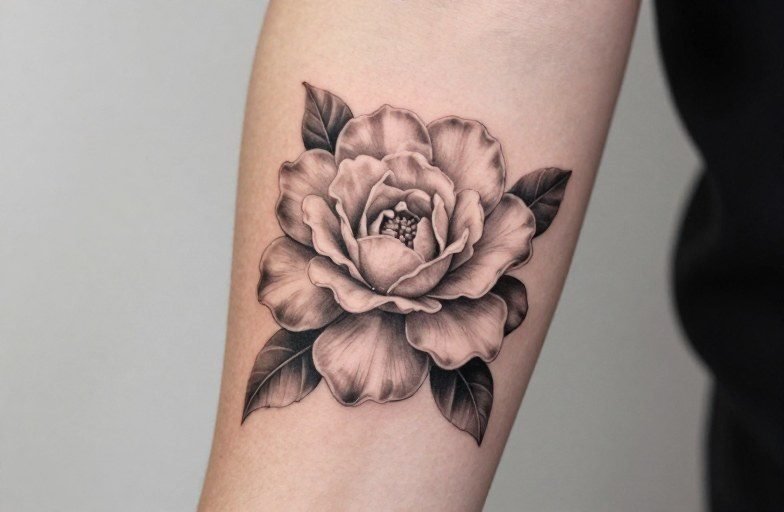
A gardenia tattoo most commonly signals purity, secret love, and quiet strength. The flower’s waxy white petals and intoxicating scent have made it a symbol of hidden affection and deep, unexpressed emotion across multiple cultures. On skin, it works as a private emblem, beautiful enough to display, personal enough that its full meaning stays between the wearer and whoever they choose to tell.
History & Cultural Roots
The gardenia’s symbolic weight accumulated slowly, across continents and centuries, rather than emerging from a single source. Understanding where these meanings come from helps explain why the tattoo carries such layered resonance today.
East Asian Origins
In China, the gardenia (zhīzi) appears in classical poetry and painting as an emblem of hidden virtue, beauty that doesn’t announce itself. The flower’s pure white color against dark, glossy leaves created a visual metaphor for moral clarity standing out from worldly confusion. Some trace its association with secret love to the Tang dynasty, where gardenia oil perfumed love letters. In Japan, the flower (kuchinashi, literally “no mouth”) reinforced themes of wordless emotion and things left unsaid. The name itself became a pun poets exploited: beauty without speech, feeling without declaration.
Western Adoption
European and American cultures encountered gardenias primarily through colonial trade and later through the flower’s popularity in corsages and bridal arrangements. By the early 20th century, gardenias had become associated with old money elegance, Southern gentility, and specifically with white formal wear, think gardenia boutonnieres at debutante balls. This elite association sometimes translates into tattoo choices as a nod to family heritage or regional identity, particularly in the American South. The flower also carries strong connections to jazz culture; Billie Holiday’s signature gardenia behind the ear made it an emblem of artistic sensibility and complicated femininity.
How It Ages on Skin
Gardenia tattoos present specific technical challenges that affect how they look five, ten, or twenty years down the line. The flower’s distinctive visual elements, smooth white petals, dark green leaves, yellow center, each age differently under skin.
- White ink: Pure white highlights on gardenia petals rarely stay bright. White pigment lacks titanium dioxide’s density in most formulations, so it yellows, fades to skin tone, or disappears entirely within 3-7 years. Most experienced artists use negative space (uninked skin) for the brightest petal areas rather than white ink.
- Soft shading vs. hard lines: Gardenias photographed in natural light show subtle tonal gradations. Translating this to tattoo requires smooth gray-wash or color blending. Linework-only gardenias read more graphic and stylized; they hold their structure longer but lose the flower’s characteristic softness.
- Dark leaves as anchor: The deep green or black-green foliage provides crucial contrast that helps the design remain readable as it ages. Without sufficiently dark leaves, a gardenia tattoo can become a pale blob as lighter pigments fade.
- Placement matters for longevity: Inner bicep, upper thigh, and torso placements (protected from sun) preserve fine detail far better than hands, feet, or collarbone areas where constant sun exposure and skin movement accelerate degradation.
Yellow centers, whether done in bright gold or muted ochre, tend to hold reasonably well but can muddy into brownish tones over time. Artists often recommend slightly oversaturating the yellow initially, anticipating this shift.
Common Variations & Styles
The gardenia’s simple radial structure, five to twelve petals spiraling from a central point, adapts across tattoo traditions with surprising flexibility. Each style carries different symbolic weight.
Single Bloom vs. Branch
A solitary gardenia blossom, often rendered at medium scale (palm-sized or larger), emphasizes the flower’s symbolic isolation, secret love, private grief, personal purity. The single bloom reads as contemplative, inward. Adding stem and leaves introduces narrative possibility: growth, connection to something larger, the passage of time. Multiple blooms on a branch suggest continuity, generations, ongoing devotion, or the persistence of memory.
Black and Gray Realism
This approach captures the gardenia’s sculptural quality, the way light plays across waxy petals. Done well, it creates a memorial or devotional tone. The absence of color strips away some of the flower’s associations with innocence and romance, replacing them with something more austere, mourning, perhaps, or serious commitment.
Traditional and Neo-Traditional
Bold outlines, limited color palettes, and stylized leaves distinguish these approaches. A traditional gardenia might feature deep green leaves with heavy black outlines, white petals with minimal shading, and a bright yellow center. The style’s graphic clarity ensures longevity and immediate readability. Neo-traditional work might introduce decorative elements, jewelry, filigree, or geometric frames, that complicate the flower’s meaning, adding personal or cultural layers.
Minimalist and Fine Line
Single-needle or very fine line gardenias have proliferated recently. These delicate designs emphasize the flower’s elegance but require careful placement and afterthought about aging. Fine line gardenias work best small, in protected areas, and often carry a deliberately temporary or ephemeral quality that some wearers find appropriate to the theme of fleeting beauty or secret emotion.
Religious & Spiritual Angles
The gardenia’s symbolic vocabulary intersects with spiritual traditions in specific, sometimes unexpected ways.
In Christian iconography, white flowers broadly represent the Virgin Mary’s purity, and gardenias occasionally appear in this context, particularly in Catholic communities of the American South and Latin America. The flower’s association with secret love can also map onto divine love, the hidden, ever-present nature of grace. Some wearers choose gardenias as baptism or confirmation tattoos, marking spiritual commitment without the more explicit cross or Marian imagery.
Buddhist and Hindu interpretations sometimes draw on the gardenia’s Chinese and Japanese associations with wordless teaching, the transmission of wisdom beyond language. The flower’s strong fragrance, released without visible action, becomes a metaphor for dharma or spiritual influence that operates without force.
Contemporary spiritual but non-religious wearers often gravitate toward the gardenia as an emblem of intuitive knowledge, truths felt rather than reasoned, the body’s wisdom. This interpretation emphasizes the flower’s connection to scent, our most primal and least verbal sense.
Who Chooses This Tattoo
Certain patterns emerge in who selects gardenia tattoos, though individual reasons always vary.
- People with Southern or Caribbean heritage: The gardenia’s cultural prominence in these regions makes it a natural choice for those marking family roots or regional identity.
- Those processing hidden or complicated relationships: The secret love symbolism attracts people who’ve experienced love that couldn’t be openly expressed, affairs, LGBTQ+ relationships in unsupportive environments, love across social boundaries, or simply profound feelings never declared.
- Survivors of specific hardships: The gardenia’s thick, waxy petals suggest resilience; they don’t bruise or wilt easily. Some wearers connect this to surviving illness, abuse, or loss.
- Music and performance communities: Billie Holiday’s legacy makes the gardenia a recognized emblem within jazz and blues circles, sometimes chosen by musicians or fans as tribute.
- People marking transitions: The flower’s association with purity (new beginnings) and its use in wedding arrangements makes it common for marriage tattoos, fresh starts after divorce, or recovery milestones.
Gender presentation varies widely with this design. Gardenias read as traditionally feminine but have been successfully adapted into masculine compositions through larger scale, incorporation with skulls or daggers, or placement in more conventionally “masculine” locations.
Personal & Modern Meanings
Beyond inherited symbolism, gardenia tattoos accumulate personal significance through the specifics of each design choice.
The addition of dates, names, or coordinates transforms a generic flower into a memorial or anniversary marker. Some wearers include insects, bees, moths, butterflies, suggesting pollination, attraction, or the gardenia’s nocturnal scent-dispersal strategy. Others incorporate handwriting samples, creating direct connection to specific loved ones.
Color variations carry modern symbolic weight. Pink gardenias (cultivated varieties exist, though rare) suggest gentler, more romantic emotion than the stark white of traditional symbolism. Yellow or golden gardenias, sometimes chosen for aesthetic contrast against darker skin tones, shift the meaning toward joy and celebration rather than secretive purity. Blue gardenias don’t exist in nature; their appearance in tattoos signals deliberate artifice, fantasy, or the transformation of the impossible into the permanent.
Placement increasingly carries meaning. Behind the ear directly references Billie Holiday and suggests public performance of private identity. Over the heart maintains the classic secret-love reading. Along the spine or ribs, hidden, protected, close to breath and pulse, emphasizes intimacy and vulnerability. Ankle and wrist placements, more visible, suggest willingness to share the symbol’s meaning with others.
Final Word
The gardenia tattoo endures because it balances accessibility with depth. Its meanings are specific enough to matter, purity, secret love, quiet strength, hidden virtue, yet flexible enough to accommodate individual experience. The flower’s formal simplicity (radial petals, strong leaves, central point) makes it technically achievable for most skilled artists, while its cultural associations provide ready vocabulary for wearers who want symbolism without having to invent it whole cloth.
What separates a successful gardenia tattoo from a forgettable one is usually the specificity of the wearer’s connection to the symbol. The flower rewards intention. Chosen for genuine resonance rather than generic beauty, executed with technical awareness of how its distinctive elements age, the gardenia becomes a lasting private language, beautiful to observers, fully meaningful only to the one who wears it.
Frequently Asked Questions
Does a gardenia tattoo always mean secret love?
Not necessarily. While secret love is the most common traditional association, wearers choose gardenias for purity, resilience, family heritage, musical tribute, or personal milestones. The meaning depends on your specific context and what you bring to the design.
How well do white gardenia petals hold up over time?
White ink fades faster than darker pigments and often yellows or disappears into skin tone. Most skilled artists use negative space, leaving skin uninked, for the brightest petal areas, which preserves the white appearance far longer than white pigment alone.
What’s the best size for a gardenia tattoo?
Palm-sized or larger works best for capturing the flower’s layered petal structure. Too small, and the detail blurs within a few years. Single-needle minimalist gardenias can work at smaller sizes but require protected placement and acceptance that they’ll soften significantly over time.
Can men wear gardenia tattoos without them looking feminine?
Absolutely. Scale, placement, and surrounding elements matter more than the flower itself. Larger designs on chest, back, or thigh, combined with bold linework, geometric frames, or complementary imagery like daggers or skulls, create masculine presentations. The gardenia’s jazz heritage also provides culturally masculine reference points.
Related Tattoo Meanings
- Floral Tattoo Meaning
- Gecko Tattoo Meaning: Adaptation, Survival Quiet Luck
- Goose Tattoo Meaning: Loyalty, Migration Guardianship
- Explore more









