
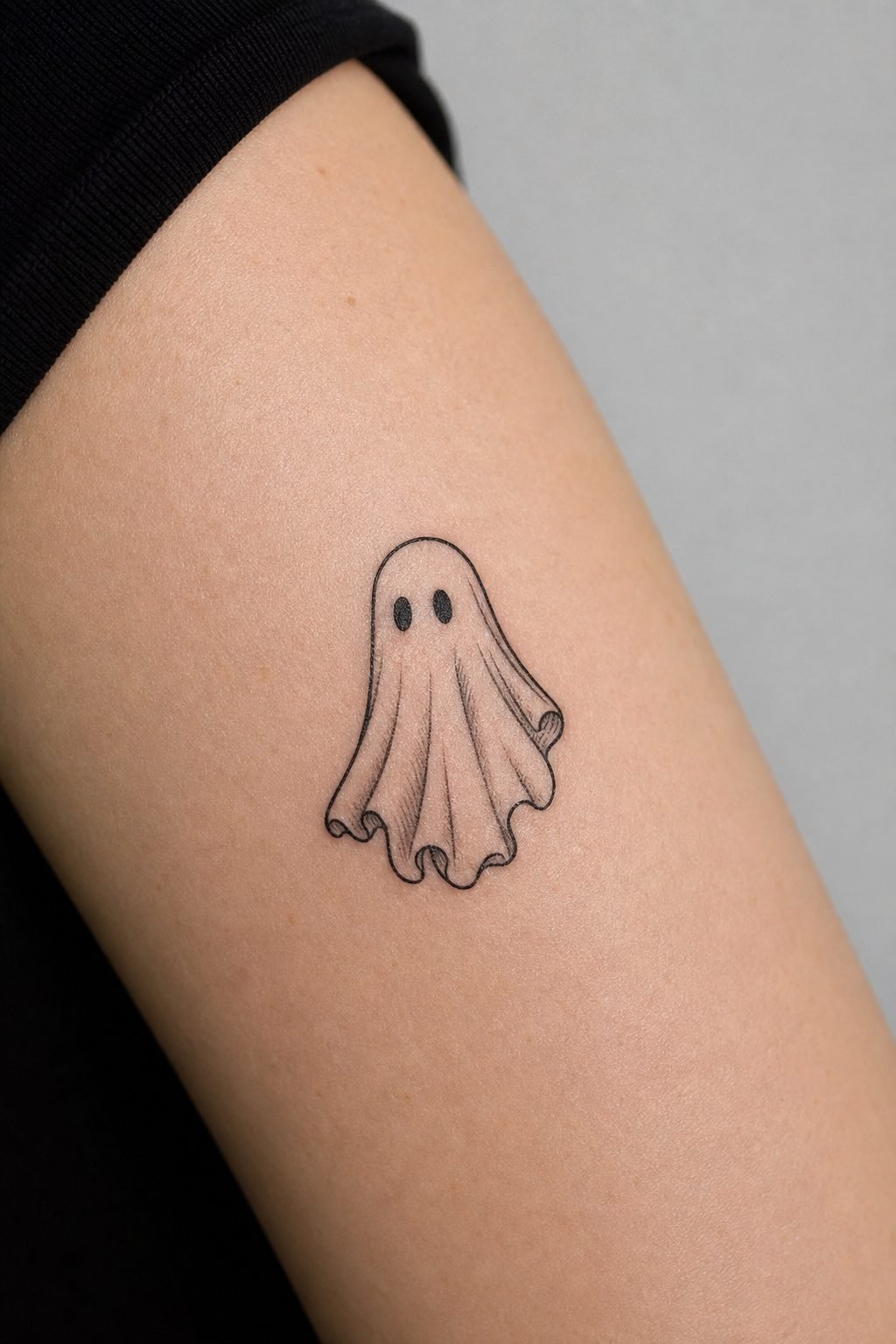
The Origened Nature of Ghost Imagery in Tattoo Art
Ghost tattoos occupy a distinctive space in contemporary body art, drawing on imagery that resonates across cultures and centuries. Unlike overtly macabre designs, these tattoos typically favor ethereal suggestion over graphic horror. The translucent figure, the hollow eye, the dissolving form, each element carries weight that shifts based on context, placement, and accompanying imagery.
Understanding what ghost tattoos communicate requires looking at how different traditions have conceptualized spirits. Japanese yūrei imagery often depicts flowing white garments and long, unbound hair, rooted in specific funeral customs. Celtic traditions contributed the bean sí or banshee, a wailing spirit tied to family lineage and impending death. These varied sources have filtered into modern tattoo vocabulary, where artists blend and reinterpret according to individual vision.
Visual Language: Transparency and Dissolution
The technical challenge of rendering something immaterial on solid skin gives ghost tattoos their particular power. Artists frequently employ negative space, strategic fading, and grayscale washes to simulate translucency. Some designs incorporate torn edges, smoke wisps, or water-like ripples where the figure meets empty skin. This interplay between presence and absence mirrors the subject matter itself.
- Single-needle work excels at fine, wispy linework suggesting instability
- Dotwork and stippling create atmospheric depth without heavy saturation
- White ink highlights, when healed properly, can suggest luminescence against darker backgrounds
- Double exposure techniques merge ghost figures with landscapes, clocks, or natural elements
Memory and the Unfinished: Grief in Visual Form
Among the most common motivations for ghost tattoos is memorial. The ghost functions as a vessel for presence after physical absence, neither fully alive nor completely gone. This liminal quality makes it emotionally suited to processing loss without the literalness of a portrait or dates.
Specific approaches to memorial ghost tattoos vary considerably. Some choose recognizable silhouettes of the deceased, rendered translucent or surrounded by meaningful objects. Others prefer anonymous figures, perhaps a child in vintage clothing, an adult in period dress, suggesting the departed without literal representation. Objects associated with the person often anchor the ethereal form: a musical instrument, gardening tools, a book held in semi-transparent hands.
Personal Objects and Symbolic Anchors
The relationship between ghost figure and accompanying imagery determines much of the tattoo’s emotional register. A ghost cradling a specific flower differs substantially from one emerging from a broken mirror or standing in an empty doorway. Consider how these pairings function:
- Clocks or hourglasses emphasize suspended time, moments unlived or frozen
- Natural elements like falling leaves or snow suggest cycles and impermanence
- Architectural features, windows, staircases, thresholds, imply passage and liminality
- Animals, particularly pets, rendered as spirits alongside human figures
Placement carries additional significance in memorial work. Chest pieces over the heart, inner forearms where visible to the wearer, or upper back positions where the figure seems to accompany or watch over, all carry distinct emotional weight.
Transformation and the Self That Was
Beyond memorial, ghost tattoos frequently represent personal transformation. The past self as specter, haunting, instructive, or merely witnessed, offers a framework for acknowledging growth without dismissing earlier experience. This application tends toward more abstract or stylized imagery, sometimes incorporating multiple figures suggesting different life stages.
Artists working in this territory often explore fragmentation. A face partially dissolved, a body transitioning into birds or smoke, a figure reflected in water that shows something different beneath the surface. These visual strategies literalize the psychological experience of feeling both continuous and changed.
Rebirth Imagery and Cyclical Interpretation
Certain cultural frameworks treat ghosts not as endpoints but as transitional states. Buddhist concepts of the bardo, intermediate existence between death and rebirth, have influenced tattoo imagery emphasizing passage rather than finality. Similarly, Mexican Día de los Muertos visual traditions, while distinct from ghost imagery per se, inform approaches that celebrate rather than mourn spiritual persistence.
Designs incorporating these frameworks might include:
- Butterflies or moths emerging from or composing the ghost form
- Phoenix imagery merged with spectral figures
- Geometric or mandala patterns suggesting cosmic order within dissolution
- Color transitions from grayscale to full saturation, suggesting movement between states
Protection, Warning, and Spiritual Presence
Historically, spirit imagery often served protective functions. Roman lemures required placation; ancestral spirits in numerous traditions offered guidance and guardianship. This protective dimension persists in contemporary ghost tattoos, though frequently secularized or personally reinterpreted.
Guardian figures in tattoo form range from specific ancestors rendered watchful to more archetypal spirit presences. The hollow-eyed protector, the silent witness, the figure that stands at the threshold between the wearer and unseen threat, these recur across portfolios. Unlike explicitly religious guardian imagery, ghost protectors maintain ambiguity about their nature and intentions, which some find more honest or personally resonant.
The Uncanny as Aesthetic Strategy
Deliberately unsettling ghost tattoos occupy their own category. Drawing on horror aesthetics but stopping short of graphic gore, these designs leverage the uncanny, familiar yet wrong, almost human but not quite. Techniques include:
- Distorted proportions, particularly elongated limbs or oversized features
- Reversed or absent facial features
- Multiple eyes, mouths, or limbs suggesting supernatural perception or capability
- Juxtaposition of childlike forms with threatening contexts
Such work demands technical precision; the uncanny fails if execution reads as accidental rather than intentional. Artists specializing in this approach often study specific horror illustration traditions, from Victorian ghost story imagery to contemporary Japanese horror aesthetics.
Design Considerations and Technical Execution
Successful ghost tattoos require particular technical awareness. The subtleties that make these designs effective, soft edges, atmospheric effects, implied motion, also make them challenging to execute and maintain. Skin type, placement, and aftercare significantly impact how well ethereal effects heal and age.
Grayscale work dominates ghost tattooing for good reason. Color, particularly saturated or warm tones, tends to assert physical presence contrary to the desired effect. When color appears, it typically functions as limited accent: pale blue suggesting cold, faint red implying residual life, green-gold for certain supernatural associations. White ink remains controversial; while effective when fresh, it often yellows or disappears entirely depending on skin tone and sun exposure.
Longevity and Aging
All tattoos spread and fade; ghost designs face particular risk since their impact depends on delicate gradations. Strategic use of slightly heavier linework in core areas, with intentional fading toward edges, often ages more gracefully than uniformly subtle approaches. Experienced artists plan for this, building in structural elements that maintain readability even as fine details soften.
- Contrast levels should be checked in grayscale during design phase
- Areas of intended negative space require careful planning against surrounding work
- Touch-up schedules should be discussed, as ghost tattoos may need refreshing sooner than bolder designs
- Scale matters: overly small ethereal details often become indistinct within years
Final Thoughts
Ghost tattoos resist singular definition, which constitutes their strength. The same visual vocabulary serves mourning, transformation, protection, and aesthetic exploration depending on context and intention. What unifies the form is its engagement with liminality, presence and absence, memory and forgetting, the material and the imagined.
For those considering ghost imagery, clarity about personal motivation matters more than adherence to conventional symbolism. The most enduring examples emerge from genuine need rather than trend adoption. Consultation with artists who have demonstrated fluency in atmospheric, figurative work yields better results than approaching specialists in unrelated styles. The technical demands are real; the emotional stakes, for many, equally so.
Ultimately, ghost tattoos offer a rare convergence: imagery with deep cultural roots, substantial technical challenge, and genuine capacity for personal meaning. Whether honoring the dead, acknowledging internal change, or simply drawn to the aesthetic possibilities of rendered absence, the form rewards thoughtful engagement with its complexities.
Frequently Asked Questions
Do ghost tattoos have negative or dark connotations?
Not inherently. While ghost imagery connects to death and the supernatural, contemporary applications emphasize memory, transformation, and protection. The emotional register depends entirely on design choices, accompanying imagery, and personal intention. Many ghost tattoos function as gentle memorials rather than macabre statements.
What tattoo styles work best for ghost imagery?
Black and grey realism, fine line work, and illustrative styles translate most effectively. The subtle gradations these approaches allow support the ethereal quality central to ghost imagery. Some neo-traditional and Japanese-influenced work also adapts well, though with bolder graphic sensibility. Fully saturated color styles generally struggle to achieve the desired translucent effect.
How well do ghost tattoos age over time?
They require more maintenance than bold, high-contrast designs. Fine details and soft edges are vulnerable to spreading and fading. Planning for aging during design, incorporating structural elements that remain readable, helps significantly. Expect more frequent touch-ups than with heavier traditional work, and prioritize sun protection to preserve subtle gradations.
Can ghost tattoos incorporate specific cultural imagery respectfully?
Research and consultation matter enormously. Japanese yūrei, Celtic bean sí, Mexican calavera-influenced work, and other culturally specific forms carry histories and protocols. Working with artists knowledgeable about the tradition, or avoiding direct appropriation in favor of personally developed imagery, represents best practice. Avoid treating culturally meaningful forms as generic spooky aesthetics.









