
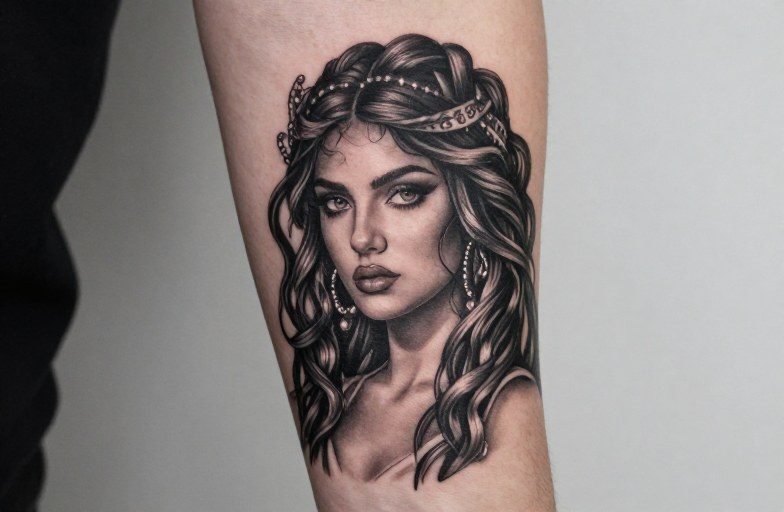
A Hecate tattoo most directly signals devotion to the liminal: the spaces between life and death, choice and consequence, the known and the hidden. The Greek goddess Hecate governs crossroads, magic, and the night, and her imagery carries weight for people drawn to transformation, protection, or the reclaiming of feminine power that patriarchal narratives tried to bury. The meaning shifts with the specific imagery, her torch, the triple form, the keys, the dogs, but the core remains about navigating uncertainty with agency.
Who Chooses This Tattoo
Walk into any shop booking Hecate-inspired work and you’ll notice patterns, not stereotypes. The client base skews toward people who’ve undergone significant personal metamorphosis, career pivots, gender transitions, recovery, spiritual awakenings. There’s also a strong contingent among practicing witches, Hellenic pagans, and occultists who want devotional ink that isn’t mass-market.
The Triple Goddess Connection
Many who choose Hecate specifically resonate with the maiden-mother-crone archetype she embodies, though her crone aspect dominates. This appeals to people rejecting youth-obsessed culture, particularly women entering middle age who find power in the “hag” label that patriarchal stories weaponized. The triple form, three faces or three figures back-to-back, lets the wearer claim complexity rather than the flattening “good woman” archetype.
Occult Practitioners vs. Symbolic Adopters
There’s a meaningful split here. Devotional pieces for actual practitioners tend toward traditional iconography: torches, keys, serpents, black dogs, sometimes Greek inscriptions. The symbolic adopter, someone who connects to the crossroads metaphor without religious practice, often gravitates to more abstract or neo-traditional renderings. Neither approach is illegitimate, but the design conversation with your artist should clarify which camp you’re in, since accuracy matters to practitioners and artistic freedom matters more to the symbolically motivated.
Personal & Modern Meanings
Contemporary Hecate tattoos rarely stay purely classical. The symbol gets layered with personal narrative in ways that would confuse ancient Greeks but make perfect sense in the chair.
Crossroads as Literal Life Moments
The goddess’s dominion over crossroads translates cleanly to modern experience: divorce, coming out, emigration, sobriety, leaving cults or high-control religions. Some designs incorporate actual geographic coordinates or dates into the crossroads imagery, binding the mythic to the specific. The torch she carries becomes illumination during dark periods; the keys become access to locked parts of the self.
Reclamation of the Witch Figure
Post-2016, Hecate saw a surge in bookings connected to political awakening and feminist reclamation. The witch as resistant figure, persecuted, misunderstood, powerful anyway, resonated for obvious reasons. Tattoos in this vein sometimes pair Hecate with contemporary resistance symbols: raised fists, protest dates, or reworked traditional imagery that centers agency rather than male gaze sexuality.
Color vs Black and Grey
Your palette choice fundamentally changes how this tattoo reads and how it ages.
Black and Grey: The Atmospheric Approach
Most Hecate work lives in black and grey, and for sound reasons. The nocturnal associations feel natural without color. Smoke, moonlight, torch flame rendered in greywash, the texture of her cloak, this all works beautifully in monochrome. The triple silhouette against a moon reads instantly. Black and grey also ages more predictably; fine color detail in torch flames or serpent scales often muddies within five to seven years unless generously sized.
Strategic Color Use
When color appears, it’s usually limited and symbolic: torch flame in yellow-orange, serpent in green, moon in pale blue or silver. Some neo-traditional pieces use purple for magic associations, though this can read generic “witchy” rather than specifically Hecate. The key with color here is restraint, her iconography is already visually busy (three figures, multiple animals, flames, keys). Adding full spectrum risks visual chaos, especially at smaller sizes.
Mythology & Folklore
Understanding the source material helps you avoid accidentally wearing something that contradicts your intention.
Classical Sources and Their Limits
Hesiod’s Theogony gives her the most authoritative early treatment, emphasizing her universal honor and gifts from Zeus. Later sources, particularly the Homeric Hymn to Demeter, cement her chthonic, underworld-adjacent role. The triple form itself is often linked to later syncretism with other moon goddesses, not purely original to her cult. What persists across sources is her association with boundaries, transitions, and knowledge accessible only to those willing to travel at night.
The Suppressed Cult
Christianization didn’t erase Hecate cleanly; it demonized her, transforming her into the witch-queen of medieval imagination. Her torch became hellfire, her dogs became hellhounds, her crossroads became sites of diabolical pacts. Some modern wearers specifically choose her to reverse this suppression, wearing what was meant to frighten as a badge of survived persecution. The tattoo becomes archaeological recovery as much as personal statement.
Similar & Related Symbols
Clients considering Hecate often weigh her against related imagery. Knowing the distinctions prevents regret.
- Persephone: Underworld connection, but seasonal cyclicality rather than liminal governance. Better for narratives of descent and return, less for ongoing navigation of uncertainty.
- Medusa: Protection and petrification, the gaze as weapon. Hecate offers more ambiguity; Medusa offers more direct confrontation.
- The Morrigan: Celtic war/fate goddess with triple aspect. More martial, less magical. Choose based on which cultural framework resonates.
- Triple moon symbol (waxing, full, waning): Generic Wiccan imagery without Hecate’s specific narrative weight. Simpler, less visually complex, but also less distinctive.
- Keys alone: Saint Peter, papal authority, or Hecate’s keys. Context and surrounding imagery determine reading.
If you’re drawn to multiple figures, consider whether the triple form specifically matters, or whether a single Hecate with her attributes would communicate more clearly at smaller sizes.
Best Placements
Hecate’s visual complexity creates real constraints. Three figures, animals, objects, this adds up fast.
Scaling Reality
The triple form needs room to read. At under four inches, three faces become three smudges within a few years. Thigh, upper arm, calf, and back pieces offer the real estate. Ribs and sternum can work for single-figure Hecate with selective attributes, but the triple form struggles there unless you’re very large-framed. Forearms and wrists generally suit symbolic extracts, a single torch, a key, a black dog, rather than full narrative compositions.
Flow and Body Geometry
The triangular composition of three figures back-to-back naturally suits certain body contours. Upper back, with the point descending toward the spine, creates natural symmetry. Thigh pieces can orient the triangle with one figure forward, two receding, playing with depth. Consider how clothing covers or reveals; Hecate’s occult associations mean some wearers want control over visibility in professional contexts.
Before You Decide
Spend time with the specific iconography, not just the name. A torch means illumination; keys mean access or binding; the black dog means psychopomp guidance or protection depending on rendering. The serpent means rebirth or poison, wisdom or danger. These aren’t interchangeable decorative elements, they’re a language.
Research your artist’s comfort with the subject matter. Some excel at classical figuration but struggle with occult symbolism; others do dark, atmospheric work beautifully but lack anatomical precision for multiple faces. Ask to see healed photos, not just fresh work. The fine lines in triple faces and the greywash in torchlight are exactly where mediocre execution becomes obvious after healing.
Finally, sit with whether you want this because the symbol genuinely moves you, or because it’s currently visible in witchy aesthetic circles. Hecate’s iconography is too specific, too visually complex, to wear casually. The people who love this ink long-term are the ones who needed what she represents before they knew her name.
Frequently Asked Questions
Does a Hecate tattoo require me to practice witchcraft?
No. Many people choose her for the crossroads symbolism, personal transformation, or feminine power without any religious practice. The meaning lives in your relationship to the symbol, not in formal affiliation.
What’s the difference between Hecate and the triple moon symbol?
The triple moon is a generic Wiccan symbol representing maiden, mother, and crone phases. Hecate is a specific goddess with her own mythology, attributes, and iconography. They’re sometimes visually similar but carry different narrative weight.
How much detail can I include in a small Hecate tattoo?
Less than you probably want. Three faces with attributes need significant size to age well. At under four inches, consider a single symbolic element, torch, key, or black dog, rather than the full triple form.
Is the triple-bodied Hecate historically accurate?
The triple form is often linked to later syncretism with other goddesses rather than her earliest cult. Classical sources describe her with single form and multiple attributes. Both approaches are valid depending on whether you prioritize ancient accuracy or evolved tradition.
Related Tattoo Meanings
- Greek Goddess Tattoo Meaning: Symbolism, Styles Placement
- Moon Cycle Tattoo Meaning
- Lunar Phase Tattoo Meaning
- Explore more









