
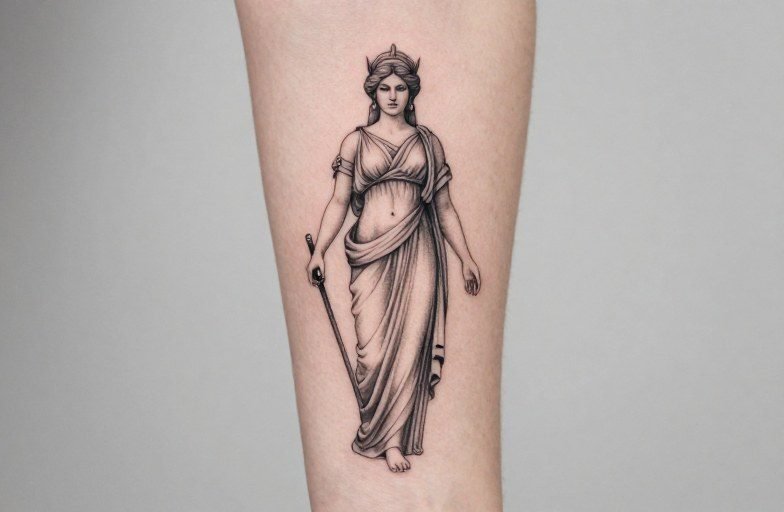
Greek goddess tattoos draw from one of the most visually striking and symbolically dense mythologies in human history. These designs typically channel specific divine attributes, Athena’s strategic wisdom, Aphrodite’s erotic power, Artemis’s untamed independence, rather than generic “goddess energy.” The meaning hinges on which figure you choose and how she’s rendered: a serene marble bust reads differently than a wrathful Hecate torching a threshold.
Symbolism & History
The Major Olympians
Each goddess carries distinct iconography that tattoo artists have mined for decades. Athena, often shown with helmet, owl, or aegis, signals intellectual combat, she’s the patron of tactics, not just war. Aphrodite, whether born from seafoam or paired with doves and roses, anchors designs around desire, generative power, and sometimes the danger of beauty (her affair with Ares, the cursed necklace of Harmonia). Artemis with bow and stag speaks to autonomy, bodily sovereignty, and the wild spaces outside civilization.
Lesser-known figures carry potent niche appeal:
- Hestia, hearth, domestic order, the flame that stays lit; rare but deeply personal for those who’ve built sanctuary from chaos
- Nemesis, retribution, proportionate justice, the reckoning you don’t outrun
- Hecate, crossroads, liminal spaces, necromancy; triple-formed and torch-bearing, she’s surged in popularity among those drawn to witchcraft symbolism
- Persephone, the dual queen, spring growth and underworld descent; seasonal depression, survival, complicated motherhood
Visual Language of Power
Classical Greek art favored idealized proportions, contrapposto stances, serene expressions, draped garments that reveal and conceal simultaneously. This visual tradition gives goddess tattoos a built-in gravitas. The marble aesthetic, whether rendered in stark black-and-grey or muted color, carries associations of endurance, museum-worthiness, cultural weight. Some artists push against this, reimagining goddesses with modern features, punk styling, or mixed cultural elements, but the classical reference point remains the anchor.
Common Variations & Styles
Black-and-Grey Realism
The most technically demanding approach. Achieving convincing marble texture through stippling and whip shading separates competent artists from exceptional ones. Smooth skin gradients against rough stone grain create the illusion of sculpted material. These pieces age well if the black is saturated enough, grey-only realism tends to muddy after 5-7 years without strong dark anchors.
Neoclassical & Art Nouveau Hybrids
Mucha-influenced flowing lines, decorative borders, ornamental halos. These designs sacrifice some anatomical accuracy for rhythmic pattern and symbolic density. Aphrodite with hair becoming waves, Athena with owl integrated into geometric armor plating. The style suits larger pieces where the decorative frame can expand to fill space.
Graphic & Illustrative
Bold outlines, limited color palettes, sometimes incorporating text or modern symbols. A Medusa portrait with snake-hair simplified into graphic shapes, or a one-eyed Athena referencing street culture. These read faster from distance, hold clarity longer as they age, and allow more personal interpolation of the source material.
Statuary vs. Living Figure
Crucial distinction. Broken statuary, cracked marble, missing limbs, moss growth, speaks to lost civilizations, fragility of legacy, beauty in ruin. Living, breathing goddesses with human skin tones claim ongoing relevance, personal identification, sometimes defiance of classical restraint. The choice shapes meaning as much as the goddess selected.
Best Placements
Thigh and calf offer the vertical canvas for full-figure classical poses. The natural muscle structure can mirror contrapposto weight shift, enhancing dimensional illusion. These placements handle detailed drapery well and allow concealment for professional contexts.
Back pieces, especially upper back between shoulder blades, suit Athena or Artemis with weaponry, the scapular movement can animate drawn bows or raised spears. Spine placement risks distortion; center compositions carefully around vertebral landmarks.
Forearms and hands work for portrait crops or symbolic attributes (owl, torch, pomegranate) rather than full figures. The small scale demands simplification, fine detail blurs faster here due to thinner skin and constant movement. A Medusa hand piece, snakes wrapping fingers, has become a recognizable sub-genre but requires an artist experienced in hand anatomy and willing to discuss touch-up realities.
Ribs and sternum carry the classical association, Greek statuary often emphasized torso, and these placements echo that focus. Pain is significant; the trade-off is intimacy, the design held close to breath and heartbeat.
Who Chooses This Tattoo / Personal Meanings
Gender dynamics here are worth addressing directly. Greek goddess imagery has been marketed heavily toward women, but the tattoo’s appeal crosses boundaries. Men selecting Athena often emphasize her warrior aspect over maternal origin; men choosing Aphrodite sometimes frame it through aesthetic philosophy rather than erotic identification. The tattoo functions as aspiration, not necessarily identification, claiming qualities you want to cultivate or remember you possess.
Common personal threads include:
- Academic or professional transitions (Athena for new degrees, career pivots into leadership)
- Recovery from controlling relationships (Artemis’s virginity reinterpreted as self-ownership)
- Mother-daughter pairs (Demeter and Persephone, sometimes split across two bodies)
- Chronic illness or mental health management (Persephone’s seasonal descent, Hecate’s liminal navigation)
- Creative practice itself (the Muses, though technically nymphs, often grouped here; Calliope for epic poetry, Thalia for comedy)
The meaning isn’t inherent to the image, it’s activated by the specific goddess, the style chosen, the placement, the life context. Two Athena tattoos on different people can diverge completely: one celebrating military service, another marking escape from an intellectually suppressing environment.
Similar Symbols
Consider whether a Greek goddess is the right vessel, or if adjacent iconography serves better. Roman equivalents (Minerva, Diana, Venus) carry slightly different cultural weight, more imperial, less democratic-city-state. Norse goddesses (Freyja, Frigg, Hel) offer comparable complexity with different aesthetic registers. Hindu goddesses (Kali, Durga, Lakshmi) provide more explicit multi-armed power imagery but carry different cultural appropriation concerns.
Non-figural alternatives: olive branch (Athena), scallop shell (Aphrodite), hunting bow (Artemis), torch (Hecate, Demeter). These allow smaller scale, less commitment, sometimes easier integration into existing work. A full goddess portrait declares its significance; an attribute can whisper.
Medusa deserves separate mention. Once a monster figure, she’s been reclaimed, particularly since the 2010s, as a symbol of survivor resistance, the gaze that turns predators to stone. This reinterpretation is now mainstream enough that artists and wearers should know they’re participating in a specific contemporary conversation, not just classical reference.
Final Thoughts
Greek goddess tattoos endure because the source material offers both visual splendor and genuine conceptual depth. The risk is superficial engagement, selecting a goddess for aesthetic alone without grappling with her mythology. The best pieces result from sitting with contradictions: Athena born from her father’s skull, Aphrodite’s cruelty to those who don’t worship adequately, Artemis’s transformation of Actaeon. These aren’t sanitized empowerment figures; they’re complex, sometimes dangerous powers that demand respect. Your tattoo will live longer than the impulse that created it. Choose a goddess whose full story you can carry.
Frequently Asked Questions
Which Greek goddess is most commonly tattooed and why?
Athena and Medusa dominate, though for different reasons. Athena offers accessible symbolism, wisdom, strategy, protection, without the sexual baggage of Aphrodite. Medusa’s surge reflects reclaimed survivor narrative, her serpent hair visually striking and immediately recognizable even in simplified form.
How well do detailed Greek goddess tattoos age over time?
Line-heavy designs with strong black saturation age most predictably. Fine facial features, subtle marble texture, and delicate drapery folds tend to soften and merge within 7-10 years. Strategic use of bold outline around the figure’s silhouette preserves readability even as interior detail degrades.
Is it culturally appropriative to get a Greek goddess tattoo if I’m not Greek?
Greek mythology occupies a complicated position, widely taught in Western education, heavily commercialized globally, yet still actively meaningful to Greek cultural identity. Most Greek people welcome genuine engagement with the mythology; the friction arises from treating it as purely decorative exoticism. Researching the specific goddess beyond surface level demonstrates respect.
What’s the difference between a Greek goddess tattoo and a generic ‘goddess’ tattoo?
Specificity. Generic goddess imagery, flowing robes, moon imagery, vague feminine power, draws from multiple traditions and risks visual cliché. Naming and rendering a specific Greek goddess anchors the design in particular attributes, stories, and visual conventions. The difference is between claiming ‘divine femininity’ and claiming Athena’s particular brand of calculated, armored intelligence.
Related Tattoo Meanings
- Iris Tattoo Meaning: Symbolism, Styles Placement Guide
- Pete Hegseth Deus Vult Tattoo Meaning: Symbolism Explained
- Ram Head Tattoo Meaning: Power, Stubbornness Astrology
- Explore more









