
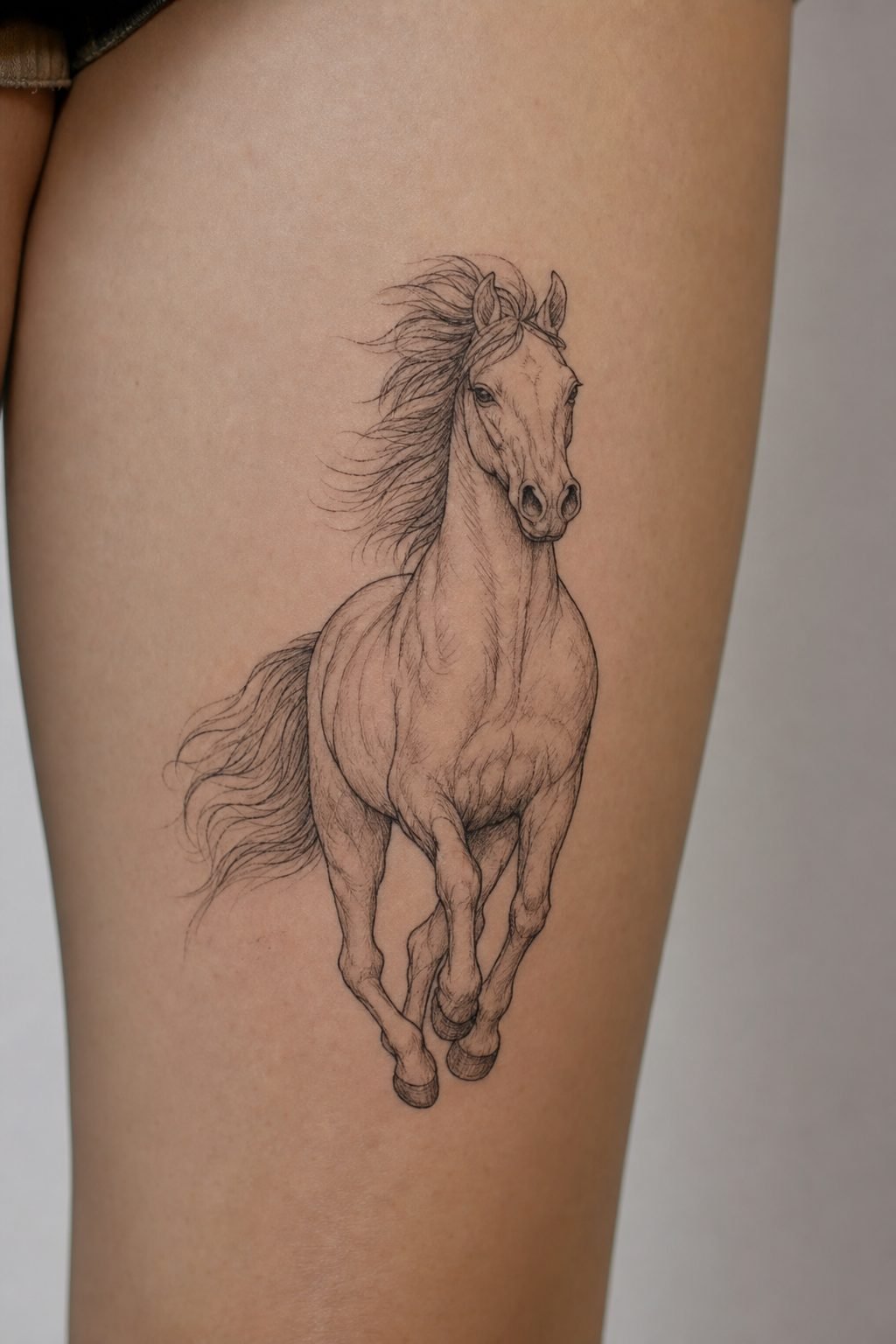
Horse Tattoo Meaning: Freedom, Strength & Spirit
The horse occupies one of the most enduring positions in tattoo iconography. Across millennia and continents, this animal has carried human ambition, anxiety, and awe on its back. Understanding what a horse tattoo communicates requires looking at biology, mythology, and the specific choices you make in design. No single meaning dominates. Instead, the horse operates as a flexible symbol whose significance sharpens or softens depending on breed, posture, color palette, and accompanying elements.
The Core Symbolism of Horse Tattoos
Freedom and Unrestrained Movement
Horses evolved as prey animals built for flight. Their entire physiology, from the elongated cannon bone to the expanded nostrils that oxygenate blood during gallops, serves escape and endurance. This biological reality underpins the tattoo’s association with liberty. A horse rendered at full stride, mane horizontal, hooves barely touching ground, captures something humans cannot easily access: pure, unburdened momentum. The image resonates particularly with those who have left restrictive environments, whether relationships, careers, or geographic origins. The freedom here is not merely political or philosophical; it is kinetic, embodied, visible in muscle tension and flying dirt.
Power Without Aggression
Strength in horse symbolism differs from the predatory force of bears or wolves. A horse’s power is cooperative, historically directed by human partnership yet never fully controllable. The draft horse pulling impossible weight and the Arabian cutting cattle both demonstrate capacity that exceeds brute force: stamina, responsiveness, willingness to work. Tattoos emphasizing this quality often show the neck arched, the haunch rounded, the eye alert but not wild. The strength is present, available, disciplined rather than explosive.
Spiritual and Psychic Dimensions
Many cultures positioned horses as intermediaries between worlds. Norse mythology features Sleipnir, Odin’s eight-legged steed traversing worlds. Celtic traditions often linked horses to the sun’s journey and to prophecy. In Buddhist symbolism, the horse carries the prince who will become the Buddha away from palace confinement toward enlightenment. These associations persist in tattoo choices: a horse with wings or multiple legs, a horse emerging from or dissolving into abstract elements, a horse paired with lunar or solar imagery. The spiritual horse is not tame; it is the vehicle that carries consciousness beyond ordinary limits.
Design Elements That Shape Meaning
Posture and Direction
A horse rearing upward carries confrontational energy, historically associated with war horses and cavalry charges. This suits those who have faced down opposition or who want to claim space. The same horse with head lowered, grazing or drinking, reads as peaceful, grounded, connected to earth rather than sky. Lateral movement, the classic galloping silhouette, emphasizes journey and transition. Forward-facing horses create direct engagement with the viewer; profile views allow contemplation of form and line. Your chosen posture should match not just aesthetic preference but the emotional register you want the tattoo to hold.
- Rearing: defiance, protection, readiness to engage
- Galloping: momentum, escape, pursuit of goals
- Standing alert: vigilance, presence, preparedness
- Head lowered: peace, connection to place, acceptance
- Recumbent: vulnerability, rest, mortality
Breed and Physical Type
Specific breeds carry distinct cultural weight. The Arabian, with its dished face and high tail carriage, connects to Bedouin nomadism and the romantic tradition of the desert. Heavy draft breeds, Clydesdales and Shires, evoke agricultural labor, working-class persistence, and the pre-industrial past. The American Mustang represents wilderness surviving domestication’s failure, a narrative of return to original nature. Ponies and Icelandic horses introduce playfulness or compact resilience. Your breed choice is rarely neutral; it locates the tattoo within specific historical and regional narratives.
Color and Markings
Black horses have served as psychopomps, guides to the afterlife, in European and Japanese traditions. White or gray horses often carry sacred or royal associations. The Appaloosa’s spotted coat, developed by the Nez Perce people, carries specific Indigenous history that should be approached with respect and understanding if incorporated. Facial markings, the blaze or star, can be emphasized for personal significance or minimized for classical purity. Color realism versus black-and-gray work changes emotional temperature: color tends toward vitality, black-and-gray toward solemnity or timelessness.
Cultural and Historical Contexts
Indigenous American Traditions
For Plains nations and others, the horse transformed existence after Spanish introduction in the 16th century. Buffalo hunting, warfare, and territorial expansion all reshaped around equestrian mobility. Horse imagery in tattoo or other art forms often linked to specific warrior societies, to horse medicine, or to the giveaway tradition where horses demonstrated generosity and status. Contemporary Indigenous tattoo practitioners may incorporate horse imagery as part of cultural reclamation, though this belongs properly to those communities rather than outside adoption.
East Asian Representations
Chinese tradition often linked the horse to success, speed, and perseverance, most notably in the motif of the eight horses of King Mu. Japanese tattooing (irezumi) includes horses among its classic subjects, frequently paired with floral elements or warriors. The horse appears in the zodiac as one of twelve animals, associated with straightforwardness, strength, and social ability. These traditions offer compositional approaches that differ from Western realism: more stylized, more integrated with surrounding pattern, more narrative in arrangement.
Classical and Military European Imagery
Greek and Roman equestrian sculpture established the horse as a vehicle for imperial and heroic representation. The mounted portrait became a genre extending through medieval chivalry to Napoleonic propaganda. Tattoo adaptations of this tradition range from literal reproductions of famous statues to ironic or critical variations. The classical horse tends toward ideal proportion, controlled energy, and public significance rather than private meaning.
Placement and Scale Considerations
The horse’s elongated form suits certain body areas and challenges others. The flank, thigh, or side of the torso allows the full body to extend naturally, following muscular lines. The back offers space for complex compositions, multiple horses, or integrated landscape. Smaller placements, wrist, ankle, behind the ear, require simplification that risks becoming generic; success depends on identifying the most essential line or silhouette and committing to radical reduction. Forearm and calf positions split the difference, allowing recognizable form at medium scale. Consider how the tattoo will interact with your movement: a galloping horse on a calf gains animation when you walk, a rearing horse on the chest rises and falls with breath.
Pairing Horses With Complementary Elements
Flowers soften the horse’s energy and introduce seasonal or symbolic specificity: peonies for prosperity in Japanese-influenced work, roses for passion or memorial, wildflowers for the Mustang’s prairie environment. Geometric frames or mandala backgrounds create contrast between organic and structured forms. Other animals change the narrative entirely: horse and rider establishes partnership and control; horse and raven introduces death and intelligence; horse and dog suggests domesticated loyalty in tension with wild freedom. Text elements, whether names, dates, or quotations, should be integrated carefully; the horse’s movement can make static lettering feel imposed rather than composed.
Final Thoughts
The horse tattoo endures because it operates on multiple registers simultaneously: biological reality, historical weight, personal aspiration, aesthetic pleasure. Your specific design choices, posture, breed, color, context, placement, determine which registers dominate. The best horse tattoos do not merely illustrate a concept like freedom or strength; they make that concept visible through particular decisions about form. Work with an artist who understands equine anatomy, not just symbolically but structurally: the angle of the pastern, the weight distribution in a canter, the way light falls across the shoulder. Precision in rendering supports depth in meaning. The horse has carried human meaning for thousands of years; your tattoo continues that tradition while making it singularly yours.
Frequently Asked Questions
What does a black horse tattoo typically symbolize?
Black horses have historically served as guides to the afterlife in European and Japanese traditions, carrying associations with mystery, transition, and the unknown. In contemporary tattooing, this often translates to themes of personal transformation, mourning, or confrontation with mortality. The specific meaning depends heavily on posture and accompanying elements, a rearing black horse reads differently than a grazing one.
Is it culturally appropriate for non-Indigenous people to get Mustang or Appaloosa tattoos?
The Mustang as a general symbol of wild American freedom exists in broad cultural circulation, though the specific history of Spanish colonial introduction and Indigenous adoption deserves acknowledgment. The Appaloosa’s spotted coat, however, carries particular significance tied to Nez Perce history and should be approached with care. If you are not Indigenous, consider whether your design draws on specific tribal iconography or merely references a breed’s physical appearance, and research accordingly.
How much detail is necessary for a small horse tattoo to be recognizable?
Small horse tattoos succeed through radical simplification rather than miniature replication. Focus on the most distinctive silhouette elements: the relationship between neck and head, the curve of the back, the proportion of leg to body. A skilled artist can suggest the full form through a few essential lines. Attempting to include mane texture, musculature, or facial features at very small scale typically produces muddled results.
What should I consider when choosing between color and black-and-gray for a horse tattoo?
Color emphasizes vitality, specific breed accuracy, and contemporary energy. Black-and-gray tends toward solemnity, historical reference, and timelessness. Consider your skin tone’s interaction with both approaches, how the tattoo will age, and whether your design references a tradition that historically used one or the other. Japanese-influenced work often uses color strategically; classical European equestrian imagery frequently employed monochrome. Your artist can advise on what reads best at your chosen scale and placement.









