Becoming a tattoo designer means learning to create art that lives on skin, not paper, not screens, but actual human bodies that move, stretch, and age. I’ve been in this trade for over a decade, and I can tell you straight: there’s no shortcut. You need to draw constantly, apprentice under a working artist, and understand how your designs will heal and settle over years. This guide covers the real path from drawing in your bedroom to working in a shop.
Start With the Fundamentals (And Never Stop)
Before you ever touch a machine, you need to draw. Not occasionally, daily. I still sketch every morning with coffee. Tattoo design demands fluency in line weight, black and grey contrast, color theory, and how shapes flow with body contours.
What to Actually Practice
Focus on subjects that translate to skin. Roses, skulls, daggers, script lettering, Japanese waves, traditional Americana, these staples appear constantly because they work. I tell clients who want to design that they should fill sketchbooks with:
- Bold line work with varying weights (think 3RL to 14RL needle groupings)
- Smooth gradients from black to skin tone
- Lettering in multiple styles: script, block, Old English, typewriter
- Animal and human anatomy from different angles
- Designs that wrap around cylinders (arms, legs) and flat planes (chest, back)
Your Instagram can wait. Your sketchbook can’t. I’ve watched too many eager kids post digital mockups before they can pull a clean line with a pencil.
Study How Tattoos Age
This is where bedroom designers crash. That intricate single-needle design with hair-thin lines? In five years it’s a grey smudge. I see this in my chair weekly, someone brings a Pinterest screenshot of fresh work, wants it replicated, and I have to explain why the artist used bolder lines and more negative space than the photo shows. Learn to design for the healed result, not the fresh Instagram post.
Build a Portfolio That Gets You Noticed
Your portfolio is your foot in the door. Shops get approached constantly, and most portfolios get thirty seconds before a decision. Make yours impossible to dismiss.
What Belongs in Your Book
Include only finished pieces, not works-in-progress. Show variety, traditional, neo-traditional, black and grey, some color if you have it. But also show consistency. I want to see twenty solid pieces, not two hundred mediocre ones. Include:
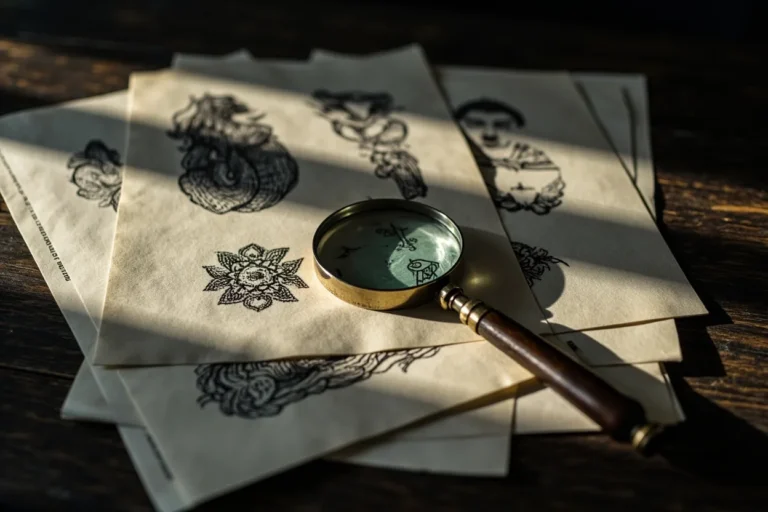
- Flash sheets (multiple related designs on one page)
- Custom pieces designed for specific body placements
- Black and grey renderings showing smooth shading
- Color work with proper saturation planning
- Lettering at various sizes
Physical portfolios still matter. I keep one in my station. Digital tablets are convenient, but there’s something about flipping pages that shows seriousness.
What to Leave Out
Skip the portraits of celebrities unless they’re exceptional. Skip anything drawn on lined notebook paper. Skip digital-only work if you can’t also show traditional media. And absolutely skip anything you copied without credit, shop owners recognize stolen flash instantly, and it’s a dealbreaker.
Get an Apprenticeship (The Only Real Way In)
Online courses won’t teach you skin tension, needle depth, or how to stretch skin while maintaining a consistent angle. Apprenticeship is non-negotiable in US tattoo culture. Most states require it for licensing anyway.
Finding the Right Mentor
Walk into shops with your portfolio, not your expectations. Dress clean, be humble, accept that you’ll hear “no” repeatedly. I apprenticed under an artist who made me draw roses for three months before I touched a machine. It was brutal and necessary. Look for:
- Shops with consistent walk-in traffic (you’ll learn faster)
- Artists whose healed work looks as good as fresh
- Clean stations and proper barrier methods
- Someone who explains why, not just how
Expect to pay for apprenticeship, either upfront or through unpaid work. Free apprenticeships exist but are rare and competitive. I paid twelve hundred dollars in 2012, worked part-time at the shop front desk, and spent eighteen months before tattooing paying clients.
What Apprenticeship Actually Looks Like
You’ll clean tubes, set up stations, break down barriers, and observe hundreds of tattoos before your mentor lets you work on practice skin, then fruit, then yourself, then friends, then finally walk-ins. The progression varies but the sequence doesn’t. Anyone offering to teach you machine work in a weekend is running a scam.
Understand the Business Side
Designing tattoos is art. Running a tattoo career is business. Most artists I know who burned out failed here, not at drawing.
Pricing Your Work
Start at shop minimums, usually eighty to a hundred fifty dollars depending on your city. As you build speed and reputation, move to hourly rates. I currently charge two hundred per hour, which is mid-range for my market. Top artists in major cities command four hundred plus. Factors include:
- Your speed and consistency
- Local market rates
- Style complexity (color realism takes longer than bold traditional)
- Your booking demand, raise prices when you’re consistently booked out
Never undercut shop rates to build clientele. It devalues everyone and attracts clients who price-shop rather than value art.
Shop Culture and Independence
You’ll start in someone else’s shop, likely on a percentage split (I began at fifty-fifty). Some artists eventually open their own studios; others prefer the community and reduced overhead of shop life. Both are valid. I’ve done both, and there’s no shame in staying where you’re supported.
Design for the Human Canvas
This separates tattoo designers from illustrators who happen to work on skin. You must account for pain tolerance, healing behavior, and how bodies change.
Placement Reality
Ribs hurt. Everyone asks. I warn clients that rib pieces require more sessions because movement and breathing make consistent work harder. Finger tattoos blur and fade fast, hands see sun, water, and friction constantly. Inner bicep skin stretches differently than outer forearm. Your designs must adapt to these variables, not ignore them.
Healing and Aftercare Guidance
Your design doesn’t end when the machine stops. I explain aftercare to every client: keep it clean, apply thin layers of recommended ointment, avoid soaking, no picking scabs. Healing takes two to four weeks for surface closure, longer for full settling. Color saturation looks different at six weeks than six days, design with that timeline in mind. Darker, bolder choices hold; subtle pastels often disappoint after healing.
Develop Your Voice (Eventually)
Early in your career, versatility matters more than distinctiveness. I did every style that walked through the door for years. But as you mature, your preferences emerge. Maybe you gravitate toward Japanese bodysuits, or delicate ornamental work, or photorealistic black and grey. Cultivate that specialty.
Your “style” isn’t invented, it’s discovered through repetition. I found my preference for bold neo-traditional with limited color palettes after roughly eight hundred tattoos. Be patient. The artists you admire with recognizable aesthetics put in thousands of hours.
Key Takeaways
Becoming a tattoo designer requires years of drawing, a formal apprenticeship under an experienced artist, and genuine understanding of how ink behaves on living skin. There’s no fast track, no online certification that replaces shop hours, and no substitute for the thousands of drawings that build your visual vocabulary. Start with relentless practice, present a focused portfolio, find a mentor who’ll teach you properly, and commit to learning both the craft and the business. The work is demanding, the hours are irregular, and the learning never stops, but there’s nothing quite like seeing someone wear your art for life.
Frequently Asked Questions
How long does a tattoo apprenticeship typically last?
Most apprenticeships run one to three years, with eighteen months being common. You’ll spend the first several months drawing and observing before touching any equipment, then progress through practice materials to supervised client work.
Do I need art school to become a tattoo designer?
No formal art education is required, though it helps. What matters more is demonstrable drawing skill, visual consistency, and the willingness to learn tattoo-specific techniques that differ from other media.
Can I make good money as a tattoo designer?
Income varies widely by location, speed, and reputation. Starting artists might earn thirty to forty thousand annually; established artists in busy markets can exceed six figures. It’s commission-based work with no guaranteed paycheck.
What’s the hardest part of learning to design tattoos?
Most apprentices struggle with translating flat drawings to three-dimensional, moving body parts. Understanding skin as a living, stretching, aging canvas rather than static paper fundamentally changes how you compose and execute designs.
Related Tattoo Guides
- How to Conceal a Tattoo With Makeup: A Pro s Guide
- How to Draw a Tattoo: A Working Artist s Guide
- How to Get Tattoo Ink Out of Clothes: A Real Guide
- Explore more