I’ve watched a lot of interesting ideas walk through the shop door. Some of them turn into tattoos people love for decades. Others become cautionary tales I use when I’m mentoring apprentices. The difference usually isn’t talent, it’s whether the person thought past the Instagram photo and asked: how does this live on skin? Skin moves. It tans. It scars. It gets older. The coolest concept on paper can turn into a muddy mess if you don’t account for that reality. So let’s talk about what actually works, where it works, and why some of the most interesting tattoos I’ve done were the ones that sounded simple on paper but became something else entirely once the needle hit skin.
Popular Styles That Stay Interesting
Styles go through waves. Three years ago I couldn’t do enough fine-line floral. Now I’m seeing a swing back toward bold traditional and weird little illustrative pieces. The through-line? The styles that last are the ones with strong technical foundations.
Neo-Traditional and Illustrative
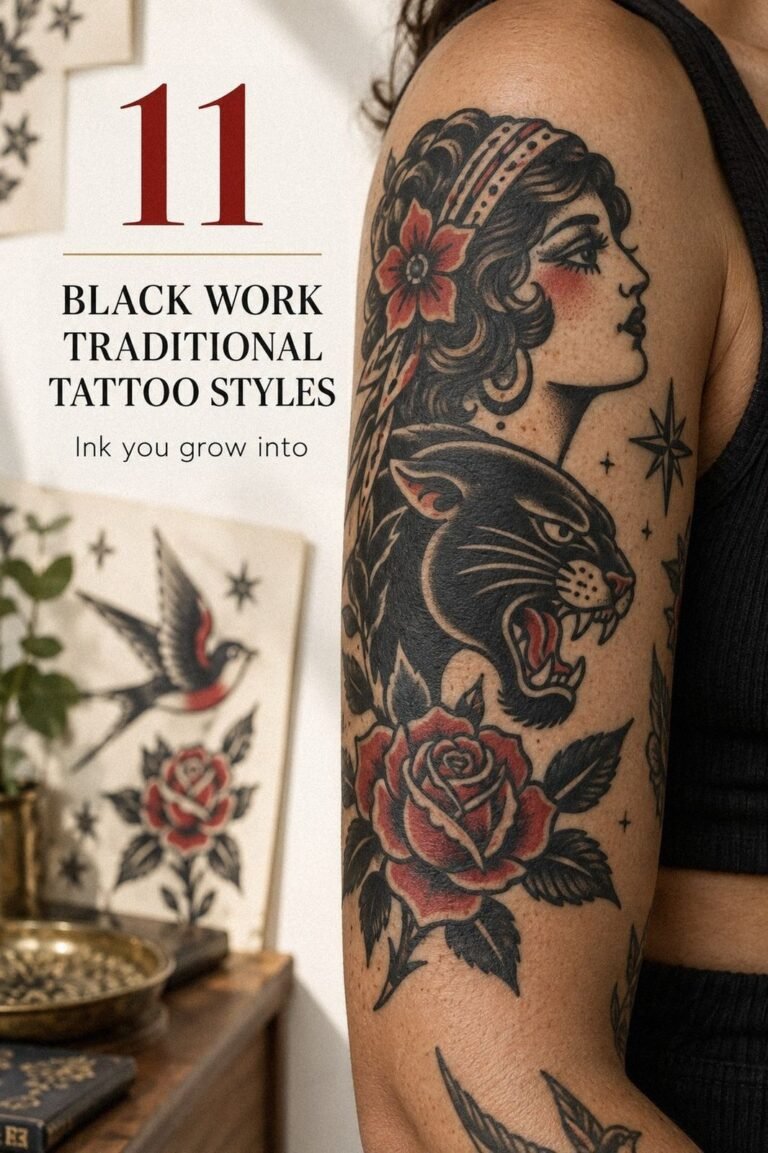
Neo-traditional gives you the best of both worlds: the bold readability of old-school flash with more color range and weirder subject matter. I’ve done neo-traditional moths with human eyes, coffins with windows showing starry skies inside. The black outlines hold. The limited but saturated color palette ages clean. What makes these interesting isn’t the complexity, it’s the confident restraint. An apprentice once asked me why I don’t pack more detail into these pieces. I told her: because in five years, that detail becomes noise. The client doesn’t want noise. They want something they can still read from across the room.
Blackwork and Ornamental
Blackwork has exploded, and for good reason. Solid black, dotwork, geometric patterns, these age like stone. I’ve got a client who got a full ornamental sleeve seven years ago. It looks basically identical today. The key is contrast and precision. Shaky geometry doesn’t forgive. But when it’s done right, ornamental blackwork becomes part of your architecture. It follows muscle flow, emphasizes bone structure, turns your body into something designed rather than decorated. That’s interesting in a way no trending TikTok design can touch.
Design Ideas That Mean Something
The most interesting tattoos I’ve done weren’t the most visually complicated. They were the ones where the person had a real reason, even if that reason was hard to articulate.
- Personal mythology: Not literal family portraits, but symbols that map your actual life. A client got a broken compass with no needle, just the circle and directions. Her father was a sailor who lost his way to alcohol. She didn’t want to explain it to anyone. She wanted to know it was there.
- Modified flash: Taking a traditional design and twisting it. I did a dagger through a heart where the heart was actually a house plan, the rooms labeled with her siblings’ names. Her parents’ divorce. Her own apartment. The dagger was the street she grew up on. Sounds busy, but in bold traditional lines, it reads clean and hits hard.
- Negative space tricks: Using your skin tone as part of the image. A raven where the eye is just uninked skin. A forest where the trees are black and the sky is your arm. These age interestingly, the contrast actually increases as the black settles and your skin changes.
- Text as image: Not quotes. I’ve talked most people out of quote tattoos. I mean letterforms as visual elements, ambigrams, deliberate misspellings that become other words upside down, single words in scripts so stylized they become abstract shapes first and readable second.
What to Avoid
Here’s where I get honest. Micro-realism portraits of pets or children? I’ve done them. They look incredible for about two years. Then the eyes blur, the fur becomes texture without form, and someone comes back asking for a coverup. If you want to honor something living, go symbolic. A friend’s dog had one brown eye and one blue. She got two simple circles, different colors, placed where she could see them. Reads instantly. Lasts forever. The person who got the full photorealistic puppy on their ankle? She’s saving up for laser now.
Best Placements for Interesting Work
Placement changes everything. Same design, different spot, completely different tattoo. I always tell people: think about your life, not your feed.
High-Visibility vs. Hidden
Hands, neck, face, these are statement placements. They change how you’re perceived. I’ve got a regular who works in corporate law with full traditional hands. He wears it like armor. But he’s also the exception. Most people with hand tattoos are making a choice to opt out of certain rooms. That’s not bad. It’s just real. Know what you’re choosing.
Inner bicep, ribs, thigh, these are yours. They stretch less than you’d think (ribs move, but the skin there is thin and heals tricky). Thighs are underrated real estate. Flat, stable, easy to heal, easy to show or hide. I’ve done some of my most interesting work on thighs because people give themselves permission to go bigger, weirder, more personal.
Back pieces are a commitment most people don’t finish. The ones who do? Different breed. They sit for years, session after session, building something that they’ll rarely see themselves. That’s interesting to me. The back piece is for everyone else, or for some future self looking in the mirror. It’s a long game.
Color Choices That Last
Color is where I see the most disappointment. Not because color fades, everything fades, but because people choose colors that don’t fade well together.
- Black and grey: The standard for a reason. Black ages to charcoal, grey softens to something atmospheric. A well-done black and grey piece looks better at ten years than it does fresh. The healing settles it. The skin adds its own texture.
- Traditional palette: Red, yellow, green, blue. These are the pigments we’ve used longest because they hold. Newer colors, neon pinks, pastels, white ink, are gamble. I’ve seen white ink disappear entirely on darker skin tones, not because the artist was bad but because physics. White is titanium dioxide. It reflects light. It also spreads and blurs faster than carbon black.
- Strategic color: One of my favorite pieces was almost entirely blackwork with a single blood-red line running through it. That red is going to hold attention for twenty years because it’s not fighting anything else. When everything is colorful, nothing is.
Skin Tone Considerations
Darker skin doesn’t mean no color. It means different color. I work with melanin, not against it. Bright yellows and oranges pop beautifully. Deep purples and blues can look almost black in a way that’s rich rather than muddy. The worst thing you can do is go to an artist who doesn’t have healed photos on skin like yours. Ask. If they hesitate, leave. This is basic professionalism.
Tips for Choosing Your Artist
The idea is only half. The person putting it in your skin is the rest. I’ve fixed enough bad tattoos to know this intimately.
- Look at healed work, not just fresh photos. Every artist posts fresh. The ones who post five-year-healed pieces are the ones confident in their craft.
- Ask about their process, not just their price. Cheap tattoos aren’t good. Good tattoos aren’t cheap. But expensive doesn’t guarantee quality either. I’ve seen $300/hour artists who can’t draw and $100/hour artists who should be charging triple.
- Bring references but not a blueprint. The best tattoos happen in collaboration. I had a client bring me a children’s book illustration from the 1970s, a photo of her grandmother’s hands, and a color swatch from a sweater. We built something none of us could have imagined alone.
- Trust your gut in the consultation. If they rush you, if they don’t ask questions, if they treat your idea like a transaction, that’s the tattoo you’re getting. Transactional. The artists who slow down, who push back on bad ideas, who get visibly excited about solving a visual problem? That’s where interesting lives.
Final Thoughts
Interesting tattoos aren’t the ones that get the most likes. They’re the ones that still mean something when you’re explaining them to a stranger at a party, or not explaining them because they’re private, or forgetting them entirely because they’ve become part of you like a scar or a freckle. The best work I’ve done, I sometimes forget I did. It belongs to the person now. That’s the goal. Not my portfolio, not their feed. Their skin, their story, their years. So take your time. Let the idea sit. Come back to it. If it still matters, find someone who cares about that too. The needle is permanent. The choosing should be too.
More Tattoo Ideas
- Cool Tattoo Ideas That Age Better Than Trends
- Religious Tattoo Ideas That Actually Mean Something
- Realistic Butterfly Tattoos: Complete Style Guide
- Explore more
Frequently Asked Questions
What tattoo styles age the best over time?
Bold traditional American and Japanese styles with thick black outlines and limited color saturation tend to hold up longest. Fine line and watercolor tattoos often blur or fade significantly within 5-10 years, requiring frequent touch-ups.
Are small minimalist tattoos a good long-term choice?
Tiny minimalist designs are trendy but risky because details blur together as skin ages and ink spreads slightly. If you want something small, choose simple shapes with adequate spacing rather than intricate micro-designs.
How does placement affect how well a tattoo holds up?
Areas with frequent sun exposure, friction, or stretching like hands, feet, and joints fade fastest. The upper arm, back, and thigh offer more stable skin that better preserves tattoo clarity over decades.
Should I avoid certain colors if I want longevity?
Black and dark blue pigments last longest, while yellow, white, and pastel shades fade fastest and may become nearly invisible. A design with strong black contrast will remain readable even as brighter colors soften.