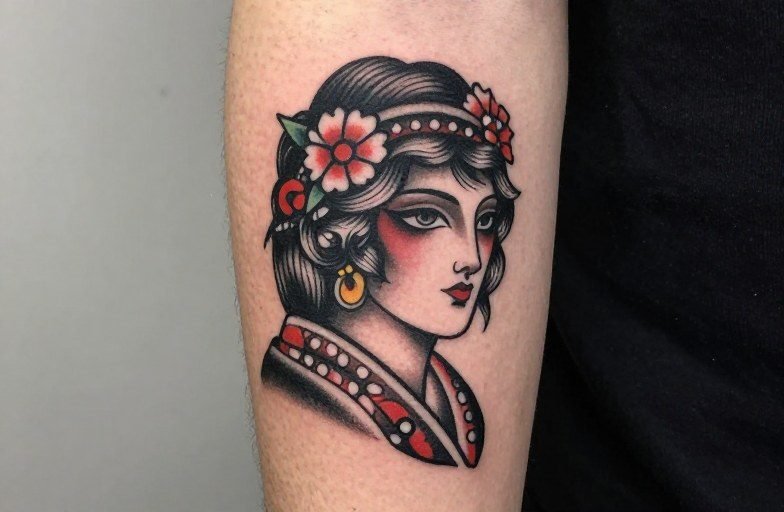
Italian traditional tattoos pull from a specific well: Catholic devotional imagery, maritime symbols from Genoa and Naples, and the bold, readable aesthetic of classic European tattooing. Think sacred hearts with dripping flames, clasped hands in prayer, daggers through roses, and the Madonna rendered with heavy black outlines and limited but saturated color. The style sits somewhere between old-school American traditional and the more ornate European school, less cartoonish than Sailor Jerry, more overtly religious than British skin art. It developed in port cities where sailors, dock workers, and working-class devotees wanted imagery that announced faith, luck, and belonging.
Who It Suits
This style favors people who want their tattoos to read clearly from a distance and hold up for decades. The bold lines and restricted palette aren’t subtle; they’re declarations.
Skin Tone and Aging Considerations
Heavy black outlines and solid color packing make Italian traditional work legible on virtually all skin tones. The high contrast between black linework and skin means these tattoos don’t rely on delicate graywash to carry the design. On darker skin, the black holds its authority; on lighter skin, the reds and golds stay vivid longer than in styles with softer edges. The real aging advantage is structural: these designs don’t fall apart when lines spread slightly over twenty years because the original lines were already thick and the shapes simple.
Personal Style and Commitment
- Works for people who dress in classic, workwear, or vintage-influenced clothing, the aesthetic coherence matters
- Suits those comfortable with visible religious imagery regardless of personal belief; the iconography is cultural as much as spiritual
- Ideal for collectors building a traditional-focused limb rather than scattered single pieces
- Less suited to those wanting negative space, fine-line delicacy, or hidden, easily concealed meanings
Key Characteristics & Motifs
Italian traditional has a recognizable visual grammar. Understanding its components helps you spot authentic work and communicate with artists who specialize in the form.
Core Visual Elements
The sacred heart dominates, anatomically stylized, wrapped in thorns, topped with flames, sometimes pierced by a sword or cross. Madonnas and child appear frequently, rendered with simplified facial features that emphasize serenity over realism. Anchors, ships, and swallows connect to maritime heritage, often paired with banners bearing names or dates. Daggers, roses, and snakes reference mortality and temptation. The color palette is disciplined: crimson red, navy blue, forest green, mustard yellow, and cream, all against heavy black. Skin shows through only where the design intentionally leaves it.
Lettering and Banner Work
Script is integral, not afterthought. Names of family members, saints, or short phrases, “Per Sempre” (forever), “Mamma,” “Fede” (faith), arc across banners that weave through imagery. The lettering itself is tattooed: thick vertical strokes, thin horizontals, slight serifs, always legible. Bad banner work kills an otherwise solid piece; the text must curve naturally with the body part, not look pasted on.
Best Placements
Italian traditional tattoos were designed for the body as it moves and ages, not as flat paper. Placement choices affect how the imagery reads and how well it survives.
Classic Locations
- Upper arm/shoulder cap: The sacred heart or Madonna here follows the deltoid curve; visible in short sleeves, hideable for formal settings
- Forearm: Banners and daggers work well along the radius; the flat plane keeps lettering readable
- Chest, centered: Large devotional pieces, Christ, Virgin, sacred heart, anchor the torso symmetrically
- Hands and knuckles: Crosses, small hearts, letters; historically common, now socially more acceptable but still career-limiting in some fields
- Thigh and calf: Larger compositions with multiple elements, ships with full rigging, praying figures
Placement to Approach Carefully
Ribs and stomach challenge this style. The heavy black and solid color need stable skin; stretching and weight fluctuation distort simple shapes more noticeably than complex ones. Neck and throat placements exist historically but commit you to full visibility. The side of the head, above the ear, works for small crosses or hearts but limits future large-scale options.
Linework & Technique
Technical execution defines whether Italian traditional looks authentic or like a cheap imitation. The line quality is specific: confident, slightly varied weight, never wispy.
Line Variation and Weight
Outlines run between 7 and 14 needle groupings depending on the element. Major shapes, heart contours, figure silhouettes, banner edges, get the heaviest lines. Interior details like facial features, fabric folds, and flame tips use thinner but still solid lines. There’s no stippling, no soft gradients achieved through needle density. Transitions between light and dark happen through discrete steps: black, dark color, medium color, skin. A skilled artist builds depth through adjacent color blocks rather than blended shading.
Color Packing and Saturation
Color application is aggressive. The needle moves in tight concentric circles or small ovals, depositing enough pigment that the skin barely shows through. Healed results should look like enamel or lacquer, flat, saturated, almost printed. Red especially must be packed heavily; cheap or timid application heals pink and anemic. White highlights go in last, sparingly, and often yellow slightly over time. Good artists anticipate this, using white only where it won’t turn dirty, or substituting pale yellow for highlights on skin that rejects white.
Cost & Sessions
Pricing reflects the technical demands: solid color packing takes time, and mistakes in this style are glaringly obvious.
What Drives Price
- Artist specialization in traditional work commands premium rates; generalists may offer lower prices but produce softer, less authoritative results
- Size and complexity: a palm-sized sacred heart runs shorter than a full forearm composition with banner and multiple elements
- Color count: each color requires complete needle change and setup time
- Geographic market: major cities and traditional-heavy shops (some in Brooklyn, London, Milan itself) price higher than suburban general studios
Session Planning
A single sacred heart with minimal banner might finish in two to three hours. A half-sleeve of stacked Italian traditional motifs could need four to six sessions of three hours each, with healing time between. The style doesn’t lend itself to marathon sittings; the heavy saturation traumatizes skin, and continuing past when the area swells produces patchy color. Most artists stop when the skin tightens and blanches.
Common Mistakes to Avoid
Errors in this style are particularly visible because the aesthetic depends on clarity and boldness.
Design and Concept Errors
Mixing Italian traditional with unrelated styles in the same piece usually fails. A photorealistic face inside a traditional sacred heart, or watercolor splashes behind a dagger, creates visual confusion rather than fusion. The style’s power comes from its internal consistency. Similarly, overloading a single composition, too many banners, too many elements competing, destroys the readability that makes these tattoos effective from across a room.
Technical and Healing Pitfalls
- Choosing an artist whose portfolio shows soft edges, graywash backgrounds, or “neo-traditional” hybrid work; the line weight and color saturation differ significantly
- Neglecting afterthought for solid color areas: they scab heavier than fine-line work, and picking destroys color retention
- Expecting white highlights to stay bright; they soften to cream or disappear, and good design accounts for this
- Placing heavy black compositions where they’ll receive constant sun without protection; black fades to gray-green, red to pink
Final Word
Italian traditional tattoos offer something increasingly rare: a style with established rules, recognizable lineage, and proven longevity. The imagery carries weight, religious, cultural, personal, without requiring explanation. It ages better than most styles because it was never dependent on trend or technique that time undermines. The tradeoff is commitment: these tattoos announce themselves, don’t hide easily, and demand an artist who understands the specific discipline of bold line and saturated color. Find someone whose healed work you can examine, whose lines stay crisp after five years, whose reds stay red. The style rewards patience in selection and accepts no shortcuts in execution.
Frequently Asked Questions
Do I need to be Italian or Catholic to get Italian traditional tattoos?
No. The imagery has become part of global tattoo vocabulary, though some people choose it specifically for family heritage. What’s important is understanding the iconography rather than treating it as empty decoration.
How do Italian traditional tattoos differ from American traditional?
Italian traditional leans more heavily into Catholic devotional imagery, Madonnas, sacred hearts, crucifixion scenes, while American traditional emphasizes naval/military motifs, pin-ups, and eagles. The color palette is similar, but Italian work often feels more solemn and ornate in its subject matter.
Will the heavy black lines blur together as I age?
Some spreading is inevitable over decades, but the original line weight in authentic Italian traditional work accounts for this. Thick outlines maintain their separation far longer than fine lines. The simplicity of shapes also means the design remains readable even with slight blur.
Can Italian traditional tattoos be covered up or modified later?
Heavy black and saturated color make cover-ups challenging but not impossible. An experienced artist can sometimes work within existing bold shapes. Laser removal of dense black is slower and more expensive than lighter work. Think of these as permanent decisions by design.
Related Style Guides
- North Carolina Tattoo Ideas That Actually Work
- Iceland Tattoo Ideas: Volcanic Ink for True Wanderers
- Image Designs Tattoo Ideas
- Explore more