
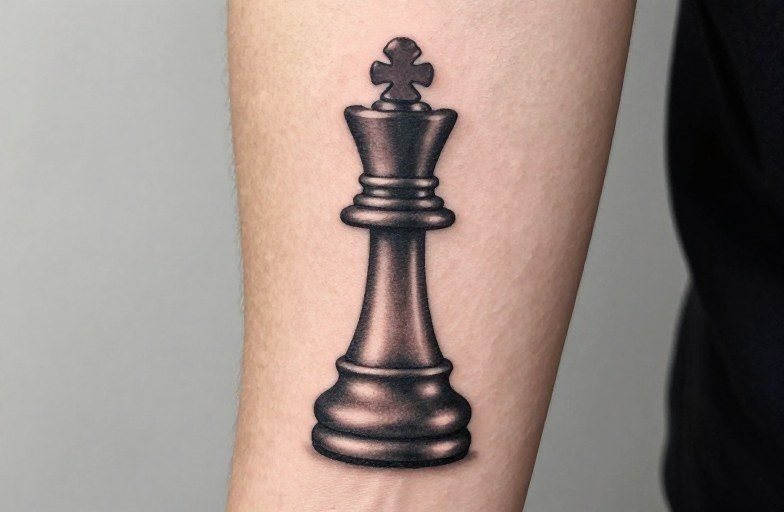
The king chess piece tattoo most commonly represents personal authority, strategic thinking, and the burden of leadership. Unlike the queen, who holds the power on the board, the king is the object of protection, the piece that cannot be lost. That distinction matters. People who choose this symbol often identify with the responsibility of holding everything together rather than the flashier role of dominating through force.
Mythology & Folklore
Chess itself carries ancient origins, often linked to Persian and Indian strategy games that spread through trade routes and conquest. The king piece, shah in Persian, source of the word “checkmate”, has always represented the human stakes of war and statecraft. The tattoo inherits this lineage indirectly; most wearers aren’t thinking of medieval Persia, but the symbol’s cultural weight persists.
War Games and Real Power
Historical chess sets mirrored actual court structures: king, queen, bishops, knights, rooks (chariots or towers), and pawns (foot soldiers). The king’s limited movement, one square in any direction, reflects a practical reality: rulers who charge into battle don’t survive. The tattoo can signal someone who understands that real power operates through protection and position, not spectacle. Some trace the piece’s symbolic resonance to this very constraint, the tension between nominal supremacy and actual vulnerability.
Checkmate as Finality
“Checkmate” derives from shah mat, “the king is dead” or “the king is helpless.” The tattoo can function as memento mori, a reminder that every position of power ends. This reading appeals to people who’ve experienced loss of status, health, or relationships, and who carry the king as a marker of survived endings rather than current dominance.
Color vs Black and Grey
Execution choices dramatically shift how the king piece reads on skin.
Black and Grey Realism
The most common approach: a photorealistic or stylized carved-wood king, rendered in washes of black ink. This treatment emphasizes age, gravity, and the piece’s traditional form. Line weight matters here, thick outlines around the base and crown hold up better over time than fine cross-hatching on the cross finial. Shading in the concave areas of the crown (the crenellations) tends to soften and blur after five to seven years, especially on high-movement placements like forearms or calves. A skilled artist will compensate by building contrast through adjacent negative space rather than relying solely on graduated tones.
Color Accents and Full Color
Some designs incorporate the classic white or black square pattern, or use gold ink for the crown band. Gold pigment presents a specific aging problem: it often shifts toward mustard or olive within a few years, and some yellow formulations carry higher allergy risk. Red accents on the base, suggesting velvet or felt, hold color well but can read as garish if the design lacks sufficient black weight to anchor them. Color versions work best at larger sizes (palm-sized or bigger) where the hues have room to breathe without turning muddy.
- Black and grey: ages gracefully, suits smaller scales, reads as serious or contemplative
- Gold accents: high risk of color shift, requires experienced color specialist
- Red base details: stable but potentially loud; balance with heavy black
- Full board context (king on square with other pieces): demands larger placement, forearm or thigh minimum
Who Chooses This Tattoo
Demographics for this design skew toward people in decision-making roles who feel ambivalent about that responsibility. Software team leads, small business owners, military NCOs, parents of dependent family members, roles where the welfare of others rests on their choices. The king piece appeals less to entrepreneurs selling self-made mythology and more to people exhausted by the constancy of that care.
Chess players themselves sometimes choose the king after significant competitive milestones, but more often after losses that reshaped their relationship with the game. The piece marks a philosophy rather than a victory. Placement patterns differ: competitive players often choose the king on the inner forearm, visible during play; those carrying symbolic meaning frequently select the chest, upper arm, or ribs, positions more private and less performative.
Personal & Modern Meanings
Contemporary wearers layer meanings that depart from chess tradition entirely.
Self-Rule and Recovery
In recovery communities, the king sometimes represents reclaimed agency, moving from being moved by addiction to directing one’s own squares. The piece’s vulnerability becomes the point: the king needs his other pieces, needs the board, needs the rules. This reading rejects rugged individualism in favor of interdependent strength. The tattoo in this context often pairs with clean dates, coordinates, or small companion pieces (pawn becoming queen, or a full set in formation).
Gender and the King
Women choosing this piece sometimes face assumptions that they “should” have picked the queen. The king’s selection can be deliberate: rejecting the queen’s unlimited movement as an unrealistic standard, or identifying with the king’s role as protected center rather than attacking force. Alternatively, some wearers simply prefer the visual symmetry of the king’s cross finial over the queen’s pointed coronet. Either way, the choice deserves no explanation, though the dynamic surfaces often enough in consultations to be worth naming.
Similar & Related Symbols
The king piece sits within a broader vocabulary of strategic and regal imagery.
Queen piece: More common, more visually dramatic, often chosen for power and autonomy. The king’s relative rarity can itself be the appeal, less Instagram saturation, more specific statement.
Crown (standalone): Broader, less precise. The chess king carries the crown but within a system of rules; the standalone crown risks reading as generic empowerment or brand loyalty.
Knight piece: Frequently chosen for its L-shaped movement, representing unconventional paths. The horse head silhouette reads clearly even at small sizes, unlike the king’s more detailed form.
Board and squares: Some designs incorporate the alternating pattern as background or negative space. This grounds the piece in context but can date quickly if the geometry feels trendy rather than classic.
Companion pieces: A king with a single pawn suggests protection of the vulnerable; king and queen together signal partnership within distinct roles; a toppled king with standing queen can mark a specific life transition or loss.
How It Ages on Skin
The king piece presents specific technical challenges over time.
Detail Degradation
The cross atop the king’s crown, its most distinctive element, often carries fine lines in the ball or orb detail. These blur fastest, sometimes becoming indistinct blobs within three to five years on sun-exposed skin. Artists can mitigate this by:
- Keeping the cross finial bold and simplified
- Using negative space rather than interior lines for the orb
- Placing the design on the upper arm, thigh, or back, areas with less movement and sun exposure
- Avoiding the wrist or ankle where circulation and friction accelerate fading
Scale Requirements
The king’s silhouette requires minimum size to read as chess piece rather than generic chess-piece-shaped object. At under two inches, the crenellated crown and rounded base merge into an unrecognizable column. For single-needle or fine-line styles, three inches minimum; for bold traditional or neo-traditional approaches, two inches can suffice if the artist simplifies intelligently. The piece ages best when the original design anticipated blur, slightly exaggerated proportions, heavier base weight, crown details that depend on shape rather than line.
The Takeaway
The king chess piece tattoo carries its weight through contradiction: supreme importance, limited movement, ultimate vulnerability. It suits people who’ve learned that leadership means being the reason others move, not the one making all the noise. The symbol works best when executed with technical respect for how it will sit in skin ten years out, bold where it counts, simplified in the details that time will steal anyway. Whether chosen for chess devotion, recovery milestone, or the quiet recognition that your life is the board others depend on, the king piece offers a specifically constrained form of power, and that limitation is exactly the point.
Frequently Asked Questions
Does the king chess piece tattoo always mean the wearer is dominant or in charge?
Not necessarily. Many choose it to acknowledge the burden and vulnerability of responsibility rather than to claim dominance. The king’s limited movement on the board actually symbolizes constraint and interdependence more than unlimited power.
What’s the best placement for a king chess piece tattoo?
The upper arm, thigh, and chest age best due to less sun exposure and movement. Avoid wrists and ankles where fine details blur quickly. Forearms work for visibility but require bolder line work to hold up over time.
Can a king piece tattoo work in a very small size?
Below two inches, the distinctive crown and base details merge into an unrecognizable shape. Minimum three inches for fine-line styles, two inches for bolder traditional approaches with simplified forms.
Is it weird to get a king piece if I’m not a serious chess player?
Not at all. Most wearers choose it for the symbolic meaning, self-mastery, leadership, recovery, rather than chess affiliation. The symbol has long since exceeded its game origins.
Related Tattoo Meanings
- Larkspur Tattoo Meaning: July Birth Flower Symbolism
- Leafless Tree Tattoo Meaning: Bare Branches, Deep Roots
- Lighter Tattoo Meaning: Flame, Rebellion Renewal
- Explore more









