
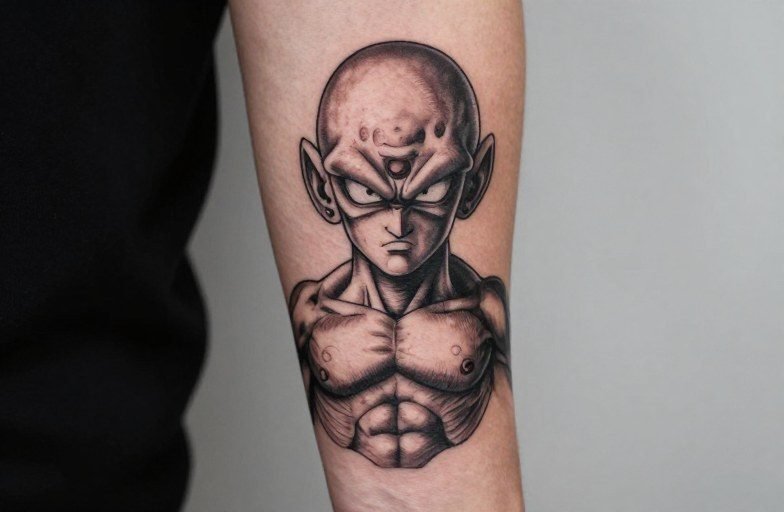
The Majin tattoo refers to the distinctive “M” mark associated with Majin characters in the Dragon Ball universe, most famously worn by Vegeta and created by the wizard Babidi. On the surface, it signals possession and servitude to evil forces, but in tattoo culture, it has accumulated far more nuanced interpretations: personal transformation, the embrace of inner darkness, loyalty to a beloved franchise, and the complex duality of heroism. The mark itself is simple, a stylized letter M with pointed, angular extensions, but its visual punch and narrative weight make it surprisingly versatile as body art.
Symbolism & Core Meaning
The Mark of Transformation
In the source material, the Majin symbol fundamentally alters whoever bears it. Vegeta’s arc remains the definitive example: the proud Saiyan prince willingly accepts the mark to gain power and finally surpass Goku, knowing full well the moral cost. This transaction, power in exchange for pieces of yourself, resonates beyond anime fandom. People who choose this tattoo often connect with that specific tension: the moments in life where ambition required compromise, where growth came through uncomfortable channels.
The symbol also represents external control versus internal will. Babidi’s magic technically enslaves his marked followers, yet Vegeta’s case blurs that line. He chooses. He retains enough consciousness to resist fully, to eventually break free through sheer stubbornness. That nuance matters for tattoo meaning. It becomes less about victimhood and more about navigating influence, recognizing when outside forces shape you while fighting to preserve core identity.
Visual Power in Minimal Form
Unlike sprawling anime tattoos that require portraits and scenes, the Majin mark functions as a minimalist symbol with maximum recognition. A two-inch rendering carries the same narrative weight as a full sleeve. This efficiency appeals to people who want fandom representation without literal character imagery. The angular design also translates well to tattooing: sharp lines hold up better over time than fine detail, and the high contrast between black ink and skin creates immediate visual impact.
Who Chooses This Tattoo
The Dedicated Fan
Dragon Ball’s generational reach means Majin tattoo collectors span age groups, from thirty-somethings who grew up with Toonami broadcasts to younger viewers who discovered the franchise through streaming. What unites them is typically Vegeta-specific attachment rather than general Dragon Ball enthusiasm. Goku fans tend toward kanji, four-star balls, or Super Saiyan hair silhouettes. Vegeta devotees gravitate toward the Majin mark because it captures his most psychologically complex moment, the pride that became his prison and his liberation.
The Symbolically Minded
Beyond pure fandom, some collectors respond to the mark’s broader thematic territory. People who have rebuilt themselves after addiction, toxic relationships, or professional burnout sometimes gravitate toward the Majin symbol as shorthand for “controlled darkness.” The tattoo acknowledges destructive impulses without romanticizing them, frames survival as active struggle rather than passive victimhood. This interpretation requires no Dragon Ball knowledge whatsoever, though most artists report that even symbolically motivated clients usually have some anime familiarity.
History & Cultural Roots
From Manga Panel to Skin
The Majin mark first appeared in Akira Toriyama’s Dragon Ball manga during the Babidi Saga, often linked to the mid-1990s publication timeline. Its design draws from multiple visual traditions: the angular letterform resembles certain demonic sigils in Japanese folklore, while the forehead placement echoes Buddhist and Hindu spiritual marks. Toriyama himself rarely discussed specific symbolism, but the mark’s function, granting power while corrupting the bearer, aligns with cross-cultural “demon contract” narratives found in everything from Faust to Japanese onmyōdō traditions.
Tattoo adoption began slowly, accelerating as anime moved from subculture to mainstream visibility in the 2000s and 2010s. Early Majin tattoos were almost exclusively black linework on forearms or calves, often accompanied by Vegeta portraits. Contemporary versions show more stylistic range: geometric interpretations, watercolor splashes behind the mark, integration with floral or macabre elements that soften or intensify the demonic association.
Forehead Placement: Authenticity vs. Practicality
Purists sometimes request forehead placement to match canonical presentation. Most reputable artists strongly discourage this. Forehead skin moves constantly with expression, receives heavy sun exposure, and offers limited space for detail that will age gracefully. The few who proceed typically scale the mark small, between eyebrows or at the hairline, accepting that touch-ups will be frequent and fading inevitable. More practical collectors choose inner forearm, chest center, or upper back, locations that honor the symbol’s frontal visibility without the functional compromises of actual forehead tattooing.
Religious & Spiritual Angles
Buddhist and Shinto Echoes
The Majin mark’s forehead placement and spiritual function invite comparison to actual religious practices. In Shinto, certain priests and practitioners receive spiritual marks or undergo rituals that establish connection to kami. Buddhist traditions across Asia use forehead anointing and symbolic marks to denote blessing, protection, or spiritual status. The Majin mark inverts this: a forced spiritual binding to destructive forces rather than chosen devotion to benevolent ones.
Some collectors with Buddhist or Shinto backgrounds report complex feelings about the tattoo, simultaneously drawn to its visual power and cautious about its demonic associations. Others specifically embrace the inversion, using the mark to explore shadow integration philosophies where acknowledging darkness becomes necessary for spiritual wholeness. This interpretation, often associated with Jungian psychology, treats the Majin symbol as personal anima or shadow made visible.
Western Occult Resonances
The mark also functions within Western esoteric traditions without direct connection to its anime origins. The angular M resembles certain sigils in chaos magic and Thelemic practices, where constructed symbols gain power through personal investment rather than inherited meaning. Collectors with occult interests sometimes layer additional symbolic elements, planetary glyphs, alchemical symbols, specific color choices, that redirect the Majin mark toward their own magical systems. This syncretic approach irritates some anime purists but represents authentic tattoo tradition: symbols migrate, accumulate, transform in new contexts.
Best Placements
High-Visibility Options
- Inner forearm: The most common choice. Easy to display or conceal, flat skin surface allows clean linework, and the vertical orientation matches the mark’s natural proportions. Aging is relatively predictable here.
- Center chest: Creates a medallion-like focal point, especially effective when scaled larger and paired with surrounding imagery. Skin texture varies significantly by individual, artists must assess stretch and hair patterns.
- Upper back/shoulder blade: Offers flat canvas and easy concealment. The horizontal expanse allows for compositional balance with other tattoos, though the Majin mark’s vertical orientation sometimes looks isolated without framing elements.
Technical Considerations
The Majin mark demands precise line work. Its power comes from sharp angles and consistent stroke weight; wobbly execution immediately reads as amateur. Black ink is standard, though some artists experiment with deep purple or crimson fills that reference Babidi’s color palette. Over time, all line tattoos spread slightly, expect the pointed extensions to soften from needle-sharp to pencil-sharp over five to ten years. This aging is normal and often aesthetically acceptable, but collectors should understand that crisp minimalism requires maintenance.
Shading around the mark (flames, auras, background elements) accelerates aging by introducing more ink and more edges that can blur together. Solid black negative-space backgrounds last longer than detailed shading but create much heavier visual presence. Discuss these trade-offs explicitly with your artist before committing.
Personal & Modern Meanings
Beyond Good and Evil
Contemporary Majin tattoos increasingly reject simple “evil mark” readings in favor of moral complexity. The symbol becomes a reminder that growth often requires engaging with uncomfortable aspects of self, anger, ambition, resentment, competitive drive, that polite society encourages suppressing. This isn’t edgelord posturing; it’s a genuine psychological framework for people who found traditional “positive thinking” inadequate for their actual experience.
The mark also functions as community signal. In spaces where anime fandom overlaps with gym culture, combat sports, or entrepreneurial hustle communities, the Majin tattoo identifies shared values: intensity, self-improvement through discomfort, willingness to operate outside conventional boundaries. These social meanings evolve independently from the source material, sometimes to Toriyama purists’ frustration.
Gender and the Majin Mark
Historically male-dominated in both fandom and tattoo representation, Majin marks have become more gender-diverse in recent years. Female and non-binary collectors often recontextualize the symbol through placement choices (delicate wrist renderings, integrated with floral work) or by pairing it with female characters who bore the mark in expanded Dragon Ball material. This evolution reflects broader shifts in anime fandom demographics and challenges assumptions about who “owns” aggressive or demonic symbolism.
Final Word
The Majin tattoo endures because it compresses substantial narrative and emotional weight into minimal visual form. Whether you connect with Vegeta’s specific tragedy, the broader theme of transformation through darkness, or simply appreciate the mark’s stark graphic power, the symbol rewards thoughtful placement and technical execution. Work with artists who understand line tattoo aging, choose locations that serve your daily life rather than pure canonical accuracy, and let the meaning develop through your own relationship with the image rather than fixed interpretation. The best Majin tattoos carry their complexity quietly, recognizable to those who know, visually striking to those who don’t, personally significant to the one who wears them.
Frequently Asked Questions
Does a Majin tattoo automatically mean I worship evil or demons?
No. Most collectors choose the mark for its narrative complexity, personal transformation symbolism, or Dragon Ball fandom connection. The demonic association in the source material functions as metaphor rather than religious statement for the vast majority of wearers.
How small can a Majin tattoo be before it starts losing detail?
Below two inches, the pointed extensions and inner angles become difficult to execute cleanly and will blur faster as the tattoo ages. Most experienced artists recommend minimum 2.5 to 3 inches for longevity.
Can the Majin mark be covered up or incorporated into a larger piece later?
Yes, though its strong geometric form and high contrast make it challenging. The angular shape can anchor surrounding imagery, but complete coverage typically requires substantial blackwork or dense design elements that obscure the original lines.
Is the Majin tattoo culturally appropriative since it draws from Japanese media?
Dragon Ball is globally commercialized media, not sacred cultural practice, so the mark itself raises no appropriation concerns. However, combining it with actual religious symbols (Buddhist mantras, Shinto imagery) without understanding their significance can be problematic and is generally discouraged by knowledgeable artists.
Related Tattoo Meanings
- Male Deep Spiritual Tattoo Meaning: Symbolism Design Guide
- Maple Leaf Tattoo Meaning: Nature, Change, and Identity
- Mark of Cain Tattoo Meaning: Protection, Exile Rebellion
- Explore more









