
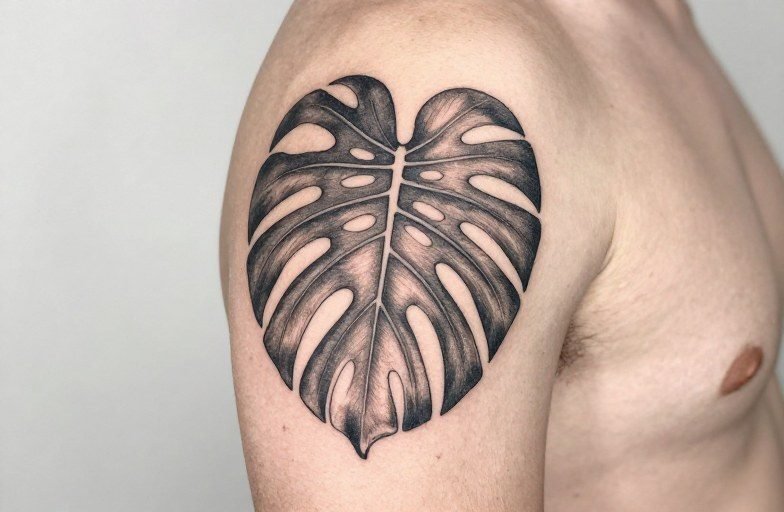
The monstera tattoo carries layered symbolism rooted in the plant’s biology and cultural footprint. Its perforated leaves represent natural adaptation, thriving in low light by evolving holes to let sunlight pass through. For most people choosing this design, it signals resilience, personal growth, and an appreciation for untamed, organic beauty rather than polished perfection.
Symbolism & History
Botanical Origins as Metaphor
Monstera deliciosa grows from Central American rainforests into suburban living rooms worldwide, and that journey shapes its tattoo meaning. The plant’s aerial roots grab onto whatever’s available, tree bark, soil, moss poles, creating a visual metaphor for finding footing wherever life puts you. The signature fenestrations (those natural leaf holes) aren’t damage; they’re evolutionary efficiency. That distinction matters: the tattoo often represents working with limitation rather than fighting it.
In Victorian plant symbolism, broad-leafed tropicals signaled exotic knowledge and colonial-era wealth. The monstera specifically, with its edible fruit (hence “deliciosa”), carried associations of abundance and rare reward. Some trace the leaf’s graphic popularity to 20th-century Hawaiian and Californian surf culture, where it became shorthand for laid-back, coastal living. Contemporary tattoo wearers rarely invoke that history directly, but the residue of “easy abundance” still clings to the image.
Modern Interpretations
Today’s monstera tattoos frequently express:
- Surviving and adapting to major life changes
- Embracing imperfection as natural and beautiful
- Connection to specific places, Hawaii, Costa Rica, Thailand, or grandmother’s sunroom
- Plant parenthood as identity, especially for millennials and Gen Z
- Environmental consciousness without preachy messaging
The leaf’s silhouette reads instantly even in small sizes, making it versatile for subtle personal statements or bold declarations.
Common Variations & Styles
Botanical Realism vs. Graphic Simplification
Realistic monstera tattoos emphasize the leaf’s architecture: the deep green gradients, the creamy variegation of Thai Constellation or Albo varieties, the way light catches waxy surfaces. These pieces demand an artist comfortable with color saturation and smooth blending. Watercolor backgrounds, soft washes of sage, terracotta, or gold, can suggest the plant’s tropical habitat without literal jungle scenes.
Graphic and linework versions strip the leaf to its essential shape: the heart-like base, the asymmetrical fenestrations, the gentle curve of the central rib. Single-needle linework creates delicate, almost scientific-illustration quality. Bold black outlines with minimal fill read as mid-century modern or Scandinavian design influence. Both approaches age better than heavy realism because the silhouette remains readable even as fine detail softens.
Combined Elements
Popular additions include:
- Monstera leaves framing animals, portraits, or other botanicals
- Geometric containers, triangles, circles, vases, contrasting organic form with rigid structure
- Botanical illustration style with Latin names and specimen labels
- Negative space techniques where skin shows through as fenestrations
- Matching sets: one leaf on each forearm, or a vine wrapping both ankles
Variegated monstera varieties (white-splashed leaves) translate poorly to tattoo unless your artist understands how white ink yellows and fades. Most experienced artists will suggest cream or light yellow instead of pure white for longevity.
Best Placements
The monstera’s natural shape, broad at top, tapering to a point, with an irregular edge, suits several body areas. The curve of a shoulder cap mirrors the leaf’s arc. Inner biceps provide flat, stable skin that shows the full shape without distortion. Ribs and side pieces work when the leaf tilts slightly, following the body’s natural lines.
Smaller designs (2-4 inches) fit wrists, ankles, behind ears, or along the collarbone. At this scale, simplify: too many fenestrations become muddy blurs within five years. Medium pieces (5-8 inches) allow the characteristic holes to read clearly. Large back or thigh pieces can incorporate full vines, multiple leaves at different growth stages, or background environment.
Consider how the leaf orients. Tip pointing upward suggests growth and aspiration. Drooping or sideways placement reads more relaxed, even melancholic. The stem’s curve can guide eye movement toward or away from other tattoos.
Who Chooses This Tattoo & Personal Meanings
Monstera tattoos attract a specific cross-section: people who identify as plant people without being precious about it, travelers who spent meaningful time in tropical places, and those recovering from something, divorce, illness, career collapse, who want a symbol of thriving despite damage.
The design crosses gender presentation cleanly. It doesn’t code strongly masculine or feminine in most contexts, though execution style shifts that: heavy blackwork reads more masculine by current norms, delicate linework more feminine, with plenty of overlap. Age range skews 25-40, typically first or second tattoo rather than heavy collectors, though that’s shifting as botanical tattoos gain mainstream acceptance.
Personal meanings I’ve encountered include marking a move to a new city where a monstera was the first plant purchased, commemorating a parent who kept one alive for decades, and representing a chronic illness where the leaf’s “damaged” appearance resonated. The plant’s easy propagation, cut a stem, root it in water, also makes it a symbol of legacy and continuation for some.
Similar Symbols & Alternatives
If the monstera appeals but doesn’t quite fit, consider these botanical relatives:
- Fiddle-leaf fig: Similar tropical houseplant status, but the leaf shape is more rigid and architectural. Less organic flow, more statement piece.
- Pothos or philodendron: Trailing growth habit suggests connection and spreading influence rather than singular resilience. Better for wrapping designs.
- Banana leaf: Often linked to Hawaiian and Pacific Islander culture specifically. Broader cultural associations; research before appropriating.
- Native ferns: For those wanting local ecology over exoticism. Maidenhair, sword fern, or bracken carry regional specificity.
- Snake plant (sansevieria): Graphic vertical lines, extremely hardy. Represents endurance more than adaptation.
Non-plant alternatives with similar symbolism include kintsugi (Japanese gold-repaired pottery), representing beauty in breakage, or coral forms that also grow through environmental negotiation.
Final Thoughts
The monstera tattoo works because its meaning is specific without being rigid. It doesn’t demand explanation, but it rewards it. The leaf’s visual recognition, thanks to decades of home décor and Instagram plant culture, gives it immediate accessibility, while its biological reality provides genuine depth for those who want it.
If you’re considering one, spend time with actual monstera plants. Notice how the leaves unfurl, how the fenestrations split as the leaf matures, how the aerial roots reach blindly for support. That observation will inform whether you want realism or abstraction, whether the stem matters as much as the leaf, whether variegation speaks to you or the classic deep green feels right. The best monstera tattoos come from people who looked closely before committing.
Choose an artist who understands botanical illustration or at least respects plant anatomy. A monstera with symmetrical holes, wrong vein structure, or a stem that couldn’t physically support the leaf reads as generic “tropical leaf” rather than specific, meaningful choice. The difference between good and great here is accuracy, and accuracy is love, made visible.
Frequently Asked Questions
Does a monstera tattoo have to be green?
Not at all. Black and grey versions age beautifully and read clearly. Some people choose sepia tones for vintage botanical illustration feel, or even bold non-natural colors if the shape matters more than literal representation.
How well does fine linework on a monstera leaf hold up over time?
The outer contour line stays sharp, but internal details like thin veins and small fenestrations can blur. Plan for touch-ups every 5-8 years, or simplify the design to ensure it reads clearly at 10 years out.
What’s the difference between a monstera and a split-leaf philodendron tattoo?
They’re often confused because the common name “split-leaf philodendron” refers to monstera. True philodendron leaves have different vein patterns and no natural holes. If you want accuracy, reference photos of actual Monstera deliciosa, not generic “tropical leaf” images.
Can a monstera tattoo work as part of a larger botanical sleeve?
Absolutely. Its broad shape provides visual rest between busier elements like flowers or ferns. The key is consistent light source and scale, monstera leaves are physically large, so pairing them with tiny flowers breaks believability unless you intentionally stylize.
Related Tattoo Meanings
- Sloth Tattoo Meaning: Patience, Peace Playful Rebellion
- Leaf Tattoo Meaning
- Nagumo Tattoo Meaning: Symbolism, Styles Placement
- Explore more









