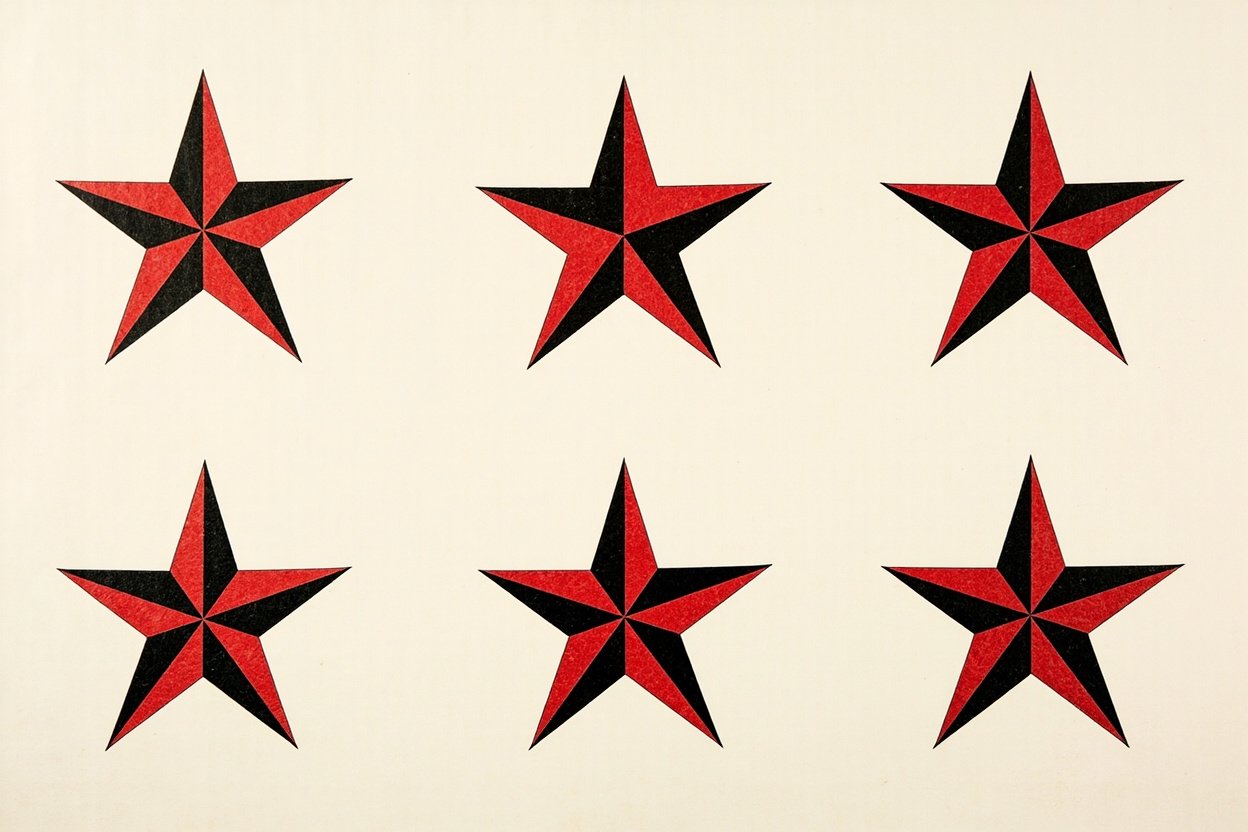
A nautical star tattoo means guidance, protection, and finding your way home. The five-point star with its split dark-and-light shading comes from sailor culture, where it stood for the North Star and a safe return to port, and it later carried into Navy tradition, old-school flash, and rockabilly style.
Quick answer: A nautical star tattoo symbolizes direction, luck, and a safe return home. The classic version is a five-point star with each point split into a dark and light half, echoing the compass rose on old sea charts. Sailors wore it for guidance; punk and rockabilly scenes later adopted it for its bold graphic look.
What the Nautical Star Actually Looks Like
The difference between a nautical star and any other five-point star is the shading. Each point is split down the middle into a dark half and a light half, alternating around the star. That two-tone contrast is what makes the design read clearly from a distance and gives it the graphic punch that attracted traditional tattooists.
The shape borrows from the compass rose printed on old maritime charts. Cartographers used the same split shading to suggest dimension on a flat page, and tattooers copied the convention. Without that alternating dark and light, you have a generic star. With it, you have the nautical version.
Size matters for this detail. Too small, and the point halves blur together into a muddy shape. Too large without clean line work, and the geometry looks sloppy. The sweet spot for readability is usually two inches or larger on flat skin, with solid black fills rather than soft grey washes that can heal unevenly.
Placement and how it wears
The forearm and upper arm are the classic placements because the flat surface preserves the geometry. The star also works on the chest, shoulder, and behind the ear for smaller versions. Hands and feet are possible but challenging: the skin there moves constantly and sheds faster, so the crisp edges that define this design tend to soften within a few years. Ribs and sternum are painful and curved, which distorts the star if your artist does not adjust the point angles to follow your body.
Origins and Sailor History
The nautical star is often linked to the age of sail, when seamen navigated by the night sky before radio, radar, or satellite. Polaris, the North Star, held a nearly fixed position over the northern horizon, making it the reference point for finding direction. A tattoo of that star would have served as a private reminder that there was always a fixed point to steer toward, even when the sea and sky offered no other landmarks.
How early this practice began is hard to pin down. Sailor tattooing in the West grew through the 1700s and 1800s, with documented professional tattooers working in ports like Honolulu and Portsmouth by the late nineteenth century. The nautical star appears in early flash sheets from the early 1900s onward, though whether it originated with sailors or with shoreside tattooers selling sailor imagery is not certain. What we do know is that the design became firmly associated with maritime life by the mid-twentieth century, when it was standard in the flash catalogs of artists like Sailor Jerry Collins and his contemporaries.
The meaning for sailors was practical and personal. You spent months away from port, the weather turned without warning, and the tattoo was a small permanent mark that outlasted any charm or letter. It read as protection, luck, and the hope of return rather than decoration alone. Some sources suggest sailors got the star before a long voyage as a kind of insurance, though records of this specific ritual are sparse and may be later romanticism.
The compass rose connection
The split shading directly copies how compass roses appeared on printed charts. A compass rose shows the cardinal directions with radiating lines, and the nautical star simplifies that into a single five-point form. The five points do not correspond to the four cardinal directions plus something extra; the number seems to have been chosen for visual balance rather than symbolic precision. Some wearers later assign their own meaning to the five points, but that is personal interpretation rather than historical practice.
Military and Navy Tradition
Within the United States sea services, the nautical star became an informal mark of time at sea or affiliation with the Navy, Marine Corps, or Coast Guard. It was never an official insignia, which allowed it to spread organically. Sailors and Marines got it to mark a particular deployment, a crossing, or simply to identify themselves to others who understood the reference.
The color conventions that developed in this context are practical rather than mystical. On ships, the port side carries a red running light and the starboard side carries a green one. Some service members colored their stars to match: red for port, green for starboard. A few wore both, one on each side of the body, so the pair echoed a ship’s own lights. This is a later tradition rather than an ancient one, probably solidifying in the mid-twentieth century as tattoo color became more reliable and affordable.
The black and grey or black and white version remains the most common in military contexts, keeping the meaning general: guidance, safe return, and belonging to a seafaring life. The specific color coding is a nice detail for those who know it, but it is not required to wear the design with respect for its history.
Color Choices and What They Signal
The color you choose changes how the tattoo reads, sometimes more than people expect.
Black and white or black and grey. This is the default and the most historically grounded. It keeps the guidance-and-protection meaning clean and works with any style from traditional to contemporary. The high contrast also ages best, since black holds its value longer than most colors.
Red. Often associated with the port side in naval convention, red also carries independent associations with passion, danger, and courage. In old-school flash, red was one of the first reliable colors available, so it became common simply because it worked. A red nautical star can signal left-side affiliation for those who know the code, or it can just be a strong color choice against skin.
Green. The starboard counterpart to red. Green reads as forward motion and is less common than red, which makes it slightly more distinctive. Paired red and green stars on left and right sides are a deliberate naval reference, though most viewers will not recognize the code without explanation.
Blue or purple. These are modern additions without traditional maritime meaning. They work if you like the color, but they shift the tattoo away from historical reference and toward personal aesthetic.
Punk, Rockabilly, and Later Adoption
The nautical star moved beyond maritime circles through the twentieth century tattoo revival and the rockabilly and punk scenes that embraced traditional flash. The design offered exactly what those subcultures wanted: bold, simple, instantly recognizable, and carrying a whiff of working-class rebellion without requiring actual sea time.
In the 1990s and 2000s, the star became common in punk and alternative fashion, sometimes stripped of its original meaning entirely. This caused a minor backlash among some traditional tattooers and sailors, who saw it as appropriation by people who did not understand the history. That debate has largely faded, partly because the design is now so widespread that no single group can claim exclusive ownership.
The rockabilly revival of the early 2000s brought the nautical star back into traditional flash prominence, often paired with anchors, swallows, and banners in full sleeve compositions. Today it sits in an unusual position: still readable as a sailor tattoo, but equally valid as a general symbol of direction or simply a strong graphic choice.
How to Get One That Holds Up
The nautical star looks simple, which makes it easy to execute badly. The geometry is unforgiving. Asymmetrical points, uneven shading splits, or wobbly lines destroy the design immediately because there is no detail to hide behind.
Look for an artist with strong traditional or neotraditional line work. Ask to see healed photos, not just fresh tattoos. The crisp edges you want will soften slightly over time, but they should not collapse. Solid black fills on alternating points give better long-term contrast than outlines alone or grey washes that can heal to similar tones.
Consider the point direction. Traditionally, one point faces upward, though some variations rotate the star. Upward is the standard orientation for the guidance meaning; other angles read as stylistic choice rather than convention.
If you want supporting imagery, the classic combinations are anchor, rope, swallow, or banner with text. These push the tattoo toward full old-school narrative. A standalone star is cleaner and more versatile, but it leaves the meaning more open.
What to Remember
The nautical star is one of the oldest continuously tattooed designs in Western tradition, and that longevity means its meaning has layered over time. For some it is a literal maritime symbol, for others a personal compass, and for many simply a strong graphic star that happens to carry history. None of these uses invalidates the others.
If you choose this design, the quality of execution matters more than the depth of your sailor credentials. The alternating point shading is the technical heart of the tattoo, and getting that right requires an artist who understands traditional geometry. A well-done nautical star will still read clearly in twenty years. A poorly done one will blur into an unrecognizable shape that defeats the purpose of choosing such a clean, deliberate design.
The history is there if you want it, but the tattoo also works without explanation. That flexibility is probably why it has survived when so many other trends have faded. It is a star that points somewhere, and the somewhere can be home, forward, or simply wherever you decide to go.
Frequently Asked Questions
What is the difference between a nautical star and a regular star tattoo?
The nautical star has alternating dark and light halves on each of its five points, copying the compass rose on old maritime charts. A regular five-point star lacks this split shading and does not carry the same maritime association.
Do I need to be a sailor or veteran to get a nautical star tattoo?
No. While the design originated in maritime culture, it has been widely adopted outside naval circles. The meaning you give it matters more than your background, though some people prefer to know the history before wearing it.
What does a red and green nautical star pair mean?
This pairing references ship running lights: red for port (left) and green for starboard (right). Some sailors and service members wear them on corresponding sides of the body. It is a later tradition rather than an ancient requirement.
How big should a nautical star tattoo be?
At least two inches across for the point shading to stay readable over time. Smaller versions blur as the skin ages and shifts. The forearm and upper arm are ideal placements for preserving the geometry.
Which way should the nautical star point?
Traditionally one point faces upward, associated with the North Star and guidance. Other orientations are stylistic choices without established symbolic meaning.