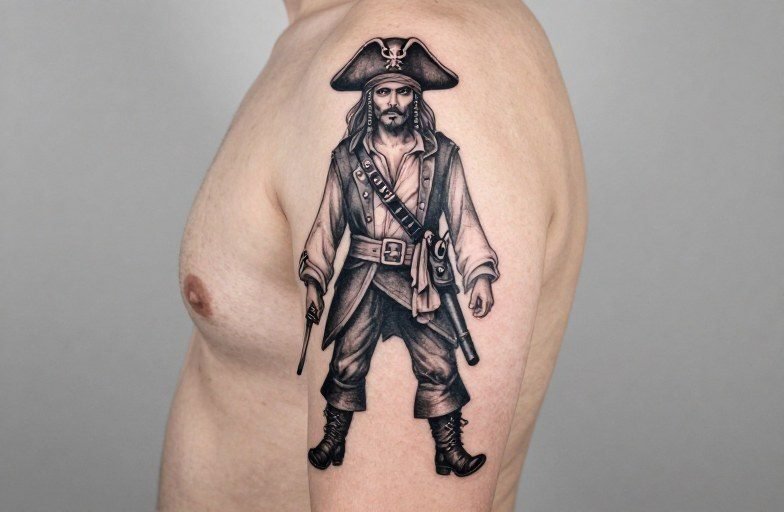
Pirate tattoos carry a core meaning of rebellion, autonomy, and refusal to live by others’ rules. The imagery draws from historical maritime outlaw culture but functions today as a personal declaration of independence, whether from a past job, a restrictive upbringing, or simply the pressure to conform. The skull, the ship, the crossed swords: each element layers additional meaning onto that foundation.
Symbolism & History
The pirate symbol set is instantly readable across cultures, which gives it unusual communicative power. You don’t need to explain a Jolly Roger to anyone.
The Jolly Roger and Skull Motifs
The skull-and-crossbones, often linked to pirate captain Edward Low and others, was a practical terror tactic, fly it, and merchant ships might surrender without a fight. As tattoo imagery, it compresses several ideas into one compact form:
- Memento mori: death comes for everyone, including the powerful
- Defiance of authority: the pirate operated outside national law
- Brotherhood: crew members marked themselves to identify the dead and signal loyalty to the ship
Some trace the skull motif further back to earlier maritime traditions, but its pirate association solidified in the 18th century and dominates popular understanding today.
Ships, Maps, and Nautical Tools
A full-rigged ship under sail represents journey and self-direction, the pirate chose their destination, however dangerous. Compasses and astrolabes (often simplified to a compass rose) suggest finding one’s own way. Treasure maps, usually rendered as aged parchment with X-marks, add layers of quest, hidden value, or secrets kept.
These elements work best when rendered with specific detail: rope texture, wood grain, salt-worn sail edges. Generic clip-art ships age poorly and look increasingly like off-the-shelf designs as surrounding tattoo trends shift.
Common Variations & Styles
Style choice dramatically changes how a pirate tattoo reads and how it ages. This isn’t merely aesthetic preference, it affects the piece’s longevity and clarity.
Traditional American
Bold black outlines, limited color palette (red, yellow, green, blue), and minimal shading. The traditional pirate ship or skull reads immediately from across a room. The heavy line weight holds up over decades; this is the style most commonly associated with Sailor Jerry and mid-20th-century naval tattooing. Colors stay relatively true, though yellows and light greens fade fastest.
Black and Grey Realism
Detailed portraits of historical pirates, realistic ship renderings, or weathered skulls with fabric and metal. Requires an artist with specific expertise in smooth shading transitions. The risk here is muddying over time, without sufficient black anchor points, grey tones can blur together. Ask to see healed photos, not just fresh work.
Neo-Traditional and Illustrative
Expanded color range, more dynamic composition, sometimes incorporating decorative elements like scrollwork or banners with lettering. Offers the most room for personal symbolism but demands strong design sense to avoid visual clutter. The banner-with-quote format is common but often poorly executed; if you want text, keep it short and legible.
Minimalist and Single-Needle
Small ship silhouettes, simple compass outlines, or tiny skulls. Reads as subtle rather than aggressive. The tradeoff: fine lines blur and disappear faster, especially on high-movement areas like wrists or ankles. Expect touch-ups within 3-5 years.
Best Placements
Pirate imagery tends toward medium-to-large scale because of the detail involved in ships, maps, and figure work. That said, placement should follow your pain tolerance, professional constraints, and how publicly you want to display the symbolism.
- Upper arm/shoulder: Classic canvas for ship designs. Muscle movement adds life to sails and waves. Heals relatively predictably.
- Forearm: High visibility; consider whether skull imagery might read differently in professional contexts. Inner forearm offers more privacy.
- Chest: Traditional for symmetrical designs, skull center, crossed swords or cannons below. Large enough for narrative detail.
- Thigh: Excellent for horizontal compositions like ship profiles or unfurling maps. Less sun exposure preserves color longer.
- Back: Only choice for truly expansive scenes, full fleet battles, detailed coastal raids. Requires significant commitment of time and money.
- Hand/finger: Small anchors, tiny skulls. High visibility, fast fading, painful healing. Many artists refuse hands on clients without substantial existing work.
Ship designs with horizontal orientation (side view) need width. A ship squeezed onto a vertical space like a calf or ribcage loses its essential proportions and can look like a different subject entirely.
Who Chooses This Tattoo / Personal Meanings
The pirate symbol set attracts a specific psychological profile, though individual reasons vary considerably.
Career Transition Markers
People leaving military service, corporate jobs, or structured institutions sometimes choose pirate imagery to mark the shift from external authority to self-direction. The timing matters, getting this tattoo during active service or employment can create real professional complications, so many wait until the transition is complete.
Subcultural Affiliation
Punk, metal, and certain biker communities have adopted pirate aesthetics as part of a broader anti-authoritarian visual language. The tattoo functions as membership signal, though less explicitly than gang or club markings.
Family and Regional Connections
Coastal communities with actual maritime history, New England fishing towns, Gulf Coast ports, Pacific Northwest logging-and-sailing towns, sometimes use pirate imagery to claim regional identity. This differs from the rebellion narrative; it’s about belonging to a specific place and its working history.
Personal Reclamation
Some choose the skull specifically after surviving illness, addiction, or violence. The memento mori aspect shifts from general warning to personal victory: I faced death, I continue. This meaning is private unless the wearer chooses to explain it.
Similar Symbols
If pirate imagery feels too aggressive or too common, related symbols carry overlapping meanings with different emphases:
- Swallows and nautical stars: Travel and return, more optimistic than the pirate’s permanent outsider status
- Serpents and snakes: Danger, wisdom, transformation, similar rebellion but more individual, less communal
- Outlaw motorcycle imagery: Overlapping anti-authoritarian meaning but tied to specific subcultural membership
- Pioneer/frontier symbols: Self-reliance and lawlessness, but land-based and often politically loaded differently
- Samurai or ronin: Disciplined outsider rather than chaotic rebel; appeals to those who want structure-without-masters
The pirate remains unique in combining maritime freedom, criminality, and democratic crew culture (historically inaccurate as the democracy part often is, but the symbolism persists).
Final Thoughts
A pirate tattoo works when the specific imagery matches your specific reason. The generic skull-with-bandana, downloaded from a flash sheet, communicates little beyond “I like pirates.” The ship that matches your grandfather’s Coast Guard vessel, rendered in the style of 19th-century scrimshaw, carries actual weight. The compass with coordinates you chose, not a stock number. The sword that references a real historical piece, not a cartoon cutlass.
The difference between a tattoo that satisfies for decades and one you regret or cover is rarely the subject category. It’s the specificity of the design, the skill of the artist, and the honesty of your own motivation. Pirate imagery offers a robust, culturally legible vocabulary for certain kinds of self-definition. Whether that vocabulary fits your particular story is a question worth sitting with before the needle starts.
Frequently Asked Questions
Do pirate tattoos have to be large to look good?
No, but the subject matter fights against small scale. A detailed ship needs room for rigging and hull definition to read correctly. Small pirate tattoos work best as simple anchors, minimal skulls, or compass roses, stripped to essential shapes rather than compressed detail.
Will a skull tattoo hurt more than other designs?
Pain depends on placement and your personal sensitivity, not the image itself. Skull tattoos often go on bony areas like forearms, shins, or ribs, which do hurt more than fleshy spots. The design complexity, lots of black fill or fine shading, extends session time, which increases cumulative discomfort.
Are pirate tattoos considered unprofessional?
Visibility matters more than subject. A skull on your hand is harder to navigate professionally than a ship on your upper arm under a shirt. Some industries don’t care; others do. Consider your actual workplace, not abstract rules, and place accordingly.
How do I keep a black and grey pirate ship from looking muddy?
Demand strong black contrast in the design. Your artist should anchor the piece with solid blacks in the hull, sails, or water line, then build greys outward. Without those dark anchor points, the greys blend into one tone within a few years. Ask specifically about healed photos of similar work.
Related Tattoo Meanings
- Hades Tattoo Meaning: Power, Shadows Rebirth
- Rebellion Flag Tattoo Meaning: Symbolism, History Personal Expressio
- Navy Tattoo Meaning: Service, Honor The Deep Bond
- Explore more