
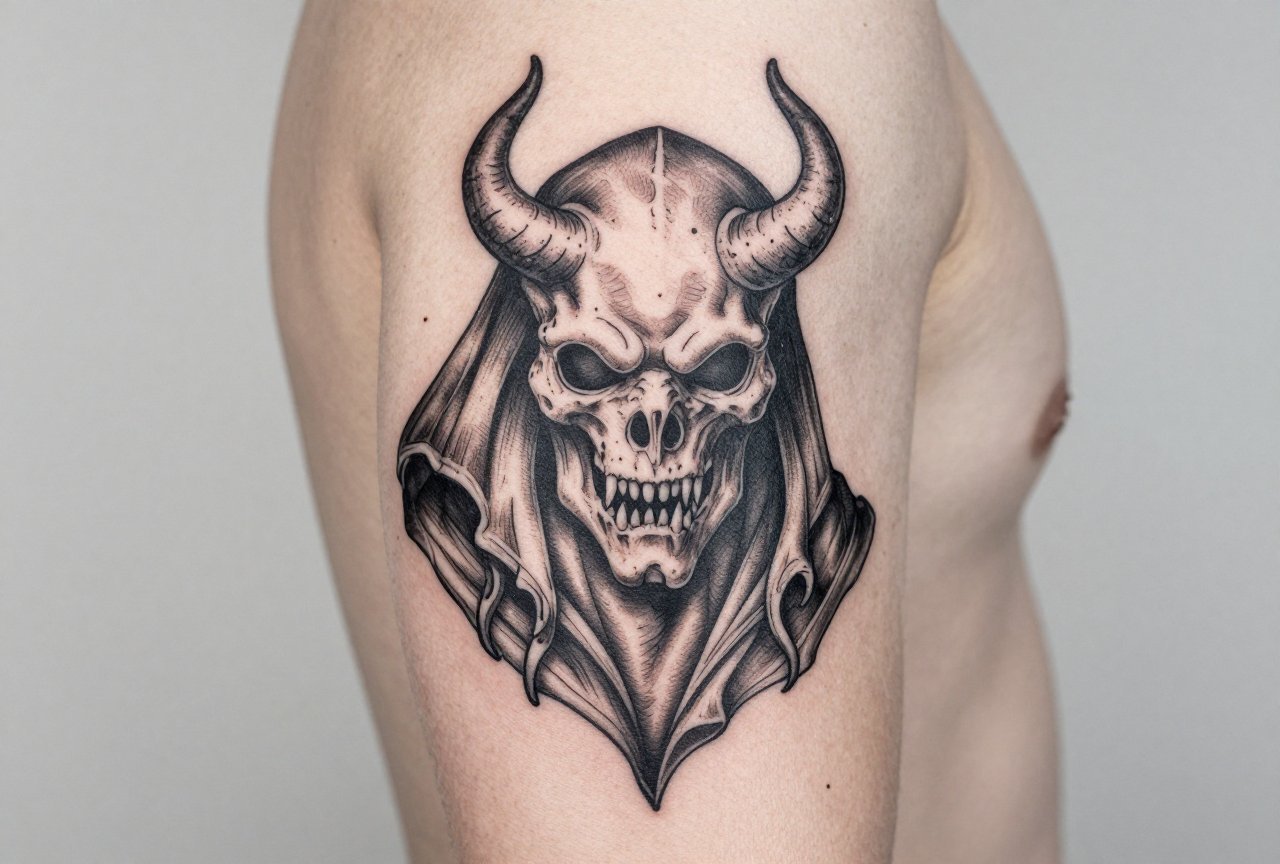
A Hades tattoo means power over what others fear. It speaks to ruling your own darkness, finding wealth in buried places, and understanding that endings feed new beginnings. I’ve tattooed this god on soldiers leaving for deployment, on people who’ve buried parents, on kids who finally got sober, each one carrying a different piece of the underworld king’s story.
Symbolism & History
Hades gets a bad rap. People conflate him with the Christian devil, but that’s not the myth at all. In my chair, I tell clients: Hades didn’t choose the underworld. He drew the short straw when he and his brothers divided the cosmos. Zeus got sky. Poseidon got sea. Hades got the dead. And he ruled it without complaint, without the petty drama Olympus ran on. That stoic acceptance hits different for people who’ve been handed raw deals.
The Helm of Darkness & Bident
The helm, called the Cap of Invisibility, shows up constantly in Hades tattoos. It’s not about hiding; it’s about moving unseen through your own life. I’ve done this piece where the helm dissolves into smoke across someone’s shoulder, the face barely there. The bident, his two-pronged spear, gets less play than Poseidon’s trident but carries sharper meaning: choice, division, the fork where you decide. Line work here needs to be clean. Shading ages softer on the bident’s prongs, so I usually push for bolder lines if someone wants it legible in ten years.
Cerberus & The Pomegranate
Cerberus, the three-headed hound, guards the boundary. Tattooing him, you feel the weight, literally, clients sit longer for all that black fill. The pomegranate seeds Persephone ate? That’s the contract that binds. I did one on a woman’s ribs where the seeds scatter into actual clock gears, each one marking a year she stayed in a marriage that was killing her. The myth lives because the metaphor holds.
Common Variations & Styles
Shop culture around Hades pieces splits into camps. Some artists lean heavy blackwork, full underworld gloom. Others pull the classical sculpture angle, marble tones, dramatic light. Both work, but they heal and age differently.
- Blackwork & dark realism: Heavy saturation, deep blacks, skulls and shadows. Heals with more contrast loss than you’d think, those velvety blacks often settle to charcoal. Plan for a touch-up.
- Neoclassical/statue style: White ink highlights, greywash modeling. Looks stunning fresh, but white fades to skin tone fast. I warn clients: that marble glow becomes memory within five years.
- American traditional: Bold outlines, limited palette, Cerberus heads stacked like a totem. Holds up forever. I’ve seen Sailor Jerry-influenced Hades pieces from the 80s still reading clear.
- Fine line & illustrative: Delicate bidents, pomegranate vines, minimal faces. Trendy now, but the thin lines blur. I did one on a wrist that needed rebuilding in eighteen months.
We see this a lot: someone brings a Pinterest render with impossible contrast, no black pooling, no skin showing. I have to explain that tattoo ink sits under skin, not on top of it. The underworld king deserves honesty about how he’ll actually look.
Best Placements
Hades imagery carries weight. You want somewhere that framing helps, not fights.
Large Scale Pieces
Back panels, full thighs, chest pieces, this is where Cerberus sprawls, where the throne room builds. I’ve tattooed Hades seated on a full back, columns fading into the client’s existing shoulder work. The vertical space lets you stack symbolism: river Styx at the bottom, throne at center, helm dissolving toward the neck. Takes multiple sessions. The healing between sucks, sleeping on your stomach, back peeling like sunburn.
Smaller & Medium Placements
Forearms work for bidents, single pomegranate seeds, stylized helms. Ribs for the myth’s emotional weight, Persephone’s story, the abduction that wasn’t, the negotiation. Ankles and wrists for minimalist takes. I did a tiny black helm behind someone’s ear, visible only when they tuck hair back. She’d survived ovarian cancer. The placement was the point: invisible power, personal territory.
Who Chooses This Tattoo / Personal Meanings
In my experience, Hades people don’t walk in loud. They research. They sit with the idea. The guy with the Poseidon sleeve wants conversation; the Hades client usually wants the work to speak.
- Survivors of depression or addiction: The underworld as place, not punishment. They walked through, they ruled what tried to rule them. I’ve heard “I made friends with my darkness” more than once.
- People in grief work: Hades as host, not villain. The dead have somewhere to go. A mother who lost her son had me tattoo the helm over her heart, the face turned away, looking down.
- Those who’ve taken power back: Corporate escapees, abuse survivors, anyone who seized authority in a space where they were supposed to stay small. The underworld king doesn’t ask permission.
- Classics enthusiasts, obviously: But even they carry personal weight. The professor who can read Ancient Greek, who chose the pomegranate specifically because the Homeric Hymn uses a different word for seed than later texts.
One client, covered in bright Japanese work, sat for six hours of solid black on his calf. No color, no relief. “I need somewhere that matches the inside,” he said. That’s the Hades conversation.
Similar Symbols
People cross-shop myths. I help them sort what actually fits.
- Persephone: The companion piece, the seasonal cycle, the queen who chose her throne. Couples get matching Hades/Persephone work, but I push them toward separate compositions that speak to each other rather than mirror images.
- Anubis: Egyptian underworld guardian, jackal-headed, scales of judgment. More about weighing worth than ruling territory. The overlap is death’s bureaucracy, but the tone differs.
- Hel: Norse half-living queen, split face, the dishonored dead. Bleaker, less agency, more fate. Hades chose to govern well; Hel simply is.
- Pluto: Roman name, same god, but the conflation with wealth (plutonium, plutocrat) shifts meaning. I’ve had finance guys request Pluto specifically for the money angle, not the death one.
- Skull imagery generally: Dia de los Muertos, memento mori, pirate flags. Hades sits above these, he’s the administrator, not the reminder. The skull is what you become; Hades is who receives you.
Final Thoughts
A Hades tattoo isn’t decoration. It’s a statement about what you’ve carried, what you’ve buried, what you’ve grown in dark soil. In my chair, I watch people settle into the symbolism like a heavy coat they finally accept wearing. The needle hurts. The black saturates. The healing itches, flakes, reveals. Six weeks later, they look in the mirror and see a king who made the best of a bad draw, who kept his word, who ruled the place everyone else feared to name. That’s the work. That’s why we mark it.
Frequently Asked Questions
Does a Hades tattoo mean I worship the devil?
Not at all. Hades is a Greek god, not a Christian figure. In the myths, he’s a stern but fair ruler of the dead, not evil or demonic. Most people who get this tattoo connect with his stoicism or underworld symbolism, not any religious worship.
Will a mostly black Hades tattoo fade to a grey blob?
Heavy blackwork does soften over time, but it doesn’t disappear. The key is solid saturation during application and sun protection afterward. A well-done black piece stays readable for decades, though you might want a refresh after ten years to bring back the depth.
What’s the difference between Hades and Pluto tattoos?
Same god, different cultural lens. Hades emphasizes death, the underworld, and shadow work. Pluto carries Roman associations with wealth and minerals underground. The imagery often overlaps, but the name you choose signals which meaning you lean toward.
Can I combine Hades with other Greek gods in one piece?
Absolutely, and it often strengthens the story. Hades with Persephone speaks to partnership and seasonal cycles. With Hermes, it’s about the psychopomp journey. Just give each figure enough space to read clearly, crowded mythological scenes blur faster than focused ones.









