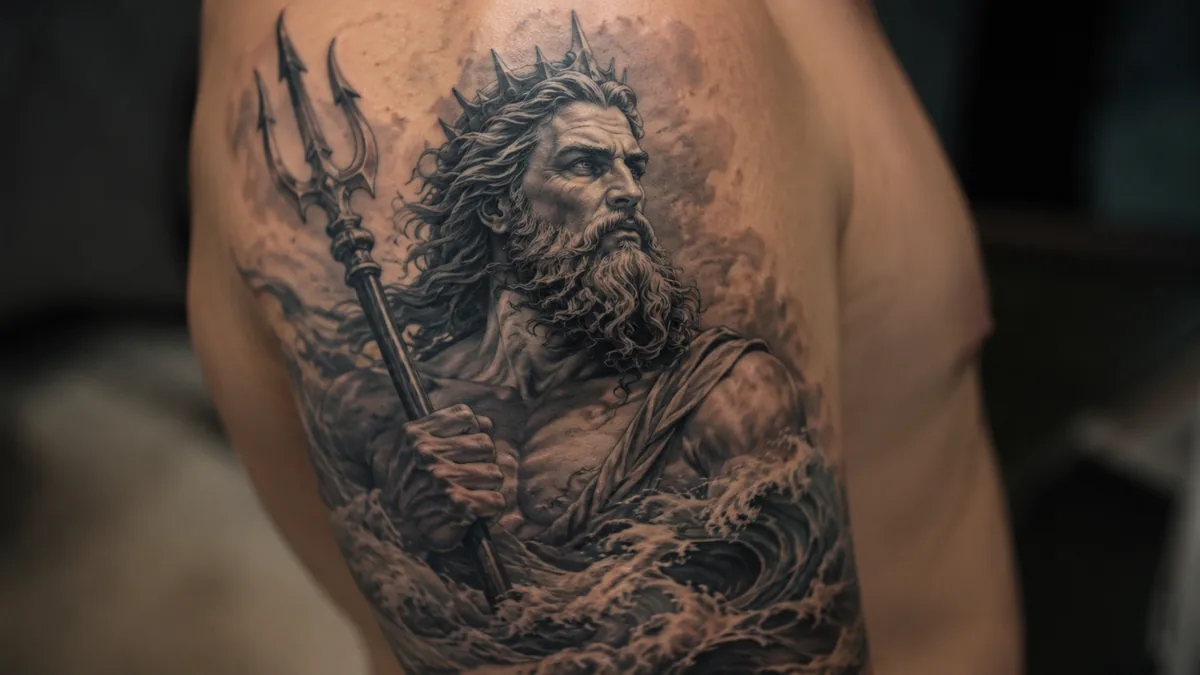
Poseidon is the Greek god of the sea, earthquakes, and horses. As a tattoo, he carries serious weight. People choose him to represent raw power, the untamable force of nature, and authority over the chaos in their own lives. He’s not a safe, decorative choice. He’s a statement.
The core message is this: strength that doesn’t apologize. If you’re drawn to the mythology, the ocean connection, or just the sheer visual drama of a god holding a trident in a storm, a Poseidon tattoo reads loud and clear from across the room. Here’s what it actually means.
Core Symbolism: What a Poseidon Tattoo Actually Means
Poseidon represents power, dominance, and control over forces bigger than any single person. The sea in Greek thought was both provider and destroyer. Poseidon ruled that duality. On skin, the tattoo speaks to someone who respects that tension, who understands that real strength includes the capacity for destruction and the wisdom to hold back.
A lot of people get him to represent resilience after a storm, literal or personal. Sailors historically invoked Poseidon for safe passage. In tattoo culture that translates to: I’ve survived rough water. The trident specifically is a symbol of command and authority. The whole image together says I’m not afraid of the deep.
Greek Mythology Background That Actually Matters
You don't tame the ocean. You don't tame this tattoo.
Poseidon is one of the three sons of Cronus, alongside Zeus and Hades. They divided the cosmos: Zeus took the sky, Hades the underworld, Poseidon the sea. He’s not a minor character. He shapes geography, he starts wars, he fathers monsters. The Greeks feared and respected him equally.
His temples were built near ports and on coastal cliffs. He was also god of earthquakes, which the Greeks called him the Earth-Shaker. Horses were sacred to him because he was said to have created the first horse. If you’re drawn to horse symbolism, a Poseidon tattoo can carry that layer too, though most designs lean into the ocean side of his mythology.
Popular Design Variations and What They Communicate
Portrait-style Poseidon with flowing beard, trident raised, surrounded by crashing waves is the most common build. It hits hard in black and grey with heavy contrast. Some clients go for just the trident, clean and minimal, which reads more personal and less narrative. Others incorporate sea creatures, ships, or a storm backdrop to deepen the scene.
Neo-traditional Poseidon is popular right now. Bold outlines, saturated color, exaggerated features. It pops. Japanese-influenced versions exist too, blending Poseidon into wave compositions that nod to Hokusai. Fine line Poseidon is possible but tricky. Thin strokes on a deity portrait in a high-movement zone will blur over time. Know what you’re committing to before you pick that style.
Trident Symbolism as a Standalone or Add-On
The trident is Poseidon’s weapon and his attribute. As a standalone tattoo it represents the same ideas without needing the full figure: authority, mastery of the elements, and the number three, which in many traditions symbolizes balance, creation, and completion. Some people get the trident alone as a nod to strength without the mythological baggage of a full deity portrait.
As an add-on to a Poseidon piece it reinforces the command aspect of the design. Placement of the trident in the composition matters. Raised trident reads aggressive, active power. Trident planted in the ground or resting reads authority and calm. Talk to your artist about the story you want the pose to tell before you sit down.
Black and Grey vs Color: How Each Reads and Ages
Black and grey is the dominant choice for Poseidon work, and for good reason. The subject is mythological, dramatic, and benefits from the weight that solid shading and deep blacks provide. A well-executed black and grey Poseidon heals nice, holds detail, and ages predictably. The contrast between white highlights and deep shadows does the heavy lifting. It reads from across the room without needing saturated color.
Color Poseidon pieces tend to go neo-traditional or illustrative. Deep ocean blues, sea greens, and stormy greys used well can be stunning. The risk is that blues and greens fade faster than blacks in high-sun areas. If you’re putting a saturated blue piece on a forearm or shoulder, budget for a touch-up in five to seven years. Committed care and sun protection extend that window significantly.
Placement, Pain, and How It Ages on Different Zones
Poseidon is a large-format design at its best. A full back piece, chest panel, or thigh placement gives your artist room to build the scene properly. The upper arm and ribcage also work for medium-scale portraits. Small Poseidon pieces are possible but the face detail suffers, especially in fine line. Bold will hold. A larger piece with solid linework will still read clean in ten years.
Pain varies by zone. Ribs and sternum are spicy. Upper back is manageable. Thigh is generally one of the easier large zones. In terms of aging, the chest and back hold ink well. High-wear zones like the inner forearm and hands will need maintenance earlier. Ask your artist about needle depth and saturation in your chosen area. A tight, properly healed Poseidon with crispy lines is a piece that lasts a lifetime.
Who Gets a Poseidon Tattoo and How to Make It Personal
Sailors, surfers, fishermen, maritime workers, and anyone with a deep connection to the ocean are natural fits. So are people who’ve been through something catastrophic and made it through. The symbolism of surviving the storm, of having Poseidon on your side, resonates with people who don’t scare easy. Athletes, military, and people in high-stakes careers are drawn to the authority and power angle.
To make it personal, build the details around your story. Add the coordinates of a meaningful body of water. Work in a ship or a specific sea creature with personal meaning. Choose a pose that reflects your interpretation of power, is it controlled or unleashed? Bring reference, talk to your artist before booking, and let the composition breathe. A Poseidon tattoo done right is not background art. It’s a conversation starter that means something every time someone asks about it.