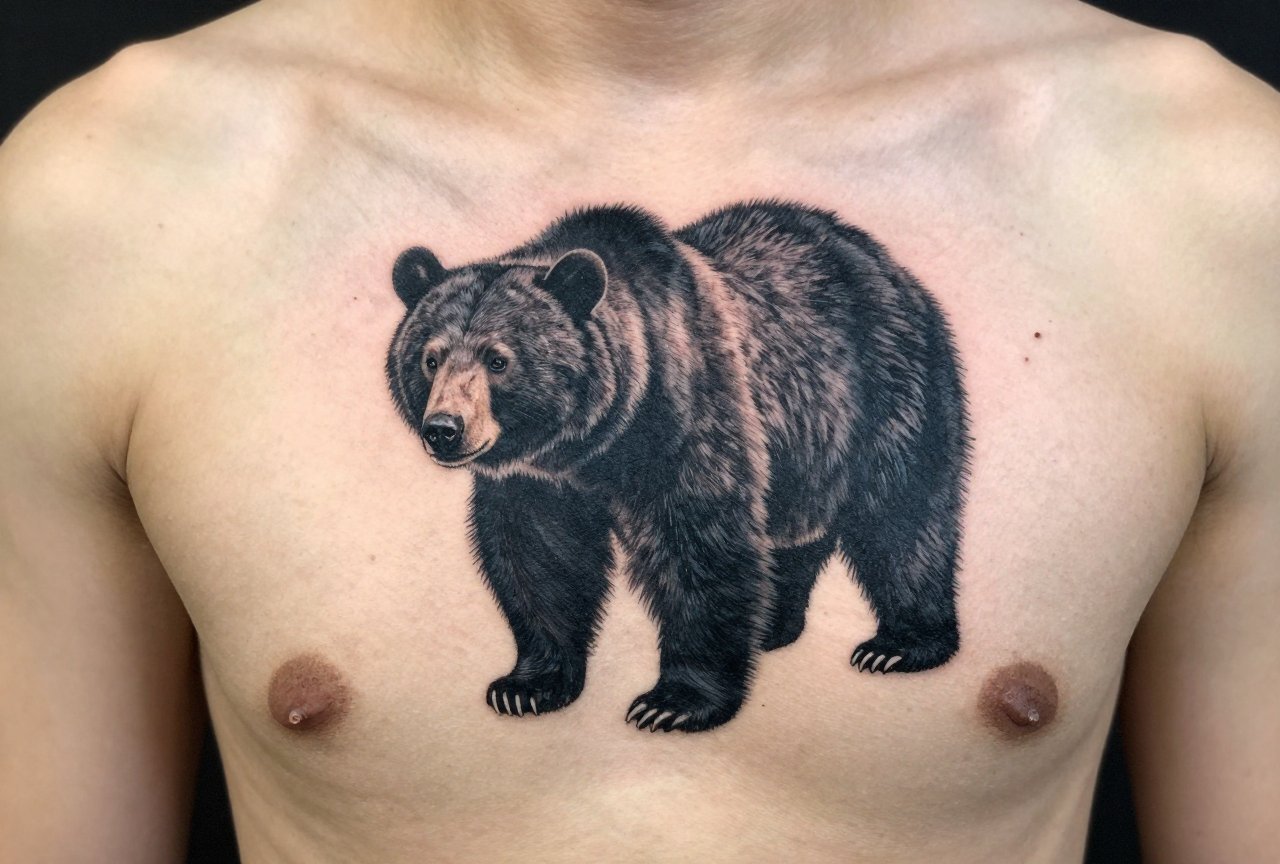
A realistic black bear tattoo isn’t just a portrait of an animal. Done right, it’s a study in shadow, muscle, and the particular weight of a creature that can weigh 600 pounds but move like smoke through a forest. I’ve tattooed bears on shoulders, thighs, ribs, each one demands a different approach to the same dense, dark fur and those surprisingly expressive eyes. This guide breaks down what actually matters when you’re considering one, from how the ink sits in skin to the conversations I have with clients before we start.
Origins & History
Bear imagery in tattooing has deep roots in North American shop culture, particularly in the Pacific Northwest and mountain states where artists grew up seeing these animals on hiking trails, not just in documentaries. The realistic style emerged from wildlife illustration traditions, think Roger Tory Peterson field guides crossed with the technical precision of 1980s black-and-grey Chicano lettering.
From Flash to Photorealism
Old-school bear tattoos were bold outlines, heavy black, maybe a little brown wash. The realistic shift happened when artists started referencing actual photographs, studying taxidermy (I know a guy who apprenticed at a museum), and pushing single-needle work for fur detail. By the mid-2000s, Instagram accelerated everything, suddenly clients were bringing in National Geographic shots and asking for that level of detail on their forearm.
Regional Styles
Canadian artists often emphasize the bear’s bulk and winter coat, thicker, softer rendering. Alaska-trained tattooers I’ve met tend toward harder contrast, sharper definition, maybe because they’re tattooing people who actually encounter these animals in conditions where softness means death. Lower 48 shops usually split the difference.
Key Characteristics & Motifs
What separates a realistic black bear from a generic bear tattoo? Specifics. The shoulder hump on a grizzly versus the straight back of a black bear. The Roman nose profile. The way fur changes density from the thick ruff behind the ears to the shorter hair on the face.
- Fur texture: Built through stippling, whip shading, and single-needle line work, not solid black blocks. I spend hours on this, layering from dark base to highlight.
- Eye detail: Bears have small, dark eyes relative to head size. Getting the moisture catch right makes or breaks the life in the piece.
- Nose leather: That wet, textured surface demands smooth black-grey transitions. I’ve seen artists ruin it with too much solid black.
- Claw rendering: Often included for context, but realistic claws show wear, dirt, the irregularity of real keratin, not polished cartoon nails.
- Environmental context: Pine needles, river rocks, salmon, elements that ground the bear in habitat rather than floating it on skin.
The best pieces I’ve done incorporate one telling detail: a torn ear, a scar across the muzzle, snow caught in fur. These humanize the animal without anthropomorphizing it.
Color vs Black and Grey
Here’s where I talk clients down sometimes. Black bears aren’t actually black, they’re deep brown, sometimes cinnamon, occasionally blue-grey in certain lights. But “realistic” doesn’t always mean “color.”
Black and Grey Advantages
This is what most people choose, and for good reason. Black and grey ages cleaner, maintains contrast longer, and reads better from distance. The tonal range lets me build fur depth through value alone, no worrying about color saturation dropping out unevenly. I did a full-back black bear in black and grey seven years ago; it still reads strong because we stayed in that value structure.
When Color Works
Color realistic bears demand a different commitment. Autumn foliage, a green-gold salmon, the particular blue of glacial water. These elements can frame the bear beautifully, but the animal itself rarely benefits from color in its fur. I tell clients: if you want color, put it in the environment, keep the bear in grey tones. Otherwise you’re fighting two battles, maintaining fur texture AND color saturation.
Best Placements
Skin movement and sun exposure determine longevity. Bears have directional fur flow; placement affects how that reads as the body moves.
- Thigh: My favorite for large pieces. Stable skin, good fat padding for long sessions, and the cylindrical shape wraps the bear’s bulk naturally. I’ve done thighs where the bear’s shoulder flows into the client’s hip flexor, looks like the animal is emerging from the body.
- Upper arm/shoulder: Classic placement. The deltoid curve suits a bear’s turned head or fishing posture. Watch the ditch (inner elbow) though, healing there is rough, and detail softens faster.
- Back: Canvas size for full body portraits. The spine line can bisect the composition awkwardly if we’re not careful. I offset the bear or use the spine as a tree trunk element.
- Forearm: Increasingly popular, but limits size. I simplify fur detail here, too fine and it blurs within two years. One client wanted a bear’s face watching from his inner forearm; we compromised on a slightly stylized muzzle to guarantee longevity.
- Ribs: Painful. Skin stretches weirdly. But the bear’s lateral profile aligns with the body’s natural lines. I warn people: this is a commitment, both in session endurance and touch-up likelihood.
Who It Suits
Not everyone should get a bear. I say this as someone who loves doing them. The imagery carries weight, strength, solitude, wilderness, that can feel performative if it doesn’t connect to something real in your life.
Clients who sit best for these pieces: people with actual outdoor experience, not just aesthetic interest. Someone who saw a bear while solo hiking carries different energy than someone who thinks they look cool on Pinterest. That said, I’ve tattooed bears on city dwellers who never camped, what matters is the personal symbolism, not the biography. One regular client got a mother bear with cubs after fostering teenagers. The connection was genuine.
Style-wise, realistic bears work on most body types but scale matters. A 400-pound client’s bear can be massive, imposing; the same design on a smaller frame needs adjustment so it doesn’t overwhelm. I redraw for the body, never just shrink.
Modern Variations
The style keeps evolving. I’m seeing interesting hybrids in shops lately.
Double Exposure & Composite
Bear silhouette filled with forest landscape, or a bear’s form dissolving into geometric shapes. These read well initially but I caution clients: the more elements competing, the faster the piece dates. I did one where the bear’s fur transitioned into a topographic map of Yellowstone. Gorgeous, but it’ll need touch-up in five years to keep those fine contour lines.
Neo-Traditional Realism
Hold the line, I know that sounds contradictory. But some artists are combining bold neo-trad outlines with realistic interior shading on bears. The outline provides structure that pure realism sometimes lacks as it ages. I’ve experimented with this, thicker outer contour, single-needle interior. Holds up better than expected.
Motion & Sequence
Multiple bears showing movement: standing, fishing, running. This works on larger pieces like backs or thighs where narrative sequence has room to breathe. I did a sleeve of a bear’s year, spring cub, summer feeding, winter den. Took four sessions. The client cried at the reveal. That’s the goal.
Choosing an Artist
This matters more than design. A mediocre artist with a great reference photo still produces mediocre work. Here’s what I tell people shopping around:
- Look at healed photos, not fresh: Anyone can make black look black on day one. Ask for one-year-healed examples. Fur detail either holds or it doesn’t.
- Check animal-specific experience: Portrait artists don’t automatically translate to wildlife. The fur texture alone is a specialized skill. I’ve seen beautiful human portraitists struggle with animal hair direction.
- Discuss reference limitations: Good artists won’t copy a photograph exactly. Copyright issues aside, tattooing isn’t photography. We interpret. If an artist insists on tracing a photo, that’s a red flag for both ethics and creativity.
- Session planning: Large realistic bears take multiple sessions. Anyone promising a full thigh piece in one sitting is either rushing or lying about the detail level. My average bear thigh is 12-15 hours over three sessions.
- Shop culture fit: You’re spending serious time with this person. The artist who does my best bear work is quiet, methodical, plays audiobooks. Some clients need more energy. Match your temperament.
Final Thoughts
A realistic black bear tattoo is a serious undertaking. The best ones I’ve done, the ones I still think about, came from clients who understood that realism means embracing imperfection: the asymmetry of a real animal, the scar tissue, the way fur clumps when wet. We’re not making a logo. We’re translating a living creature into skin, and skin is a living, changing medium too.
Come prepared with reference but open to interpretation. Expect multiple sessions, some real discomfort, and a healing process that’ll test your patience. The result, if we do it right, is something that doesn’t just depict a bear but carries its weight. That’s the difference between decoration and art. I’ve been doing this fifteen years, and the bear tattoos that still satisfy me are the ones where the client felt something shift in their chest when they saw it finished. That’s the standard. Everything else is just technique.
Frequently Asked Questions
How long does a realistic black bear tattoo take to heal?
Surface healing runs 2-3 weeks, but the inner skin layer needs 2-3 months before I’d call it settled. Fur detail areas often scab heavier than smooth shading, don’t pick, keep it clean, and expect some ink loss that we touch up later.
Will the fine fur detail blur over time?
Yes, gradually. Single-needle work softens first. I design with this in mind, building texture through multiple needle sizes so the piece ages into a slightly softer version rather than a blob. Plan a touch-up at 3-5 years.
Can you cover an old tattoo with a realistic bear?
Sometimes, depending on the existing ink density. Black bears need dark areas that can incorporate old blackwork, but fine fur detail over saturated color is nearly impossible. I need to see the old piece in person to judge feasibility.
Why do realistic bear tattoos cost more than other animal designs?
The fur texture alone adds hours. A wolf or lion has shorter, more uniform hair. Bear fur is dense, layered, and directionally complex. You’re paying for the time and the specialized skill, not just the image.
Related Style Guides
- Realistic Diamond Tattoos: A Working Artist s Guide
- Realistic Hand Tattoos: A Working Artist s Guide
- Realistic Horror Tattoos: A Working Artist s Guide
- Explore more