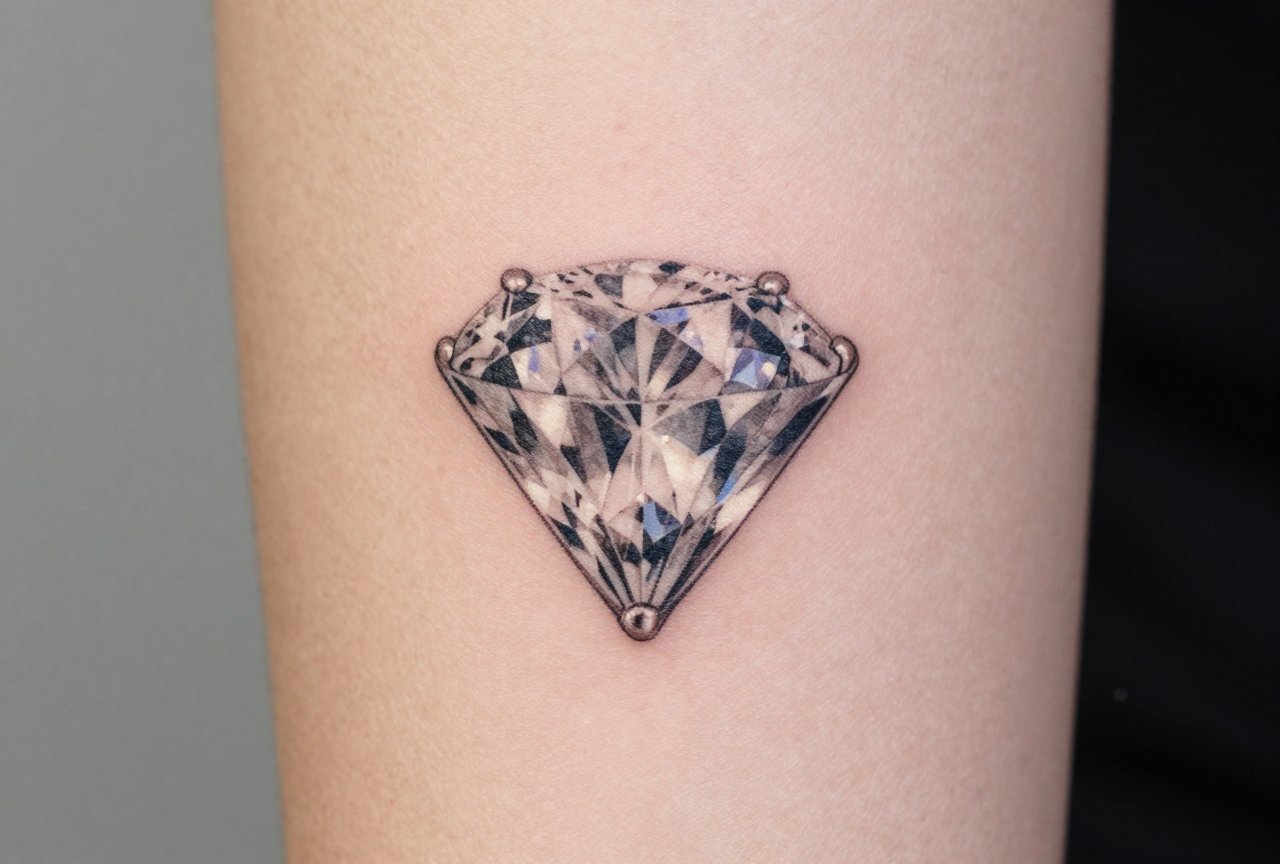
A realistic diamond tattoo isn’t your typical flash sheet gem. It’s a study in light, geometry, and patience. When someone sits in my chair asking for a diamond, I know we’re signing up for long hours, careful needle changes, and a conversation about how that brilliant sparkle will settle into skin over time. The goal isn’t just a pretty rock, it’s convincing the eye that light is actually refracting through something hard, something with weight. Done right, these pieces catch room light and hold their own against any portrait or wildlife piece in a portfolio. Done poorly, they flatten into grey blobs that look like bad clip art. I’ve seen both extremes, and the difference always comes down to understanding what makes a diamond read as real.
Origins & History
From Sailor Jerry to Photorealism
Traditional diamond tattoos have been around since the sailor days, simple, bold, usually paired with dice or playing cards. Those old-school pieces were about symbolism: luck, wealth, risk. The realistic style broke away from that lineage in the late 90s and early 2000s when artists started pushing what machines and pigments could do. I remember watching Paul Booth’s early stone work and being floored by how he made metal and glass feel cold on warm skin. That shift changed everything. Clients stopped wanting symbols and started wanting objects that felt physically present.
What Sparked the Realistic Trend
Photography culture helped. Instagram, for all its flaws, let people see what was possible when an artist spent eight hours on a single facet pattern. High-end jewelry advertising probably didn’t hurt either, people wanted their skin to look like a Cartier window. In my shop, the realistic diamond requests started spiking around 2015, usually from clients who’d seen a celebrity piece or a viral post from a realism specialist. The demand created a pressure to execute, and a lot of artists rushed in before understanding the fundamentals.
Key Characteristics & Motifs
A realistic diamond lives or dies on its faceting. The classic brilliant cut has 58 facets, and while you’re not mapping every one in skin, you need enough to sell the geometry. I tell clients we’ll hit the major facet groups, the table, the crown, the pavilion, and use negative space strategically to suggest the ones we skip.
- Hard edges where facets meet; soft gradients within each facet face
- High contrast between light sources and shadow pockets
- Reflected environment hints, subtle color shifts suggesting room light or skin tone bounce
- Occasional inclusions or flaws for authenticity; perfect diamonds look fake
- Common pairings: roses, snakes, crowns, broken chains, geometric frames
The snake-and-diamond combo has been particularly stubborn in my chair. Something about the organic curve against crystalline structure satisfies the eye. I’ve done roses growing through diamond settings, the petals soft and the stone unforgiving. That tension is the whole point.
Color vs Black and Grey
When Color Makes Sense
Color diamonds, canary yellow, champagne, pink, are gorgeous but tricky. Skin doesn’t hold bright yellows and soft pinks evenly. I’ve watched a beautiful champagne diamond fade to muddy peach in two years because the client tanned aggressively. If you want color, commit to sunscreen like a religion. The payoff is unmistakable though. A blue diamond with proper saturation catches light in a way black and grey simply can’t mimic. I use a lot of white ink mixed with pale blues and violets, then build depth with darker jewel tones around the edges.
The Black and Grey Standard
Most realistic diamond work I do is black and grey. It’s more forgiving long-term, and the contrast range lets you push those bright highlights without fighting skin chemistry. The trick is temperature variation, cool blacks in shadow areas, warm grey washes in the mid-tones, and pure skin-break or very light grey for the hottest sparkle points. I see too many artists go too dark overall, killing the luminosity. A diamond should feel cold, not dirty. The best black and grey pieces I’ve done used four distinct grey values minimum, sometimes six, with careful stippling for that scattered-light effect inside the stone.
Best Placements
Diamonds need real estate. The detail collapses on anything under about three inches in longest dimension. I’ve had clients ask for tiny finger diamonds, and I usually talk them down or simplify to a stylized version. The geometry is too fine for small scale.
- Forearm: classic, visible, enough flat area for the geometry to read
- Upper arm/shoulder: great for larger pieces with surrounding elements
- Chest: excellent for centered, symmetrical designs; the sternum gives a natural pedestal feel
- Thigh: underrated for big work; the canvas is huge and the pain is manageable
- Hand/finger: only if simplified; realistic detail dies here quickly
Skin movement matters. A diamond on the ribs or stomach will distort with breathing and body changes. I warn clients about this. The forearm is popular for a reason, it stays relatively stable, and you can actually look at your own diamond without mirrors.
Who It Suits
Not everyone should get a realistic diamond. I say this with love. The style demands commitment to aftercare and touch-ups. If you’re someone who heals poorly, keloids easily, or can’t stay out of the sun, we need to talk. The fine highlights and subtle gradations that make these pieces work are exactly what fades fastest on problematic skin.
Symbolically, I see two broad camps. There’s the resilience crowd, diamonds are hard, unbreakable, formed under pressure. Then there’s the value crowd, luxury, rarity, self-worth. Sometimes both. I’ve tattooed diamonds on people recovering from hard years, and on people celebrating new money. The meaning is yours; my job is making it look like it actually exists. The aesthetic works across genders, though I notice men often pair with darker elements (skulls, chains) while women more often request floral integration. Both approaches work when executed honestly.
Modern Variations
Broken and Abstract Forms
We’re seeing a lot of shattered diamonds lately, fracture lines, missing pieces, light escaping through cracks. It’s a visual metaphor boom, and technically it’s harder than solid stones. The broken edges need to feel sharp, dangerous, not just messy. I did one last year where the diamond was exploding outward, each shard catching different light angles. Took eleven hours. Worth it.
Mixed Media Approaches
Some artists are combining realistic diamonds with geometric backgrounds, dotwork halos, or even watercolor splashes behind tight realism. I’m cautious about these. The diamond itself needs to anchor everything; too much surrounding noise and the eye loses the illusion. When it works, though, when a perfect geometric stone sits against loose, organic texture, the contrast is stunning. I’ve started experimenting with single-needle background textures that read as fabric or smoke, keeping the diamond itself in tight three-needle groupings.
Choosing an Artist
This is where I get direct. Not every realism artist can do stones. Portraits and animals are different muscles, soft edges, fur texture, skin pores. A diamond is architecture. You want someone whose portfolio shows hard surface work: metal, glass, crystals, mechanical elements. Ask to see healed photos, not just fresh work. Everyone’s diamonds look good day one; the question is whether those bright highlights held or blew out, whether the dark facets stayed distinct or mudded together.
- Check for healed photos specifically; fresh work lies
- Ask about needle groupings; single needle for fine details, tight groupings for solid darks
- Discuss touch-up policy; diamonds often need refinement at 6-12 months
- Budget realistically; a proper realistic diamond takes 4-8 hours minimum, often multiple sessions
- Bring reference photos of actual stones, not other tattoos
I turn down diamond requests sometimes. If someone’s budget is too tight, if their skin condition is wrong, if they want it too small or in a placement that will destroy the detail. A good artist should be honest about these limits. Anyone who says yes to everything is someone to avoid.
Final Thoughts
A realistic diamond tattoo is a commitment to the long game. The session hurts, ribs, forearm, wherever, you’re sitting still while someone maps geometry onto your body with vibrating needles. The healing itches and flakes and demands you don’t pick at it. The result, though, when you catch it in mirror light or someone stops you to ask if it’s real, that’s the payoff. I’ve been doing this long enough to know which pieces I’ll be proud of in ten years. My best diamonds are on that list. They hold up because the fundamentals were right: proper contrast, honest geometry, skin-appropriate scale, and a client who understood what they were asking for. If you’re considering one, do the research, save the money, find the right artist, and give it the time it deserves. Stones form under pressure. Good tattoos do too.
Frequently Asked Questions
How long does a realistic diamond tattoo take to complete?
Most realistic diamond tattoos need 4-8 hours minimum, and complex pieces often require multiple sessions. The faceting demands precision that can’t be rushed without losing the illusion of light and depth.
Do realistic diamond tattoos fade faster than other styles?
The fine highlights and subtle grey gradations can fade unevenly if you tan heavily or skip sunscreen. Black and grey versions generally age more gracefully than color, but all realistic work benefits from touch-ups every few years.
Can I get a realistic diamond tattoo on my hand or finger?
I generally advise against it. The scale is too small for proper faceting detail, and hand skin sheds and fades ink rapidly. Simplified or stylized versions work better for those placements.
What’s the most common mistake people make with diamond tattoo designs?
Going too small or too dark. Tiny diamonds lose their geometry, and overly dark shading kills the cold luminosity that makes a stone feel real. Always prioritize size and contrast range over adding more surrounding elements.
Related Style Guides
- Realistic Hand Tattoos: A Working Artist s Guide
- Realistic Horror Tattoos: A Working Artist s Guide
- Realistic Strawberry Tattoos: A Working Artist s Guide
- Explore more