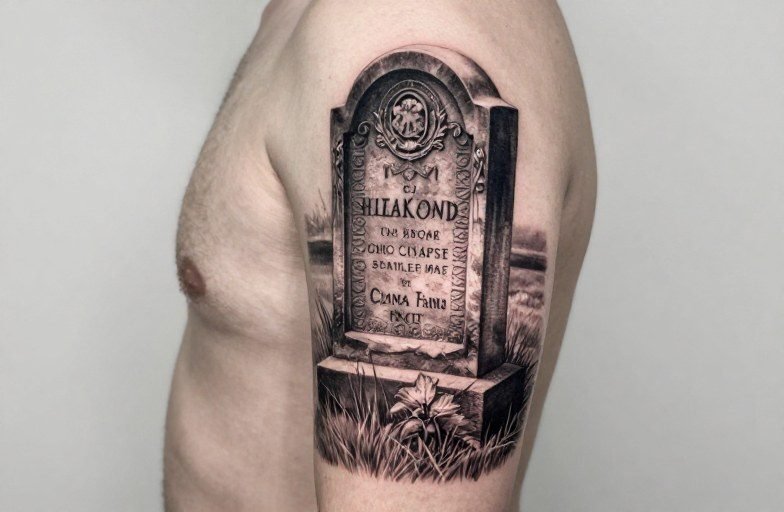
A realistic graveyard tattoo renders cemetery imagery, headstones, iron gates, weathered angels, bare trees, with photographic detail and controlled depth. The style demands technical precision: stone must read as stone, not gray blobs; fog must recede rather than flatten; and the composition needs enough contrast to hold up as ink settles into skin over years. Done well, these pieces create genuine atmosphere. Done poorly, they become muddy gray landscapes that blur together within months.
Key Characteristics & Motifs
Core Visual Elements
Successful graveyard tattoos rely on specific imagery rendered with deliberate technique. Weathered headstones carry the central focus, usually drawn with chipped edges, moss staining, and readable engraving. Bare or dying trees frame the scene and create vertical structure. Ground cover, dead grass, fallen leaves, cracked earth, anchors the composition and provides texture variation. Architectural elements like wrought-iron gates, mausoleum doors, or broken fences add human scale and narrative suggestion without requiring literal figures.
- Stone texture: built from stippled graywash, not solid gray fill, to suggest porous surface
- Atmospheric depth: lighter values in background, heavier saturation in foreground
- Light source: consistent directionality for cast shadows and stone highlights
- Organic decay: moss, cracks, tilted stones that signal age rather than neglect
Symbolism Without Cliché
Graveyard imagery carries obvious associations, mortality, memory, the passage of time. The realistic style handles these through visual storytelling rather than symbolic shorthand. A fallen stone suggests something different than an upright one. An open gate reads differently than a closed one. Overgrown paths versus maintained gravel shift the emotional register significantly. The best designs let these details do the work instead of adding literal clocks, hourglasses, or other overused memento mori elements.
Linework & Technique
Building Stone Realism
Stone presents the central technical challenge. Real stone isn’t uniformly colored; it’s layered, porous, and catches light unevenly. Tattoo artists achieve this through varied needle groupings and deliberate inconsistency. Tight single-needle work creates fine cracks and engraving detail. Larger magnum shaders lay in base tones. The critical move is leaving skin tone visible in highlight areas rather than filling everything with graywash. This negative space reads as reflected light on stone surface.
Texture requires specific approaches: stippling for rough granite, smoother gradient transitions for polished marble, broken line work for cracked or damaged surfaces. Moss and lichen get rendered with yellow-green-gray mixes, usually applied as subtle color accents even in predominantly black-and-gray pieces.
Managing Depth and Atmosphere
Atmospheric perspective in tattooing means controlling value range. Background elements sit lighter and less contrasted. Midground carries the detail focus. Foreground elements get darkest darks and sharpest edges. Fog and moonlight effects use the lightest graywash values, sometimes with deliberate blowout at edges to suggest diffusion. This layering prevents the common failure of everything reading at the same flat plane.
Choosing the Right Artist
What to Look For in a Portfolio
Not every realism specialist handles architectural or landscape subjects well. Portrait artists often struggle with environmental scale. Look specifically for healed photos of stone textures, architectural elements, and atmospheric backgrounds. Fresh tattoos look crisper than they stay; healed work reveals whether the artist actually understands how graywash settles and which values hold.
Ask to see pieces that are two-plus years old. Stone that still reads as dimensional, fog that hasn’t disappeared into skin tone, fine detail that hasn’t closed up, these indicate technical control. An artist who only shows fresh work may not understand their own aging outcomes.
Consultation Red Flags
- Promising photographic reproduction without discussing composition adaptation
- No plan for how the piece will read at ten feet versus ten inches
- Reluctance to adjust reference images for tattoo-specific constraints
- Portfolio dominated by small pieces when you want a large-scale scene
Modern Variations
Color Integration
Traditional graveyard tattoos ran black-and-gray almost exclusively. Contemporary approaches introduce restrained color for specific effects: moonlight as pale yellow or cool blue, autumn leaves as burnt orange accents, moss as muted green-gold. The key restraint is letting color serve the atmosphere rather than dominate it. A single colored element, say, a wreath of dried roses, can anchor an otherwise monochrome piece without breaking the mood.
Mixed Style Approaches
Some current designs combine realistic environmental rendering with stylized figure work. A photorealistic cemetery scene might frame a neotraditional raven or a graphic silhouette. Others incorporate ornamental borders, decorative filigree, or lettering in contrasting styles. These combinations work when the styles occupy distinct spatial zones; they fail when competing approaches occupy the same visual plane.
Another direction pushes scale extremes: micro-realism graveyard scenes on forearms or calves, or full-back pieces with panoramic scope. The micro approach sacrifices detail density and ages faster. The large-scale approach allows genuine environmental storytelling but requires significant sitting commitment and cost.
Aftercare Notes
Healing Specifics for Graywash-Heavy Work
Graveyard tattoos carry heavy graywash loads, which heal differently than bold black line work. Graywash scabs lighter and flakier, often leading clients to panic that the tattoo is disappearing. It isn’t, the values settle over six to eight weeks as the skin fully regenerates. During healing, the contrast between light and dark areas may look exaggerated; the midtones return as healing completes.
Moisturize lightly and frequently. Heavy saturation in stone areas can dry and crack if neglected. Avoid submerging the piece during the first two weeks; prolonged water exposure lifts graywash more readily than solid black. Sun protection matters enormously for longevity, UV exposure fades gray values faster than black, flattening the dimensional effect within a few years.
Long-Term Maintenance
Realistic graveyard pieces benefit from touch-up planning. The finest detail, crack lines, engraving text, distant tree branches, blurs first as skin ages and ink diffuses. Budget for a refinement session at three to five years, particularly for pieces with extensive fine-line work. This isn’t failure; it’s maintenance of a technically demanding style.
Common Mistakes to Avoid
Design-Level Errors
Overcrowding destroys atmospheric depth. A graveyard isn’t a sticker collection; every element needs spatial breathing room. Clients often want too many specific memorials crammed together, resulting in a cluttered yard sale rather than a composed scene. The negative space between stones matters as much as the stones themselves.
Another frequent error is treating the tattoo as a photograph rather than a designed image. Reference photos contain arbitrary compositions. Good tattoo adaptation crops, restructures, and simplifies for the body shape. A gate that works in a rectangular photograph may need repositioning for a calf wrap or shoulder cap.
Technical Missteps
- Too-dark overall values, eliminating the light range that creates depth
- Uniform gray fill without texture variation, stone becomes concrete
- Ignoring the body’s movement and how the composition flexes with it
- Placing fine detail in high-friction areas (inner arm, side of hand) where it won’t survive
What to Remember
The realistic graveyard tattoo succeeds through controlled restraint: enough detail to suggest specificity, enough atmosphere to create mood, enough technical precision to survive the medium’s constraints. The style isn’t about reproducing a photograph on skin; it’s about translating cemetery imagery into a tattoo that reads clearly at distance, rewards closer inspection, and ages with dignified degradation rather than chaotic blur.
Choose an artist with proven healed results in this specific territory. Plan for the long term with placement and scale. Accept that some detail will soften and design for that eventuality rather than against it. The graveyard as subject matter already embraces time’s passage, your tattoo should do the same, becoming part of that meditation rather than pretending to freeze a moment permanently.
Frequently Asked Questions
How well do realistic graveyard tattoos age compared to other realism styles?
They age moderately well if designed with longevity in mind. Heavy graywash and fine detail blur faster than bold blackwork, but stone texture actually hides aging better than smooth skin or portrait features. The key is avoiding excessive fine lines in high-wear areas and maintaining strong value contrast in the original design.
What’s the typical price range for a medium-sized realistic graveyard piece?
Expect to pay premium rates for this specialized realism work, typically $150-$300 per hour with experienced artists, and these pieces usually require 8-15 hours depending on size and complexity. A full forearm scene might run $1,200-$2,500. The investment reflects both the technical difficulty and the artist’s specific skill in architectural and atmospheric rendering.
Can realistic graveyard tattoos work on darker skin tones?
Absolutely, but the approach shifts. High-contrast designs with stronger black foundations and more limited graywash ranges read better than subtle, light-value dependent pieces. Some artists specialize in adapting realism for melanin-rich skin and understand how to build depth without relying on pale values that won’t show. Portfolio review for similar skin tones is essential.
Is it possible to add color to a healed black-and-gray graveyard tattoo later?
Yes, though with constraints. Healed graywash creates a cool base that affects color vibrancy, yellows and oranges work better than cool blues or greens, which can muddy against the existing gray. Strategic color additions like autumn leaves, flower accents, or moonlight tints are more successful than attempting full color conversion of stone areas.
Related Style Guides
- Realistic Michael Myers Tattoos: Complete Style Guide
- Realistic Patch Tattoos: Complete Style Guide
- Realistic Pin Up Tattoo: A Complete Style Guide
- Explore more