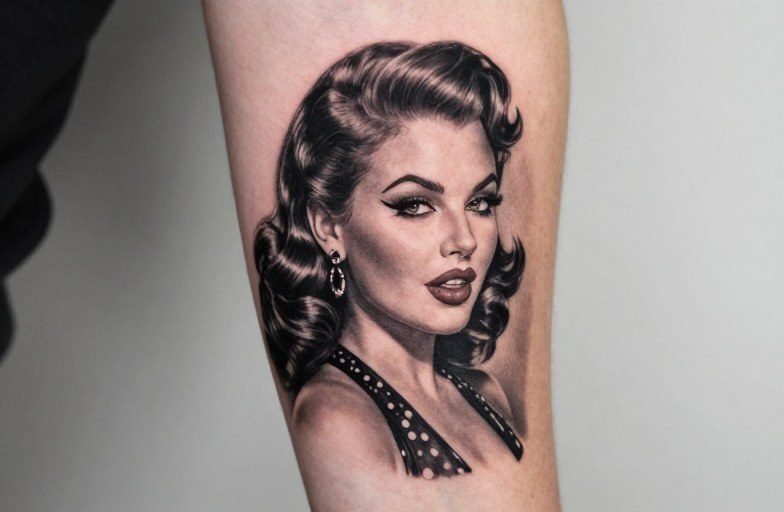
A realistic pin up tattoo reproduces the classic mid-century glamour illustration style, think Vargas girls, Gil Elvgren calendar art, or vintage nose cone art, but rendered with photographic precision rather than the bold outlines and flat color of traditional American tattooing. Skin becomes canvas for a three-dimensional figure with soft shadows, reflective highlights on satin or chrome, and hair that catches light like a photograph. The subject might be a classic bombshell, a military nurse, a cowgirl, or a rockabilly revival interpretation, but the execution demands the technical discipline of portrait realism applied to an idealized, stylized subject.
Who It Suits
These pieces tend to attract collectors with a genuine connection to vintage Americana, hot rod culture, swing music, military history, or the burlesque revival, not just someone who thinks “it looks cool.” The subject matter carries enough retro baggage that wearing it convincingly requires some personal investment in that world.
Gender Considerations
Historically collected more by men, realistic pin ups have shifted significantly. Women now commission these as self-portraits in vintage styling, as tributes to grandmothers who served in WWII, or as reclaimed expressions of their own sexuality. The figure’s pose and expression matter enormously here, passive pin cushion versus confident pilot in a flight jacket read entirely differently.
Existing Collection Compatibility
Realistic pin up tattoos sit awkwardly among heavy traditional work. The smooth gradients and absence of black outlines clash visually with bold sailor-style pieces. They integrate more naturally with other realism, neo-traditional with softer edges, or illustrative styles that share similar rendering techniques. If your arms are already solid traditional, consider placing a realistic pin up on a thigh, ribs, or back where it can exist in its own visual space.
Cost & Sessions
Photorealistic rendering of skin tones, fabric sheen, and environmental details demands time. A competent realistic pin up measuring 6-8 inches typically requires 8-15 hours of machine time. A full sleeve narrative piece with multiple figures and background elements can exceed 40 hours. Hourly rates for artists specializing in this realism tier generally run $150-$400 depending on geography and reputation.
Session Breakdown
Most artists structure the work in stages:
- Session one: Stencil placement and black/grey foundation for the figure’s structure and darkest shadows
- Session two: Mid-tone skin values and basic color blocking for clothing or background elements
- Session three: Fine detail, highlights, color saturation passes, and final polish
Rushing between sessions by under-healing risks muddying the subtle gradations that make the piece read as realistic. Budget for the timeline, not just the dollars.
Deposit Expectations
Artists doing this caliber of work typically require substantial deposits, often 50% or a flat fee for the design phase, because the preparatory illustration work rivals the tattooing itself. A detailed pin up reference drawing with accurate period costume, prop research, and lighting studies can consume 10-20 hours before the machine ever turns on.
Best Placements
The curved planes of the body fundamentally alter how a two-dimensional pin up image reads. Flat areas like the outer thigh, front of the calf, or outer upper arm preserve the figure’s proportions most faithfully. Wrapping a detailed face around a bicep or shoulder cap distorts the carefully constructed likeness.
Size Minimums
Facial features in realistic pin ups need room to breathe. Below 4-5 inches tall, the eyes and mouth become a muddy blur regardless of artist skill. The classic full-standing pose with one hand on hip and windblown hair realistically needs 8+ inches to read as intended. Smaller pieces force simplification that defeats the style’s purpose.
Flow With Body Structure
Smart placement uses the body’s natural lines. A reclining pin up along the ribs follows the curve of the floating ribs. A standing figure on the outer thigh aligns with the leg’s vertical axis. The vintage “girl on a bomb” or “girl on a rocket” motifs work exceptionally well wrapping from outer thigh to hip, using the body’s roundness as the bomb or rocket’s form.
Color vs Black and Grey
The original vintage source material was painted in full color, but black and grey realistic pin ups carry their own stark power. Removing color forces attention to the draftsmanship, anatomy accuracy, edge control, and the full value range from paper-white skin highlights to pitch-black shadow depths.
Color Realism Challenges
Skin tones in realistic color pin ups are notoriously difficult. The warm peachy-beige of vintage illustration doesn’t exist in tattoo ink. Artists mix from limited palettes, often using unusual combinations, muted purples in shadowed skin, yellow ochre for warmth, unexpected greens to neutralize ruddy tones. The best color realistic pin up artists have developed personal recipes through years of experimentation.
Red lipstick, a signature element, presents its own problems. Bright red fades fastest of any hue, often shifting pinkish or muddy within 2-3 years. Experienced artists compensate by packing it slightly heavier or choosing deeper crimsons that fade toward the intended bright red rather than away from it.
Black and Grey Longevity
Black and grey ages more predictably. The contrast range holds for decades if properly saturated. The trade-off is losing the period-accurate color palette that defines much of the pin up aesthetic, those specific mint-green dress tones, the particular red of a 1940s lip, the aviation blue of a WASP uniform.
Modern Variations
Contemporary artists have pushed the realistic pin up beyond straight reproduction. Some incorporate horror elements, zombie pin ups, vampire versions with realistic blood rendering against vintage styling. Others blend the figure with photorealistic objects that weren’t in the original vocabulary: modern firearms, contemporary tattoo machines, or science fiction elements rendered with the same technical precision as the figure.
Neo-Traditional Hybrids
A growing middle ground keeps the subject matter and some realistic rendering but reintroduces stronger graphic elements, bold linework in the hair or clothing, limited color palettes with hard edges, or stylized backgrounds that reference the original illustration source while the face remains photorealistic. These pieces often heal better and age more gracefully than pure realism while maintaining the pin up’s essential appeal.
Portrait-Based Custom Figures
Some collectors commission pieces based on their own likeness or a partner’s, styled in authentic period hair, makeup, and costume. This demands an artist comfortable with both portrait realism and the subtle idealization that makes pin up work, softening certain features, exaggerating the lighting, adjusting proportions toward the classic hourglass without losing recognizability. Not every portrait artist can make that translation.
Common Mistakes to Avoid
Reference selection derails more realistic pin up pieces than technical failure. Grabbing a low-resolution JPEG from a Google image search produces a tattoo with muddy, indistinct features. The artist needs high-resolution source material with clear lighting direction, accurate period details, and enough pixels that facial structure doesn’t dissolve into guesswork.
Anachronism Errors
Period accuracy matters to collectors who know the culture. A 1940s-style figure with 1960s makeup, a Korean War-era flight jacket on a WWII-themed piece, or modern undergarments visible beneath a supposedly vintage outfit reads as lazy research. The best artists maintain reference libraries of period photography and original illustration to verify details.
Proportion Distortion
The idealized pin up anatomy, elongated legs, exaggerated bust-to-waist ratio, tiny feet, requires careful handling in realistic rendering. Push too far and the figure enters uncanny valley, simultaneously realistic and impossible. The most successful pieces maintain believable skeletal structure beneath the stylization, with one or two carefully chosen exaggerations rather than wholesale distortion.
Aftercare Neglect
Realistic color work with extensive skin-tone blending is uniquely vulnerable to healing damage. Scabbing pulls out subtle mid-tones that took hours to build. Sun exposure during the first month destroys the delicate color balance. The aftercare protocol your artist specifies isn’t suggestion, it’s protective protocol for a significant investment.
Key Takeaways
Realistic pin up tattoos occupy a demanding niche: the technical requirements of photorealistic portraiture applied to an already stylized, idealized subject with specific historical vocabulary. Success requires an artist who genuinely understands both the tattoo discipline and the vintage source culture, not just someone who can render a pretty face. The pieces demand substantial time, money, and skin real estate to execute properly. Placement, scale, and color decisions made at the planning stage determine whether the tattoo reads as a sophisticated homage or a regrettable novelty. For collectors with authentic roots in the culture these images represent, a well-executed realistic pin up remains one of tattooing’s most technically impressive achievements.
Frequently Asked Questions
How is a realistic pin up different from a traditional sailor-style pin up?
Traditional pin ups use bold black outlines, limited color palettes, and flat graphic shading. Realistic pin ups employ smooth gradients, photographic detail, and no outlines, creating a three-dimensional painted appearance on skin.
Will the red lipstick in my color pin up tattoo stay bright?
Red is the fastest-fading color in tattooing. Expect bright reds to soften toward pink within 2-3 years. Skilled artists compensate by using deeper crimsons that fade toward your intended shade rather than away from it.
Can I get a realistic pin up tattoo based on my own photo?
Yes, but it requires an artist skilled in both portrait realism and the subtle idealization that defines pin up aesthetics. The artist must adjust proportions and lighting toward vintage styling without losing your recognizable features.
Why do realistic pin up tattoos cost more than traditional pin ups?
The preparatory illustration work, multi-session execution, and technical difficulty of smooth skin-tone gradients demand significantly more time. A realistic piece typically requires 3-5 times the machine hours of a traditional equivalent.
Related Style Guides
- Realistic Skull Hand Tattoos: Complete Style Guide
- Realistic Sunset Tattoos: Complete Style Guide
- Realistic Tulip Tattoo: Complete Style Guide
- Explore more