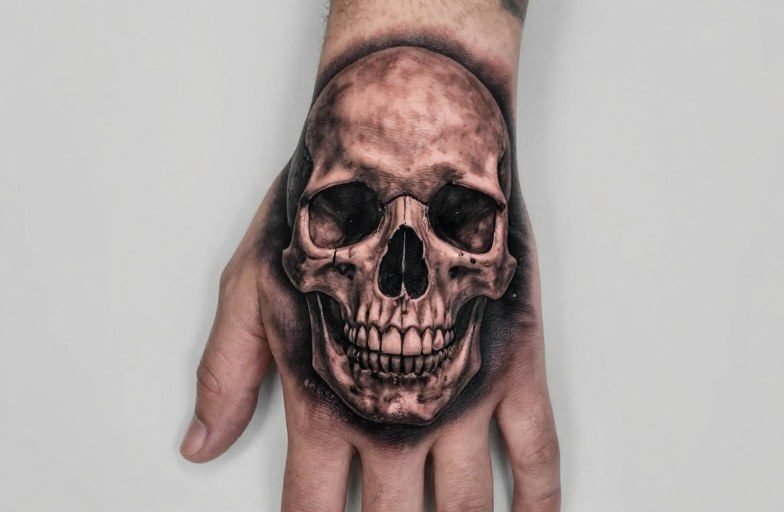
A realistic skull hand tattoo is exactly what it sounds like: a three-dimensional human skull rendered with photographic detail across the back of one or both hands. Unlike traditional or neo-traditional skull designs that rely on bold outlines and flat color, this style pursues the illusion of bone sitting under skin, complete with shadows cast by cheekbones, the hollow darkness of eye sockets, and the subtle yellow-gray gradation of actual cranial bone. The hand presents unique obstacles. Tight skin, constant movement, and near-constant sun exposure make this one of the most technically demanding placements in tattooing.
Linework & Technique
Realism on the hand abandons the conventional tattoo playbook. There’s no thick black outline to contain the image. Instead, artists build form through layers of stippled dots, whip-shaded gradients, and single-needle precision lines that mimic the soft transitions of a pencil drawing or oil painting.
Needle Groupings and Approach
Most realistic skull hand work relies on cartridges between 3RL and 9RL for structural elements, with 1RL or 3RS needles handling the finest detail. The skull’s orbital sockets demand particular care, artists typically punch these in solid black or near-black, then feather the edges outward so no hard line separates socket from cheekbone. Teeth require negative space strategy: the brightest highlights are skin left untouched, with surrounding gray wash creating the illusion of enamel catching light.
- Gray wash sequences usually run 4-5 values from near-white to pitch black
- Stippling builds texture in areas where smooth shading would look muddy on hand skin
- White ink (often mixed with a drop of yellow or raw umber) adds final bone highlights once initial healing completes
- Some artists prefer a “painterly” approach with visible needle strokes; others pursue seamless airbrush-style blending
Structural Challenges Specific to Hands
Hand skin differs from arm or back skin in measurable ways. The dermis is thinner, the subcutaneous fat layer minimal, and the underlying bone structure creates uneven surfaces. A skull design must account for how the metacarpals and knuckles distort the image when the hand moves. Experienced artists map the skull’s centerline to the third metacarpal, letting the jaw angle follow the natural V-shape between thumb and index finger. Ignoring this anatomy produces a skull that appears to slide or warp with every gesture.
How It Ages
This is where realistic skull hand tattoos separate the committed from the casually interested. Hand tattoos age faster than almost any other placement, and realism’s reliance on subtle gradation makes it especially vulnerable.
The Specific Fading Pattern
Fine detail blurs first. Within two to four years, the sharpest lines in teeth definition and nasal cavity depth soften noticeably. Gray wash areas tend to shift toward a uniform mid-tone as the lighter values fade and darker ones hold. The solid black of eye sockets usually remains readable longest, which can create an unintended “raccoon mask” effect if surrounding mid-tones drop out. Sun exposure accelerates everything; hands receive UV damage even through car windows and during brief outdoor tasks.
Touch-ups aren’t optional maintenance, they’re structural necessity. Most collectors plan for a refresh every three to five years, with some returning annually for spot reinforcement. The alternative is accepting the tattoo’s evolution into a softer, more impressionistic version of its original self.
Origins & History
Skull imagery in tattooing carries deep roots, though the realistic hand placement is a relatively recent development. Traditional skull designs, often linked to Mexican folk art and military memorial traditions, have appeared in American tattooing since at least the early twentieth century. The photorealistic approach emerged later, as tattoo machines gained precision and artists began cross-training in fine art disciplines.
Hand placement itself carries occupational significance. Historically, hand tattoos marked certain subcultures and professions, sometimes voluntarily, sometimes through coercion. The realistic skull specifically gained traction in the 1990s and 2000s as black-and-gray realism matured on the West Coast, with artists like Robert Hernandez and Jack Rudy pushing what was technically possible with single-needle work. The migration of this style to the hands followed improvements in ink stability and needle technology, though it remains a bold choice that signals serious commitment to the craft.
Best Placements
The back of the hand dominates, but within that canvas, positioning matters enormously.
Full Back-of-Hand Coverage
The classic approach centers the skull over the knuckles, with the cranium extending toward the wrist and the mandible reaching toward the proximal phalanges. This maximizes visible impact and allows for proper proportional scaling. Fingers can extend the design, jaw fragments, teeth rows, or smoke effects wrapping toward the nail beds, but finger skin presents even more technical challenges than the hand proper.
Partial and Integrated Designs
Some collectors opt for a half-skull emerging from the wrist line, treating the hand as continuation of a forearm piece. Others position the skull at an angle, using the hand’s natural asymmetry to create dynamic tension. The radial side of the hand (thumb side) offers slightly more stable skin than the ulnar side, making it preferable for the most detailed focal points.
- Knuckles: unavoidable wear point; detail here fades fastest
- Wrist joint: movement and flexing distort the image regularly
- Between thumb and index: prime real estate for jaw angle or smoke effects
- Finger extensions: high risk, high visibility, requires dedicated afterthought
Cost & Sessions
Realistic skull hand work commands premium pricing for legitimate reasons. The technical difficulty, the artist’s reputation requirement, and the time investment all scale upward.
Most accomplished realism specialists charge between $150 and $400 per hour, with hand work typically falling at the higher end due to the precision required. A complete single-hand skull generally demands 6 to 12 hours of tattooing, often split across two or three sessions to manage swelling and skin trauma. Total investment commonly ranges from $1,200 to $3,500, with well-known specialists commanding more.
Session spacing matters. Hand skin swells dramatically, and working through excessive edema produces compromised results. Three to four weeks between sessions allows proper surface healing, though full dermal stabilization takes closer to two months. Rushing the timeline serves nobody, the artist, the collector, or the final image.
Who It Suits
Not everyone should get a realistic skull hand tattoo. This isn’t gatekeeping; it’s practical reality.
Professional and Social Considerations
Hand tattoos remain among the most visible commitments in body modification. Industries with client-facing roles, conservative dress codes, or strict appearance policies may present ongoing friction. Some collectors navigate this with makeup coverage or by selecting industries where the aesthetic aligns. The skull motif specifically carries associations, death, rebellion, certain music subcultures, that may color professional interactions regardless of personal intent.
Physical Suitability
Skin quality affects outcomes. Very thin, translucent hand skin struggles to hold saturated blacks. Extremely dry or calloused hands may require pre-tattoo skin conditioning. Autoimmune conditions affecting healing, or medications that thin blood, warrant honest disclosure during consultation. The artist needs this information to adjust technique and aftercare recommendations.
Commitment to aftercare proves essential. Hands encounter bacteria constantly, and the realistic style’s detail density means any infection or scarring damages the image permanently. The first two weeks demand disciplined washing, moisturizing, and protection, no exceptions for convenience.
Key Takeaways
Realistic skull hand tattoos represent a pinnacle of technical ambition in contemporary tattooing. They demand artists with specific skill sets, collectors with realistic expectations about aging and maintenance, and both parties with patience for the multi-session process. The hand’s anatomy dictates design choices that more forgiving placements do not. Aging will occur; the question is whether you’ve planned for it through artist selection, aftercare discipline, and budget for future touch-ups. If the visibility, the cost, and the maintenance commitment all align with your circumstances, the result can be a striking, technically impressive piece of body art that few other placements or styles can match for immediate visual impact.
Frequently Asked Questions
How long does a realistic skull hand tattoo take to heal?
Surface healing takes 2-3 weeks, but hand skin remains vulnerable for 6-8 weeks due to constant use and exposure. Full dermal stabilization requires about two months before touch-up work should be considered.
Can a realistic skull hand tattoo be covered up later?
Cover-ups on hands are extremely difficult because hand skin holds limited ink density and realistic skulls already use heavy black saturation. Laser removal sessions are often necessary before any successful cover-up attempt.
Why do some realistic skull hand tattoos look blurry after a few years?
Hand skin’s thin dermis, constant movement, and sun exposure cause fine detail to spread and lighter gray wash values to fade. This is normal aging that touch-ups can address, though never fully reverse.
Should I get both hands done at once or one at a time?
One at a time is strongly recommended. Both hands healing simultaneously severely limits daily functioning, and the swelling from bilateral work compromises precision in the second session.
Related Style Guides
- Realistic Sunset Tattoos: Complete Style Guide
- Realistic Tulip Tattoo: Complete Style Guide
- Realistic Wave Tattoos: Complete Style Guide
- Explore more