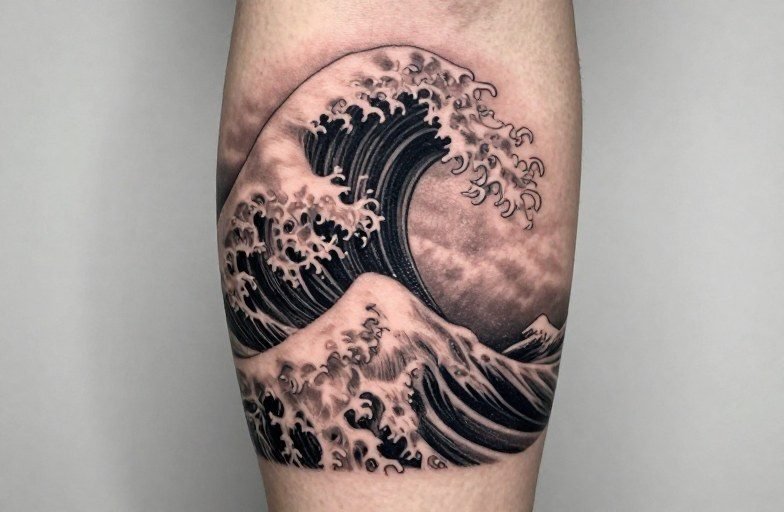
A realistic wave tattoo replicates the look of moving water through fine detail, subtle color gradation, and careful attention to how light fractures across a swell. Unlike traditional Japanese wave designs or simple line-drawn surf art, this style aims for photographic accuracy, white foam suspended in translucent blue-greens, the dark hollow of a barrel, the glassy surface catching sun. The best ones feel like a frozen moment of ocean, not a symbol of it.
Choosing the Right Artist
This style lives or dies by technical execution. Water is unforgiving: one wrong value shift and a crashing wave turns into a gray smear. You need someone who understands both color theory and the specific challenge of tattooing something that has no hard edges.
What to Look For in a Portfolio
Skip artists who only show traditional or neo-traditional work. Look specifically for:
- Smooth gradients without banding or visible step-downs between tones
- Convincing white highlights that read as foam, not just un-inked skin
- Depth created through value contrast, not black outlines
- Subject matter that includes water, glass, smoke, or other translucent elements
Ask to see healed photos. Fresh realistic wave tattoos always look punchier than they will in six months. An artist confident in their saturation levels should have year-old examples to show.
Questions Worth Asking
During consultation, find out whether they prefer working from reference photography or if they composite multiple sources. Both approaches work, but you want intentionality, not guesswork. Ask how they handle the lightest values, some artists reserve skin entirely for highlights, others use pale blue-gray or white ink. Each choice affects how the tattoo ages and how it reads on your specific skin tone.
Best Placements
Realistic wave tattoos need space to breathe. The detail required for convincing water movement doesn’t compress well into postage-stamp size.
Where They Thrive
The outer upper arm and shoulder cap offer excellent real estate for a single breaking wave with sky above. The natural curve of the deltoid can mirror the arc of a swell. Forearms work well for horizontal compositions, wave crests moving along the length of the muscle. Ribs and side torso accommodate larger pieces where the wave can wrap slightly, creating genuine dimensional movement as your body turns.
Thighs provide the most forgiving canvas for ambitious scale: enough room for foreground foam, mid-ground barrel, and distant horizon line. The relatively stable skin there (less frequent stretching than stomach, less movement than inner arm) helps preserve fine detail long-term.
Placements to Approach Cautiously
Hands and feet present problems. The small surface area forces simplification, and the high turnover of skin cells in these areas accelerates fading. White ink, crucial for foam texture, tends to disappear fastest here. Neck and throat placements can work for smaller compositions but limit future expansion if you want to build a larger ocean-themed piece later.
How It Ages
All color tattoos shift over time, but water realism has specific vulnerabilities you should understand before committing.
The White Ink Problem
White pigment is the weakest link in realistic wave work. It sits highest in the skin, breaks down fastest under UV exposure, and can yellow slightly depending on your skin’s chemistry. Artists compensate by surrounding white foam with slightly darker values, if the white fades, the contrast still carries the form. Some experienced specialists use pale blue or mint as a base for foam, adding pure white only at the brightest points. This extends readability by years.
Blue-Green Shift
Teal and turquoise inks, common in ocean realism, are notoriously unstable. They tend to migrate toward blue or gray as they age, sometimes within three to five years. Saturated deep blues hold better than lighter aqua tones. A well-designed piece accounts for this by building value structure around darker blues and greens, letting the brighter accents fade without collapsing the image.
Expect a touch-up session around year three to five. This isn’t a failure of the artist, it’s maintenance for a style that depends on subtle value shifts.
Cost & Sessions
Realistic wave tattoos sit in the upper tier of pricing for good reason. The technical demands slow execution significantly.
Time Investment
A palm-sized piece with moderate detail typically runs three to four hours. Anything showing full wave anatomy, curl lip, barrel interior, impact spray, and depth below the surface, starts at six hours and often extends across multiple sessions. Large compositions covering a full sleeve or thigh piece commonly require fifteen to twenty hours total, sometimes more if the artist works exclusively in color packing rather than whip shading.
Price Structure
Most specialists in this niche charge hourly rates between $200 and $400, with some established names commanding higher. Flat-rate pricing appears occasionally for smaller, clearly bounded designs, but the unpredictable nature of color saturation usually pushes artists toward hourly billing. Budget for the quoted time plus one touch-up session within the first year.
Resist the temptation to shop by price. A cheap realistic wave tattoo doesn’t become abstract art, it becomes a muddy blob that costs more to fix than the original would have cost done properly.
Who It Suits
Not every ocean lover needs photographic realism. This style makes specific demands on your lifestyle and preferences.
Skin Tone Considerations
Realistic water on very dark skin requires adjusted approach. The lightest values, foam, sun glint, spray, must be built from pale blue and gray rather than white alone, since white ink on melanin-rich skin can read as ashy or disappear entirely. The best artists for this work understand how to create luminosity through cool temperature shifts rather than value alone. If your artist doesn’t show healed work on skin near your tone, keep looking.
Lifestyle Fit
These tattoos demand sun protection discipline. UV exposure degrades the delicate color relationships that make water look wet. If you work outdoors without coverage options, or if you refuse sunscreen as a matter of principle, expect accelerated aging. The style also rewards patience through healing, picking at scabs destroys fine detail faster than in bolder, simpler designs.
Consider whether you want standalone ocean imagery or something integrated with other elements. Realistic waves pair naturally with marine life (whales, sharks, jellyfish), nautical instruments, or coastal landscapes. They clash aesthetically with traditional Americana or heavy blackwork unless a skilled artist deliberately bridges the styles.
Origins & History
Photorealistic tattooing emerged in the late twentieth century as equipment and pigment quality improved, but ocean realism as a distinct subcategory developed more recently. Japanese tattooing has long featured water, though traditionally as stylized background filler rather than primary subject. The shift toward waves as standalone realistic subjects is often linked to the broader rise of color realism in the 1990s and 2000s, when artists began applying airbrush and oil painting techniques to skin.
Some trace specific aesthetic influences to surf photography and underwater cinematography, the frozen barrel shot, the sunbeam through surface ripple. These visual references became available to artists through digital photography in ways that earlier generations couldn’t access. The style continues to evolve as artists experiment with motion effects, splash dynamics, and the interplay of water with light sources above and below the surface.
Final Word
A realistic wave tattoo is a commitment to maintenance, sun protection, and an artist who genuinely understands how water behaves. Done well, it holds a kind of kinetic stillness that simpler ocean imagery can’t approach. Done poorly, it ages into undifferentiated blue-gray confusion. Take time finding the right specialist, budget for the scale this detail demands, and plan for touch-ups as part of the lifecycle rather than a sign of failure. The ocean deserves that level of respect.
Frequently Asked Questions
How long does a realistic wave tattoo take to heal compared to simpler styles?
Healing time is roughly the same two to four weeks for surface healing, but the aftercare matters more. Fine color packing and white ink are vulnerable to scab damage, so avoiding friction and keeping the area moisturized without over-saturating becomes especially important.
Can a realistic wave tattoo be done in black and gray instead of color?
Absolutely, though the challenge shifts. Without color temperature to suggest depth, the artist must rely entirely on value control and subtle gray gradation. Black and gray ocean work can be striking but requires even more precision to avoid flat, muddy results.
Will swimming in the ocean damage a new wave tattoo?
Submerging a fresh tattoo in any water, salt or chlorinated, introduces infection risk and can leach unsettled ink. Wait until the surface has fully closed and peeling has stopped, typically three to four weeks. Long-term, salt water and sun exposure will accelerate fading regardless of age.
How do I find an artist who specifically specializes in realistic water?
Search hashtags and portfolios for healed ocean or water-specific work, not just general realism. Ask directly how many water pieces they’ve completed and whether they use reference photography. Artists who hesitate to show healed examples or who claim every style equally may lack the specific experience this subject demands.
Related Style Guides
- Traditional Army Tattoos: A Style Guide
- Traditional Bluebird Tattoo: Complete Style Guide
- Traditional Lucky Tattoos: Style Guide
- Explore more