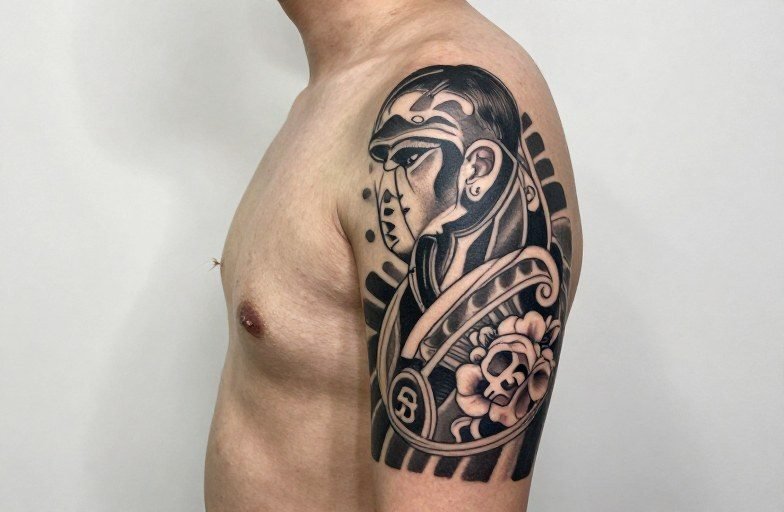
Traditional army tattoos pull from American traditional flash sheets, think thick black outlines, saturated red and green, minimal shading, but narrow the imagery to military service: eagles, anchors, crossed rifles, unit insignia, dog tags, and pin-up girls in uniform. The style demands readability from across a room and holds up for decades because the design language was built for soldiers getting tattooed in ports and barracks with equipment that punished delicate work.
Common Mistakes to Avoid
Overcomplicating the Design
American traditional lives on simplicity. A common error is cramming too many elements, unit crest, dates, a portrait, a full verse, into a single piece that should read in two seconds. The style works because negative space breathes. A traditional eagle with a banner works; an eagle clutching a photorealistic M4 with a QR code to your DD-214 does not. Pick one or two bold symbols and let the line weight do the talking.
Wrong Placement for the Imagery
Dog tags across the collarbone stretch and warp with age. Crossed rifles on the inner bicep lose detail as the skin softens. Traditional army pieces need flat, stable skin: outer forearms, calves, upper arms, chest panels. The upper back works for larger compositions like eagles or ships, but avoid spots where uniform seams or body armor rub constantly, friction fades ink faster.
- Forearm: ideal for banners, anchors, unit numbers
- Calf: stable for larger eagles or nautical pieces
- Chest: classic for symmetrical military insignia
- Hands/fingers: traditional army ink rarely goes here; the style needs room for line weight
Aftercare Notes
The First Two Weeks
Traditional army tattoos heal thickly because the saturation is dense. Expect heavy scabbing, not the light flaking of fine-line work. Wash twice daily with unscented soap, pat dry, and apply a thin layer of recommended aftercare ointment. Do not let the scabs crack, movement pulls ink out. On biceps and forearms, sleep with the limb straight to prevent bending wounds overnight.
Long-Term Fading
Red ages to pink. Green shifts toward blue-gray. Black stays black if the artist packed it properly. The limited palette of traditional work actually helps, fewer colors mean fewer variables in how your tattoo will look at year ten. Touch-ups are normal, especially on areas that see sun or friction. Sunscreen matters more than most people admit; UV bleaches red faster than any other pigment.
Origins & History
Military tattooing in the American traditional style grew from the same flash sheets that serviced sailors in the early 20th century. Norman Collins, later called Sailor Jerry, served in the Navy and later built his Honolulu shop catering to servicemen. The imagery crossed branches, anchors for sailors, eagles for Marines, crossed cannons for artillery. Some trace specific army motifs to the World Wars, when soldiers marked campaigns, divisions, and survival with bold, fast work that could be done between deployments.
The style spread through military culture itself, not civilian fashion. Tattooing was banned or heavily restricted in various periods, so the work was often done in ports, overseas shops, or unofficial setups near bases. That urgency shaped the aesthetic: bold enough to read in dim light, simple enough to finish before someone had to report for duty. The banner with lettering, the eagle with spread wings, the heart with a dagger, these became shorthand for service, loss, and belonging.
Linework & Technique
Needle Grouping and Line Weight
Traditional army tattoos rely on single-pass bold lines, usually 7-9 round liners or 11-14 magnums for the heavy black outlines. The goal is consistent saturation without overworking the skin. A wobbly line in this style cannot be hidden; there is no soft shading to blend it away. The whip shading technique, flicking the needle out to create taper, gives depth to eagles’ wings and the folds of banners without breaking the flat, graphic quality.
Color Packing vs. Wash
Color sits solid and flat. No gradients, no airbrushed fades. Red is packed in with tight circular motions. Green (often a blue-green mix) fills uniform details or background elements. Skin breaks, small gaps of negative space, keep the design from turning into a muddy blob as it ages. A good traditional piece looks almost sticker-like: crisp edge, flat fill, immediate recognition.
- Black: carbon-based, holds best, used for all outlines and heavy shadows
- Red: cadmium or organic, prone to sun fading, needs solid packing
- Green: often mixed with white for military uniform tones, tricky to keep even
- Yellow: rarely used in army traditional; when it appears, it ages poorly and is avoided
Modern Variations
Neo-Traditional and Military Fusion
Some artists push the color range, adding purples, teals, or muted olive drabs, while keeping the bold structure. Others incorporate photorealistic elements like actual weaponry or modern helmet designs into the traditional framework. These hybrids require a skilled hand; too much realism and the piece loses the graphic punch that makes traditional army tattoos readable. The best modern work keeps the line weight and limited palette but updates the subject matter: drones referenced symbolically, contemporary unit patches rendered in classic flash style.
Remembrance and Memorial Pieces
Fallen soldier tributes in traditional style often use the blank banner format, “In memory of”, with dates and names. Some add battlefield crosses (the rifle, helmet, and boots arrangement) simplified to the style’s vocabulary. These pieces carry emotional weight, but the technical rules stay firm: bold lines, readable at distance, colors that will still register in thirty years when the memory itself needs the tattoo’s help.
Choosing the Right Artist
Portfolio Red Flags
Look for consistent line weight throughout healed photos, not just fresh work. Wobbly outlines, patchy color, and designs that blur together at small sizes indicate an artist who does not specialize in this style. Traditional army work is not a default skill, it requires specific needle control and an understanding of how limited palettes age. Ask to see healed pieces from two-plus years prior. Fresh traditional looks almost too crisp; healed is where you judge the artist.
Consultation Questions
Bring reference: vintage flash, unit insignia, or specific symbols. A good artist will tell you if your idea fits the style or if you are asking for something that will fail. Ask about their preferred needle groupings for bold lines. Ask how they handle red saturation in areas that see sun. The answers should be specific, not vague reassurance. If they cannot explain why a forearm placement beats a collarbone for your banner, keep looking.
- “Can you show me healed traditional work from two years ago?”
- “How do you prevent red from fading to pink in sun-exposed spots?”
- “Would you simplify this unit crest to read at ten feet?”
- “What needle grouping do you use for the main outlines?”
Before You Decide
Traditional army tattoos carry weight because the style itself was forged in military culture, not borrowed from it. The imagery is public, everyone recognizes the eagle, the anchor, the crossed rifles, but the specific combination you choose marks your own service, unit, or loss. The permanence is the point. Before committing, live with a printed stencil taped to your mirror for a week. Check it in morning light, work light, tired light. The boldness that makes this style last also makes it impossible to ignore. Make sure you want that visibility, and make sure the artist you choose has already proven they can deliver lines that will hold their ground as long as the commitment does.
Frequently Asked Questions
Do traditional army tattoos have to use only red, green, and black?
No, but those are the classic colors that age most predictably. Some artists add yellow or blue, though yellow fades fast and blue can muddy into black over time. The best work stays disciplined with a tight palette.
Can I get my unit’s specific crest done in traditional style?
Usually, but the crest may need simplification. Traditional style requires bold, readable shapes. Detailed crests with fine lines or gradients often get redesigned to hold up as tattoos, not as replicas.
How long before I can wear my uniform over a fresh army tattoo?
Wait until the surface is fully closed, typically two to three weeks. Friction from straps and fabric can pull scabs and damage the ink. Plan around training schedules, not just appearance regulations.
Will an army tattoo hurt more on certain parts of the body?
Pain varies by placement, not by design. The outer forearm and calf are manageable. The chest, ribs, and inner bicep hurt more due to nerve density and thinner skin. Traditional work is faster than realism, which helps.
Related Style Guides
- Traditional Bluebird Tattoo: Complete Style Guide
- Traditional Lucky Tattoos: Style Guide
- Traditional Shellback Tattoos: A Complete Style Guide
- Explore more