
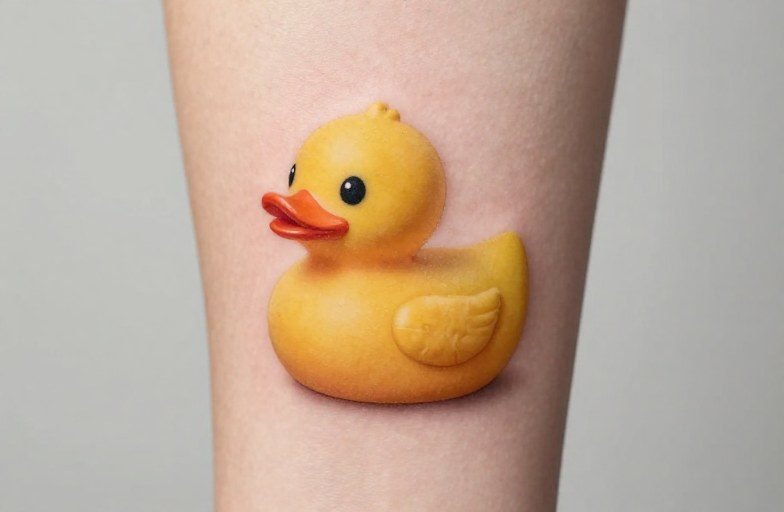
The rubber duck tattoo merges childlike nostalgia with adult irony. Most people choose it as a wink at taking life less seriously, though the meaning stretches from genuine sentiment to outright parody. That bright yellow figure floating in sudsy water has become a surprisingly versatile symbol in tattoo culture.
Best Placements
Small & Hidden Spots
Behind the ear, inner bicep, or ankle, these keep the duck semi-private, visible only during swims or intimate moments. The small scale suits simple line work: a single-needle outline with maybe a dot of orange for the bill. Healing stays straightforward on these low-friction areas, though the ankle’s bone proximity makes the needle bite sting sharper.
Bolder, Visible Canvas
Forearms, calves, and ribs accommodate larger pieces with water splashes, soap bubbles, or full bathtub scenes. The ribcage’s movement during breathing challenges smooth color packing; expect touch-ups if the artist works too fast across that shifting surface. Calves offer stable, flat territory for detailed shading but see more sun exposure, which fades yellow pigments faster than darker tones.
- Behind the ear: discreet, quick session, minimal aftercare hassle
- Inner bicep: easy to show or hide, good for medium detail
- Forearm: conversation starter, space for background elements
- Ribcage: painful, but dramatic placement for larger compositions
Who Chooses This Tattoo
Parents memorializing bath-time rituals with toddlers form one solid demographic. The duck marks a specific, fleeting phase of early childhood, those slippery, screaming, somehow joyous twenty minutes before bed. Others come from healthcare backgrounds: pediatric nurses, child-life specialists, some emergency-room staff who use actual rubber ducks to calm young patients. The tattoo becomes a professional badge worn off-duty.
There’s also the deliberately absurd camp. These collectors pair the duck with incongruous elements, flames, weaponry, gothic lettering, to weaponize cuteness against itself. The humor lands precisely because the base image carries zero inherent threat. A skull reads menacing; a rubber duck with a skull’s eye sockets reads ridiculous.
Subculture Connections
Some military and first-responder circles adopt the duck as an inside joke about maintaining normalcy under pressure. “Rubber ducking” as a debugging term in programming also draws tech workers who appreciate the double meaning: explaining problems aloud to an inanimate object actually works.
Religious & Spiritual Angles
No major religious tradition claims the rubber duck, which partly explains its appeal for the spiritually eclectic. Water symbolism, baptism, cleansing, rebirth, hovers nearby without demanding doctrinal commitment. Some collectors layer in lotus flowers, mandala patterns, or sacred geometry bubbles to nudge the image toward meditation on impermanence: the duck floats, bobs, drifts, never sinking but never arriving either.
Christian collectors occasionally reference the duck’s buoyancy as metaphor for faith keeping one afloat. The connection stretches thin; most artists roll their eyes at forced symbolism unless the client genuinely holds that belief. Honest sentiment tattoos cleaner than borrowed significance.
Common Variations & Styles
Traditional & Neo-Traditional
Bold black outlines, limited color palette, maybe a banner reading “SQUEAK CLEAN” or a birth year. These age well: the heavy line weight holds definition as skin blurs finer details. Yellow traditional ink sometimes shifts slightly greenish over decades as black surrounding lines bleed; experienced artists compensate by keeping yellow fields smaller and bordered.
Realism & Watercolor
Photographic ducks with wet-looking highlights, or splashes rendered in dripping, non-contained color. Watercolor styles without any black anchoring tend to blur into unrecognizable yellow smears within five to seven years. If you want that aesthetic, demand the artist integrate strategic dark points, bubble outlines, shadow beneath the duck, to slow the visual decay.
- Pirate duck: eye patch, peg leg, tiny hat, classic humor pairing
- Space duck: helmet, stars, floating in cosmic void rather than tub
- Minimalist outline: single needle, no fill, relies on viewer recognition
- Skeleton duck: x-ray style revealing bones inside the yellow shell
How It Ages on Skin
Yellow pigment has a reputation for fading fastest, and it’s mostly deserved. Lighter tones lack the carbon density that anchors blacks and deep blues. A rubber duck’s primary color field faces particular vulnerability. Location matters enormously: a forearm duck under daily sunscreen holds brighter than a calf piece exposed to UV every summer.
Line work versus shading creates different aging trajectories. A clean outline with minimal fill stays readable for decades even as color mutes. Heavy yellow saturation with subtle gradations turns muddy faster as adjacent tones blend together. White highlights, often added to suggest plastic shine, disappear almost entirely within three years on most skin types, becoming pointless scar tissue under the surface.
Touch-ups are normal and expected. Budget for one refresh around year five if the yellow matters to you. Some collectors embrace the fade as part of the piece’s character, the duck literally weathering like a real bath toy left too long in sunlit windows.
Personal & Modern Meanings
Contemporary tattoo culture has loosened the expectation that every image carry grave significance. The rubber duck thrives in this relaxed environment. It can mean nothing beyond “this made me laugh in the shop” and still constitute a valid choice. That said, recurring personal themes emerge.
Adult seriousness as a trap: the duck rejects performance of maturity. Childhood as worth preserving, not merely outgrowing: the duck keeps one foot in that mental space. Resilience through absurdity: when actual problems overwhelm, maintaining any humor, even stupid humor, becomes its own survival mechanism. The duck doesn’t solve anything; it floats regardless.
Commemorative Uses
Some mark recovery from depression or anxiety, the duck representing a deliberate choice toward lightness after heavy periods. Others memorialize children lost early, the bath toy a specific, tender memory rather than generic angel imagery. These carry genuine emotional weight beneath the silly surface; the contrast often intensifies rather than diminishes the feeling.
Final Word
The rubber duck tattoo works because its base image carries near-universal recognition without fixed cultural baggage. You project onto it what you need: nostalgia, defiance, humor, survival, or simply appreciation for a well-designed object doing its single job perfectly. The best versions match that simplicity in execution, clean lines, honest color, placement that suits your actual life rather than your imagined one. Let it age. Let it fade slightly. Real ducks get dingy too, and they keep floating.
Frequently Asked Questions
Does yellow ink really fade faster than other colors in a rubber duck tattoo?
Yes, yellow pigments generally fade quicker than blacks and deep blues because they contain less dense pigment particles. Sun exposure accelerates this, so placement matters, areas under clothing hold color longer than constantly exposed skin. Expect a touch-up around year five to refresh the brightness.
How much does a small rubber duck tattoo typically cost?
A simple palm-sized duck runs $150, $300 at reputable shops, depending on your city’s rates and the artist’s experience level. Complex pieces with water backgrounds or multiple ducks can reach $500, $800. Always prioritize the artist’s portfolio over bargain pricing.
Can a rubber duck tattoo look professional if I work in a conservative field?
Absolutely, placement controls visibility. Behind the ear, upper thigh, or ribcage stay hidden under standard business attire. A small, simple outline reads as quirky rather than unprofessional if glimpsed accidentally. Avoid large, garish color fields on hands or neck if workplace discretion matters.
What’s the difference between traditional and watercolor style for this subject?
Traditional uses bold black outlines and limited, saturated colors for longevity and readability. Watercolor abandons black borders for flowing, painterly effects that look striking fresh but blur significantly within five to seven years without strategic dark anchoring points. Choose based on your priority: longevity or immediate visual impact.
Related Tattoo Meanings
- 10Th Planet Tattoo Meaning: Jiu-Jitsu Loyalty Rebellion
- Duck Symbolize Tattoo Meaning: Adaptability, Loyalty Playful Spirit
- Seagull Tattoo Meaning: Freedom, Travel, and Coastal Resilience
- Explore more









